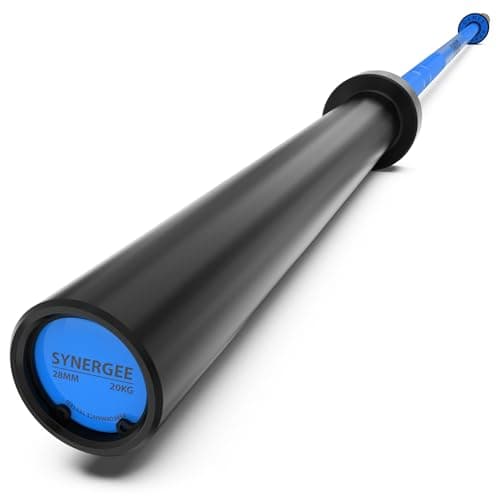
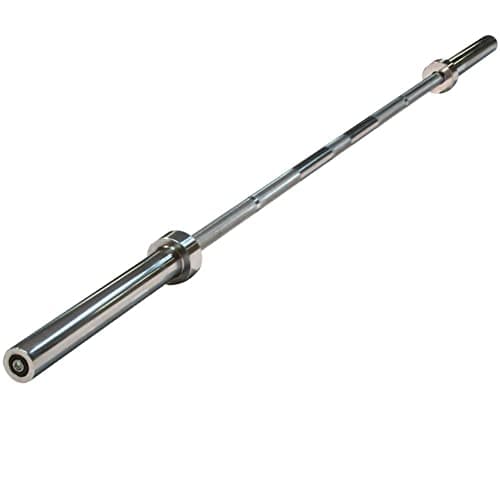
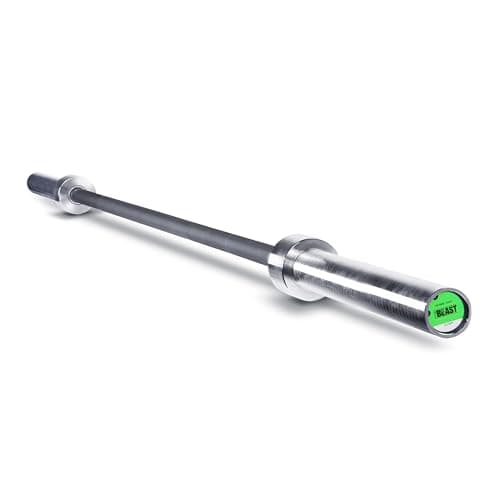
For a home gym, buy the bushing bar. It spins enough for every lift you will do, it tolerates grit and damp far better, and when it eventually slows down it can be taken apart and re-greased rather than replaced. Needle bearings spin faster and more smoothly — which matters if you snatch and clean, and matters very little if you squat, press and pull.
What is actually inside a barbell sleeve
A barbell is a shaft with a rotating sleeve at each end. The sleeve has to spin, because a loaded bar that cannot rotate transmits torque straight into your wrists on any lift where the bar turns under you. Between the shaft and the sleeve there has to be something that lets one slide against the other. There are two answers.
A bushing is a plain sleeve of a low-friction material — bronze, brass or a composite — pressed between the shaft and the sleeve. It is a sliding bearing: one surface slides directly against another, separated by a film of grease. There are no loose parts.
A needle bearing replaces that sliding contact with a ring of thin cylindrical rollers held in a cage. It is a rolling bearing: the rollers turn rather than slide. Most bars use several per sleeve.
That single structural difference produces every practical difference below.
The comparison in one table
| Bushing | Needle bearing |
|---|
| How it works | Sliding surface with a grease film | Rolling steel needles in a cage |
| Spin speed | Adequate — smooth, not fast | Fast and free-running |
| Best for | Squat, press, deadlift, general training | Snatch, clean and jerk, fast turnover |
| Tolerance of grit and damp | High — a plain surface keeps working when dirty | Lower — contamination in the cage is felt immediately |
| Serviceable at home | Yes — pull the end cap, clean, re-grease | Sometimes, and fiddlier |
| Parts count per sleeve | One or two | Several bearings plus spacers |
| Typical price | Lower | Higher |
| Failure mode | Gradually stiffens; re-grease restores it | Gets notchy or gritty; usually needs parts |
Spin is not a durability spec
Barbell marketing treats spin as a quality measure, and it is not. Spin is a suitability measure: it tells you which lifts the bar is built for.
In the Olympic lifts the bar rotates hard and fast under the hands as you turn it over. Free spinning genuinely protects your wrists there and lets the movement happen at speed. That is what needle bearings are for, and it is why competition weightlifting bars use them.
In a squat the sleeve barely turns at all. In a bench press it does not turn. In a deadlift it turns slowly, once, if you rotate your grip. For that program — which is most home training — a bushing sleeve does everything asked of it, and the extra money for bearings buys a property you are not using. The same reasoning drives our verdict on power bars against Olympic weightlifting bars.
Why bushings win the durability argument
They tolerate the environment a home gym actually has
Garages are dusty and often damp. A plain bronze bushing with grease in it keeps sliding when dust gets in; the grease traps the grit and the surface carries on. Needles in a cage are a tighter, more precise assembly — contamination there shows up as a gritty feel long before a bushing would complain. If the room is genuinely damp, that is also the room where you should be reading how to stop barbell rust.
They can be serviced with things you already own
This is the argument that matters most on a buy-it-for-life site. A bushing bar that has gone stiff is a maintenance job, not a dead bar: take off the end cap, slide the sleeve, clean out the old grease and grit, apply fresh grease, reassemble. The consumables are a rag and a tube of grease.
A bearing bar can often be serviced too, but the assembly has more in it and the parts — needle bearings, spacers, snap rings — are model-specific enough that you need the maker to still exist and still care. That is exactly the repairability question we tell readers to ask before buying anything in home gym replacement parts.
Fewer parts is fewer things to go wrong
It is the same principle that puts plates at the top of the durability hierarchy and adjustable dumbbells near the bottom. Every mechanism is a liability over a decade. A bushing is barely a mechanism.
How to tell what a bar has
Read the listing, and be suspicious of silence. Bars with needle bearings advertise it, because it costs more to build and it is a selling point. A listing that says nothing about the sleeve is almost always a bushing bar, and that is fine — but you should know rather than assume.
The other tell is the intended use. A bar sold as a "power bar" with aggressive knurl and a center knurl is built for squats and presses and will be bushed. A bar sold as an Olympic weightlifting or "games" bar with a milder knurl is more likely to be bearinged, or to use a hybrid arrangement.
Do not judge by spinning the sleeve with your hand in a shop. An unloaded sleeve spinning for a long time tells you about the grease viscosity, not about how the bar behaves under 300 lb.
Hybrid sleeves, briefly
Some bars combine a bushing with one or more bearings per sleeve, aiming for a middle ground: more spin than a plain bushing, fewer parts and less cost than a full bearing bar. In practice the durability behavior follows the bearings — if there are needles in there, grit gets into them. Treat a hybrid as a bearing bar for maintenance purposes.
So which should you buy?
Buy a bushing bar if your training is squats, presses, deadlifts, rows and the occasional power clean — which is nearly everyone reading this. It is cheaper, it survives a garage better, and it is the one you can fix.
Buy a bearing bar if you snatch and clean and jerk regularly, or if you are coaching those lifts. The spin is doing real work in those movements, and paying for it is rational.
Either way, buy the tensile strength. The sleeve decides how the bar feels; the shaft decides whether it survives being loaded. That is the number to spend on first, and it is covered in Olympic barbell specs and in barbell weight capacity explained.