Skip to content
Plate&Rack

The method · Buy It For Life Guides

Are All-in-One Home Gym Machines Worth It?

One machine that does everything is a genuinely appealing idea. It is also one frame, one set of cables and one company standing between you and a working gym in ten years.

By Stephen V.Updated How we choose
#ad

We earn a commission when you buy through our Amazon links, at no extra cost to you. It never affects our rankings, and we say so when the cheaper product is the better buy. How this works.

For most people, no — a rack, a barbell and a set of plates cost less, do the same lifts, take similar space and have almost nothing in them that can wear out. The all-in-one is worth it in two specific situations, and they are worth naming rather than dismissing.

This is one of the most searched questions in home fitness and it usually gets answered by whoever is selling the machine. So here is the version from a site that ranks equipment on how long it lasts.

What "all-in-one" actually means

The term covers several quite different products, and the answer changes depending on which one you are looking at.

The cable multi-gym. A weight stack, a frame, and a set of stations — chest press, lat pulldown, leg extension, pec deck. Everything is guided and selectorized. This is the classic home gym machine.

The Smith-machine hybrid. A guided barbell on rails, usually with a squat rack function, lat pulldown and cable crossover built into the same frame. This is where the category has moved recently, and it is closer to a rack than the classic multi-gym is.

The rack with everything bolted on. A conventional power cage with a lat tower, dip bars and a pulley system attached. It is often sold as an all-in-one and it is really a rack — which is why we rank those on the racks with cables page instead.

The third kind is the one we recommend most often, and understanding why is the rest of this page.

The genuine case for one

Everything in one footprint. If you have exactly one corner and it has to do everything, a machine that folds ten stations into a single frame is doing real work. Two separate pieces of equipment always take more floor than the sum of their frames, because each needs clearance around it.

Training alone with no safety net. A guided bar cannot fall on you, and a cable stack cannot pin you. If you are not going to buy a rack with proper safeties, that is a real advantage rather than a marketing one.

A lower technique barrier. Guided movement paths let someone start training without first learning to squat and bench safely. That matters more for adherence than the internet gives it credit for.

Shared households. Several people of different experience levels using one machine works better than several people sharing one barbell setup.

The case against, which is a durability case

One frame is one point of failure

This is the argument that matters most on this site. A gym made of separate pieces fails separately: a bench pad splits and you re-cover the bench while everything else keeps working. An all-in-one is a single object, and a failure in the cable path or the selector can take several stations offline at once.

Every station is another mechanism

Our lifespan table is blunt about which parts of a home gym have a service life: cables, pulleys, bearings, guide rods, upholstery and selector pins. An all-in-one is built almost entirely out of that list. A rack, bar and plates are built almost entirely out of the permanent list.

Parts are proprietary in a way rack parts are not

A worn J-cup on a standard 3×3 rack can be served by half a dozen aftermarket suppliers indefinitely. A molded plastic pulley bracket specific to one model of multi-gym can be served by exactly one company, for as long as that company exists and stocks it. That asymmetry is the single strongest argument in the whole category, and it is why we put the parts question before the specification question in home gym replacement parts.

The weight stack has a ceiling you cannot raise

A 200 lb stack is 200 lb forever — and on a 2:1 cable ratio that is around 100 lb at the handle. A barbell's ceiling is however many plates you own, and plates are the cheapest permanent weight there is. For anyone who intends to get stronger, this is not a small limitation.

Resale is poor

Multi-gyms are bulky, model-specific and usually need disassembly to move. Plates and bars hold their value almost indefinitely. Put both into the arithmetic on home gym cost per year and the gap is larger than the sticker prices suggest.

What we would buy instead, and what it costs

The honest alternative is not exotic. A power rack with adjustable safeties, an Olympic barbell with a published capacity, a set of plates, and an adjustable bench. That covers squats, presses, rows, deadlifts and every accessory movement, in a footprint comparable to a large multi-gym, for less money than most of them.

Then, if and only if you want the cable movements, add a lat tower to the rack you already own. That gets you the one thing the barbell genuinely cannot do — loaded vertical pulling — for a fraction of what a multi-gym costs, in no extra floor space, and with a plate-loaded mechanism that has almost nothing in it.

The staged version of this, with what to buy in which order, is in home gym equipment: what to buy, in what order.

If you are buying one anyway, buy it on these five things

  1. A published parts channel.Search the maker's site for "parts" before you order. On this category it matters more than any specification.
  2. Metal pulleys over molded plastic. Aluminum or nylon sheaves on sealed bearings last several times as long as a plastic wheel on a plain bolt, and you can see which is which in the listing photos.
  3. A published cable ratio. Without it, the stack weight is a number you cannot convert into anything useful.
  4. Whether it can also take a free barbell. The Smith-hybrid machines that keep a usable rack function are much better buys than the ones that only work on rails, because they leave you a route back to free weights.
  5. Whether the stack is upgradable. If it is not, be honest about whether you will outgrow it.

The verdict

Buy an all-in-one if your constraint is one corner of a room, several users of mixed experience, or a firm decision not to train under a free barbell. Buy a rack, bar and plates in every other case — it costs less, it does more, and in fifteen years the only thing on it that will have needed replacing is a plastic J-cup liner.
The short answer

Quick picks

#ProductBest forScorePrice
01
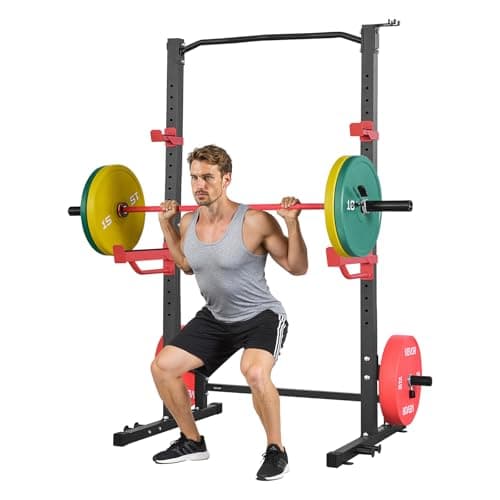
VEVOR VEVOR Power Cage Squat Rack (1,000 lb)
VEVOR Power Cage Squat Rack (1,000 lb)

The cheapest cage here that still arrives complete — J-hooks, safeties and a pull-up handle in the box.

Best budget power cage
7.2
$159.90Amazon
02
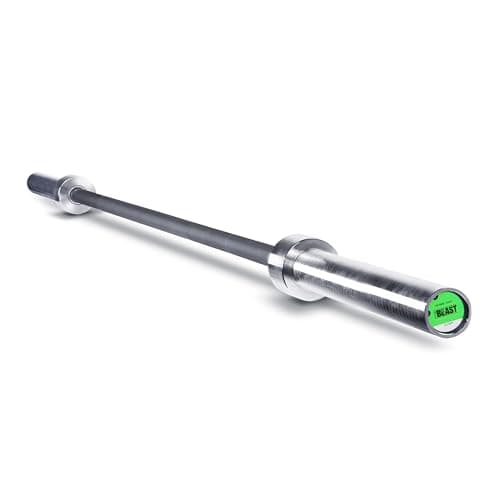
CAP Barbell CAP The Beast 7 ft Olympic Barbell (1,200 lb)
CAP The Beast 7 ft Olympic Barbell (1,200 lb)

The value bar that keeps showing up in real garage gyms — 1,200 lb rated for the price of a cheap one.

Best value all-round bar
8.0
$149.00Amazon
03
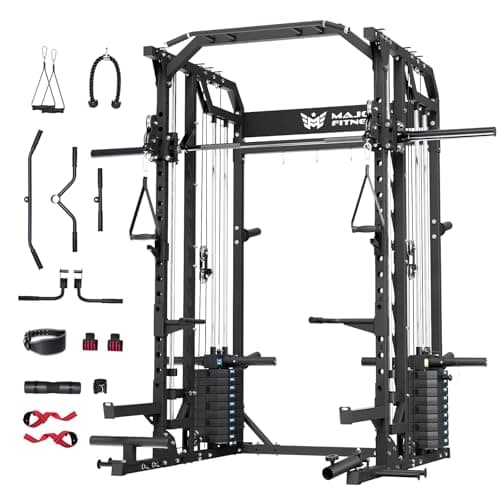
Major Fitness Major Fitness Drone2 All-in-One Smith Machine Gym
Major Fitness Drone2 All-in-One Smith Machine Gym

If you are set on one machine that does everything, this is the shape that argument takes — a Smith frame with the cables built in.

Best all-in-one machine
6.6
$1,445.99Amazon

#ad · Live prices from the Amazon Product API, as of Sep 8, 2026. Where we have no verified live price, we show none — we would rather leave a gap than print a number that has rotted.

In detail

The picks, in full

01
VEVOR VEVOR Power Cage Squat Rack (1,000 lb)

Best budget power cage

VEVOR Power Cage Squat Rack (1,000 lb)

1,000 lb rated2 × 2 in uprights11 J-hook positionsJ-hooks + safeties + pull-up
7.2/10

The cheapest cage here that still arrives complete — J-hooks, safeties and a pull-up handle in the box.

Build & steel
6
Capacity
8
Expandability
6
Footprint
7
Value
9

Pros

  • A published 1,000 lb total capacity that comfortably clears what any home lifter will ever load
  • Arrives complete — two J-hooks, two safety bars, a pull-up handle, four band pegs, plate posts and a bar hook, so there is no second order
  • Standard 2 × 2 in uprights, the commonest profile in home racks, so third-party J-hooks and spotter arms are easy to find later — measure hole diameter and spacing before ordering

Cons

  • The frame weighs about 60 lb, which is light for a cage — load the plate posts and keep it against a wall
  • The listing publishes no steel gauge and no warranty term, so the rated capacity is the only number you have

Don't buy this if…

you are chasing a 700+ lb total and want zero flex. At that level the heavier 3×3 racks are worth the money; for everyone else this is plenty of rack.

$159.90View on Amazon

Price as of Sep 8, 2026. Prices change — Amazon's is the one that counts.

#ad · we may earn a commission from this link to VEVOR Power Cage Squat Rack (1,000 lb)

02
CAP Barbell CAP The Beast 7 ft Olympic Barbell (1,200 lb)

Best value all-round bar

CAP The Beast 7 ft Olympic Barbell (1,200 lb)

7 ft / 45 lb1,200 lb capacityDual knurl marksAlloy steel
8.0/10

The value bar that keeps showing up in real garage gyms — 1,200 lb rated for the price of a cheap one.

Tensile / build
8
Coating
7
Knurl & spin
7
Capacity
9
Value
9

Pros

  • A 1,200 lb rated capacity is well beyond anything a home lifter will load, and beyond most bars at this price
  • Dual knurl marks suit both powerlifting and Olympic hand positions
  • CAP is a long-standing brand, so it is easy to buy and easy to replace

Cons

  • The finish is functional, not premium — keep it wiped down and it will not rust, but it is not stainless
  • Sleeve spin is on bushings, so it is smooth enough for lifting but not a competition-bearing feel

Don't buy this if…

you are an Olympic lifter who needs fast bearing spin and a lot of whip. This is a stiffer all-round bar; a dedicated Olympic bearing bar is the tool for cleans and snatches.

$149.00View on Amazon

Price as of Sep 8, 2026. Prices change — Amazon's is the one that counts.

#ad · we may earn a commission from this link to CAP The Beast 7 ft Olympic Barbell (1,200 lb)

03
Major Fitness Major Fitness Drone2 All-in-One Smith Machine Gym

Best all-in-one machine

Major Fitness Drone2 All-in-One Smith Machine Gym

Smith machine + squat rackDual lat pulldownCable crossoverAluminum pulley set
6.6/10

If you are set on one machine that does everything, this is the shape that argument takes — a Smith frame with the cables built in.

Build & hardware
8
Versatility
9
Wear items
4
Footprint
6
Value
6

Pros

  • Genuinely consolidates a Smith bar, a rack, a lat station and a crossover into one footprint, which is the honest appeal of an all-in-one
  • Aluminum pulleys rather than molded plastic on the part of the machine that actually spins under load
  • You can still use it as a squat rack with a free barbell, so buying it does not commit you to guided lifts only

Cons

  • Every additional station is another mechanism — cables, pulleys, guide rods and bearings all wear on timescales steel does not
  • One frame means one point of failure for your whole gym, where separate pieces fail separately and cheaply

Don't buy this if…

your goal is equipment you buy once. A rack, a bar and plates cost less, do the same lifts with a free bar, and have essentially nothing in them that can wear out.

$1,445.99View on Amazon

$1,699.9915% off

Price as of Sep 8, 2026. Prices change — Amazon's is the one that counts.

#ad · we may earn a commission from this link to Major Fitness Drone2 All-in-One Smith Machine Gym

How we picked

We do not run a testing lab

We compiled manufacturer specifications, read the published warranties, checked the relevant standards and aggregated owner reviews, then scored each product against a published rubric. The scores are judgments from documented research — they are not measurements we took, because we do not run a lab and we are not going to pretend we do. Where a number came from a manufacturer or a standard, we name it and link it in Sources.

Questions

Frequently asked

Are all-in-one home gym machines worth the money?

For most people, no. A power rack with safeties, a barbell, plates and a bench cost less, cover the same lifts, take comparable space and have almost no wear parts. All-in-ones earn their place when you have exactly one corner to use, several users of mixed experience, or a firm decision not to train under a free barbell.

What breaks first on a multi-station home gym?

The cable, where it bends at the pulley, then pulley bearings — plastic wheels on plain bolts go first. After that, guide rod bushings, the selector pin and the upholstery. The frame effectively never fails, which is why the frame warranty is the least useful part of the spec sheet.

Is a Smith machine home gym better than a power rack?

It is safer to use alone and easier to learn on, and it has more parts. The better hybrids keep a usable free-barbell rack function, which is the feature to look for — it leaves you a route into free weights rather than committing you to rails. See power rack vs Smith machine.

How much weight can an all-in-one home gym handle?

Stacks on home machines are commonly around 150 to 200 lb, and on a 2:1 cable ratio that is roughly half at the handle. That ceiling is fixed unless the stack is upgradable. A barbell's ceiling is simply how many plates you own.

What should I buy instead of an all-in-one home gym?

A power rack with adjustable safeties, an Olympic barbell, plates and an adjustable bench — then a lat tower bolted to the rack if you want cable work. It covers more movements, costs less than most multi-gyms, and the only consumable in the whole setup is a plastic J-cup liner.

Keep reading

Receipts

Sources

We do not run a testing lab, and we do not pretend to. Every spec, warranty term and standard above is the manufacturer's or a published source, cited and linked. Where we could not verify something, we say so on the page rather than quietly leaving it out. Read our full method.