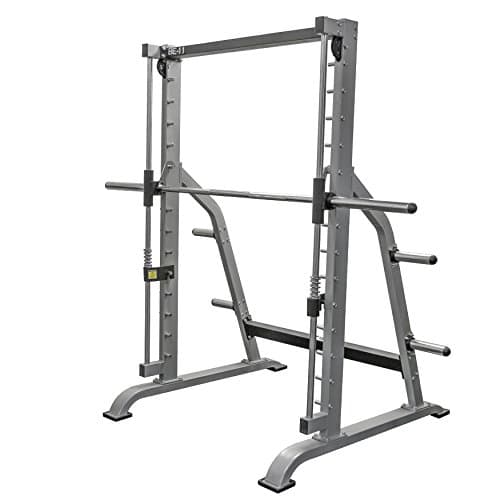
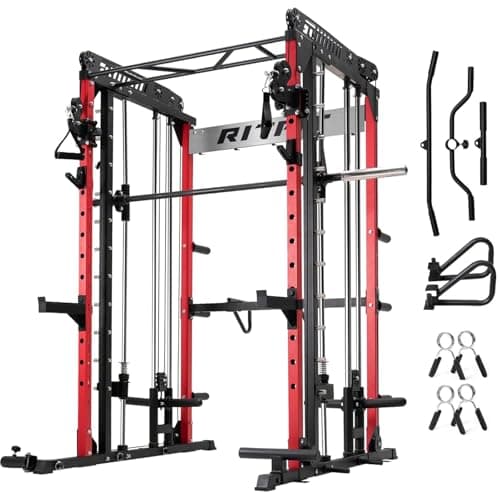
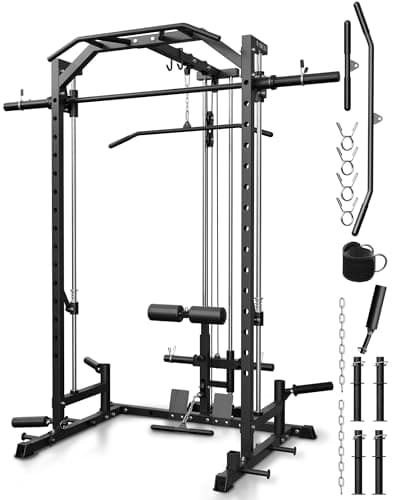
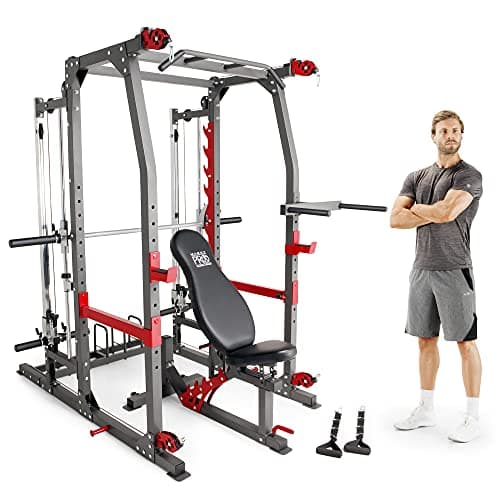
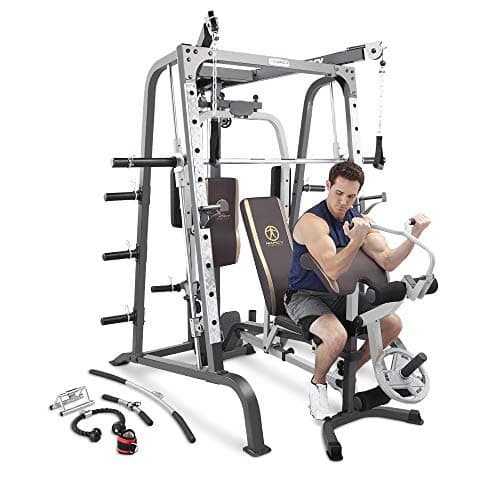
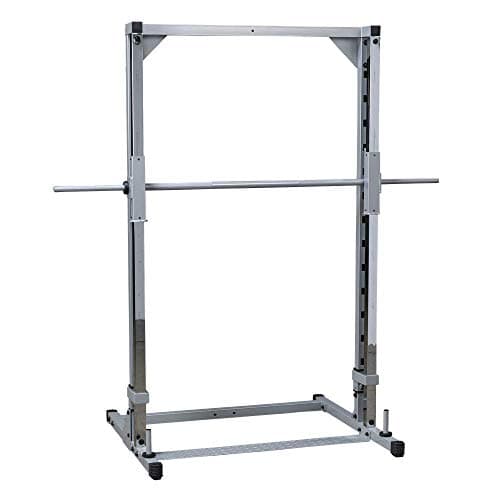
Buy the Powerline PSM144X by Body-Solid if you want the Smith machine most likely to still work in fifteen years: it is the only one here whose listing names the carriage system and the safety mechanism, and Body-Solid is the only brand in this roundup with a long-running model line and a parts path behind it. Buy the Valor Fitness cage if you want the only published capacity figure in the category — 500 lb — with the knurled sliding bar attached. Buy the RitFit M1 Pro if you want a Smith carriage, a cable crossover and a free-bar cage in one frame. Buy the Mikolo if price is the binding constraint and you accept the shortest parts trail here. And buy one of the two Marcy machines if you want a complete gym in a single delivery, bench and pulleys included.
What a Smith machine is, and what it is not
A Smith machine is a barbell fixed to two vertical or slightly angled rails, running on a carriage, with catch hooks every few inches so you can rack it at any height. The bar path is decided by the machine, not by you. That is the entire proposition: you cannot lose the bar sideways, so you can press and squat alone without a spotter and without the enclosure of a power rack.
It is not a rack, and it does not replace one. A rack holds a free barbell, which means you can also deadlift from the floor, do rows, use a trap bar, and train the stabilizing work a fixed path removes. We set the two side by side in power rack vs Smith machine, and that page reaches the conclusion this one has to repeat: if you own neither and the room takes a cage, buy the cage first.
This page exists because plenty of people have already made that decision the other way — a guided bar in a house where nobody can spot, a shared gym, a lifter coming back from an injury who wants a fixed path — and the category had no ranking on this site.
Why this category is unusually hard to rank
Every durability question about a Smith machine comes down to two parts: the rails and the carriage that runs on them. Rails have to stay parallel. The carriage bushings or bearings have to keep running smoothly while taking a load that is never perfectly centered. When a Smith machine goes bad it is almost always one of those two — a notch worn into a rail, or a carriage that has developed play and now rattles at the top of every rep.
So the specification that should be on every listing is the rail diameter, the rail finish and what the carriage runs on. Of the six machines here, one publishes anything at all about it. The rest describe themselves by station count and attachment quantity, which tells you what the machine does on day one and nothing about year ten. That is the gap this ranking is built around, and it is the same problem we ran into with cable machines in how long do cable machines last.
What we rank on, in this order
- Published carriage and rail detail. First, because it is the wear story and because a brand willing to name the mechanism is a brand that expects you to ask about it.
- Parts trail and brand longevity. A machine with bearings and rails is only a buy-it-for-life purchase if a part can be sourced in a decade. A long-running model number is the best proxy available, and we apply the same test across the site in the replacement parts guide.
- Station count against wear list. Added stations are added value and added mechanism. A frame carrying rails, a carriage, cables and pulleys has four things that can end its life; a pure Smith machine has two.
- Published capacity. Only one listing states one. Where a figure exists it is worth having, and where it does not we say so rather than estimating.
- Whether you keep a free barbell. A Smith-plus-cage frame lets you train both ways. A pure Smith machine commits you to the fixed path for everything it does.
The six, side by side
| As published | Powerline PSM144X | Valor Fitness | RitFit M1 Pro | Mikolo | Marcy SM-4903 | Marcy MD-9010G |
|---|
| Carriage detail published | Super-Glide carriage | Not published | Not published | Not published | Not published | Not published |
| Safety system published | Adjustable safeties, dual-lock spotter catch | Not published | Not published | Not published | Not published | Not published |
| Rated capacity | Not published | 500 lb | Not published | Not published | Not published | Not published |
| Free-bar cage as well | No | Yes, cage frame | Yes | Yes | No, open frame | Yes, cage |
| Cables included | No | No | Yes, crossover | Yes, 1:1 ratio | Yes, pulleys | Yes, pulley system |
| Bench included | No | No | No | No | Yes | Yes |
| Plate storage | Not published | Yes, 2 in posts | Not published | Not published | Not published | Not published |
| Availability when checked | In stock | Only 9 left | In stock | In stock | Ships 3–5 days | Ships 2–3 days |
Every cell is quoted from the manufacturer listing linked in Sources, read on 2026-10-11. Look at the first two rows: one machine out of six describes the mechanism it is built around. That is not a reason to avoid the category, but it is the reason the machine that does describe it sits at the top of this page despite having the fewest stations.
Pure Smith machine or multi-station frame?
This is the real decision, and it is a wear-list decision rather than a value one.
A pure Smith machine — the Powerline here — does one thing. It has rails, a carriage, catch hooks and nothing else. Nothing is bundled, so nothing bundled can break, and when the carriage eventually needs attention it is the only mechanism in the frame. You keep buying your bench, your cables and your free barbell separately, which is also how you get to choose good ones.
A multi-station frame — the RitFit, the Mikolo and both Marcy machines — bundles the guided bar with cables, and in the Marcy case a bench too. One delivery, one assembly, one footprint, and a much lower total price than buying the parts individually. The cost is that you now own four mechanisms in one object, the bench pad cannot be upgraded, and a failure anywhere takes the whole machine down. That is the same argument we make about multi-gyms in are all-in-one home gyms worth it, and the answer here is the same: bundles win on price per station and lose on service life.
There is a middle route worth knowing about. The Valor machine is a Smith cage — the guided bar runs inside a frame that also takes a free barbell and stores plates, with no cables at all. Two mechanisms, two training modes. If you want the fixed path without signing up for pulleys, that is the shape to look for.
The honest case for buying a power rack instead
We would be doing the job badly if this page did not say it plainly. For most people in most rooms, a power rack and a barbell is the better purchase than any machine on this page:
- It has no wear parts at all. Bolted tube steel, J-hooks and safeties. No rails to stay parallel, no carriage, no bearings, nothing to realign. We work the lifespans through in how long do power racks last.
- It does more lifts. Deadlifts from the floor, rows, trap bar work, overhead press standing free — none of which happens on rails.
- It costs less. Compare the live prices on this page against the budget power racks and the gap will usually buy you the bar and the first plates as well.
- It grows. A rack takes a lat tower, dip bars, safety straps and a landmine on the same uprights — see the attachments roundup.
The Smith machine earns its place when the fixed path is the point: training alone with no spotter and no confidence bailing out, a shared or supervised space where a guided bar is the house rule, or rehabilitation work where the bar needs to go exactly where it went last time. Those are real situations, and in them a Smith machine is the right tool rather than a compromise.
What actually fails, and when
In rough order:
- The carriage bushings or bearings. They develop play, and play becomes a rattle at the top of the stroke. This is the component that decides the machine's life, and it is the component nobody publishes.
- The rail finish. Chrome or paint wears where the carriage runs. Cosmetic at first; a notch in a rail is not cosmetic.
- Cables and pulleys on the four machines that have them — the same wear order as any cable machine, which is cable, then sheave, then cable ends.
- Bench upholstery on the two Marcy machines, which on an integrated frame cannot simply be swapped for a better bench.
- The frame. Does not fail. Powder-coated steel tube outlives everything bolted to it, as on every rack we rank.
The maintenance that actually matters is short: keep the rails clean and lightly lubricated per the manual, re-torque the frame bolts twice a year, and do not let a developing rattle go for months. In a damp garage add the rust routine from keeping gym equipment from rusting in a garage, because bare rail surfaces are the most rust-sensitive metal in the room.
How to buy a Smith machine
Measure the ceiling first, then the length
Smith machines are tall, and many of them angle the rails backwards, which means the bar travels through more vertical space than the frame height suggests. Then check the length of the room: the Marcy machines and the RitFit are long frames with a bench or a crossover span. Our rack dimensions page sets out how to take these measurements properly, and the clearances listings leave out.
Ask what the carriage runs on before you ask what it costs
If the listing will not say, ask the seller. The answer you want is bearings or a named glide system; the answer you often get is silence, and silence is itself information on a part that decides the machine's service life.
Count the mechanisms you are buying
Rails and carriage is two. Add cables and pulleys and it is four. Add a bench pad and it is five. Every one is a part that can take the frame out of service, and on an integrated machine you cannot replace any of them independently. Fewer mechanisms is the whole thesis of this site.
Check whether the bar is included and knurled
On a Smith machine the bar is part of the frame, so you do not get to choose it. One listing here states that the sliding bar is knurled and attached; the rest leave you to find out. If you care how a bar feels in your hands — and after reading barbell knurling explained you will — this is a spec worth confirming before ordering.
Budget for the plates, and for getting it into the room
None of these machines ships with weight. Price the plates alongside the machine using the cost-per-pound method, and check the delivery terms: two of the six are listed as shipping in days rather than from stock, and a machine this size is a freight delivery with a long assembly at the other end.
If the room takes a rack, buy the rack
Said once more because it is the most money-saving sentence on this page. A cage with safeties does the free-bar lifts, takes attachments, has nothing to wear out and costs less. The Smith machine is for when the guided path is the requirement, not the preference.