Skip to content
Plate&Rack

The frame · Power Racks & Cages

Power Rack with Cables vs Functional Trainer

Both put cables in a home gym. One does it as a feature of the frame you squat in; the other does it as the whole product. Which is right depends mostly on whether you have bought your rack yet.

By Stephen V.Updated How we choose
#ad

We earn a commission when you buy through our Amazon links, at no extra cost to you. It never affects our rankings, and we say so when the cheaper product is the better buy. How this works.

If you have not bought a rack yet, buy the rack with the cables in it. One frame, one footprint, one anchoring job, and the cable tower costs less bundled than bought separately. Buy the standalone functional trainer instead when you already own a rack you are happy with, or when cable work — not barbell work — is the thing you actually do most.

They are not competing products so much as competing orders of purchase

A power rack with cables is a barbell frame first. Its job is to hold a loaded bar at a height you can unrack it from and catch it when a rep fails; the pulley is bolted to that frame and shares its uprights. A functional trainer is a cable machine first and is not a barbell frame at all — it has no J-hooks, no safeties, and nothing that will hold a squat.

So the question is almost never "which is better". It is "which one does my room still need". A gym with no rack needs a rack. A gym with a bare rack and no cables needs cables, and has three ways to get them. A gym with neither and a budget for one is the only case where these two genuinely compete, and there the rack wins on every count except one — cable quality.

The comparison in one table

Rack with cablesFunctional trainer
Squat and bench under a barYes — with J-hooks and safetiesNo
Pull-upsYes, on almost every cageOnly if the frame includes a bar
Lat pulldown and low rowYes, that is the built-in towerYes
Crossovers and unilateral cable workOnly with independent dual pulleysYes — two pulleys is the whole point
Pulley height positionsUsually a fixed high and low pointMany — the Mikolo publishes 17
How the cable is loadedPlate-loaded on every rack herePlate-loaded or a selector stack
FootprintOne frameA second frame, beside the rack
Wear partsCable, pulleysCable, pulleys, and on a stack machine guide rods, bushings and a selector pin
AnchoringOne jobA second job, or a second thing that can rock

What the cable actually does on each

On a cable rack the tower is a bolt-on subsystem: a plate-loaded carriage running on the rack's own uprights, with a high pulley for pulldowns and a low pulley for rows. It covers the two movements a barbell covers worst, and on most racks it stops there. The JEEKEE here is the exception — its listing states independent dual pulleys, which is what turns "lat tower" into "crossover machine".

On a functional trainer the pulleys are the product, and the specification that matters is how many heights they adjust through. Two or three positions is a lat tower wearing a different name. Seventeen, which is what the Mikolo listing publishes, is a genuine trainer: you can set a pulley at ankle height for a kickback, at shoulder height for a press, and anywhere between for the rotational work a barbell cannot produce at all.

That range is the single honest reason to buy the standalone machine. If you will use it — if cable work is a real part of your week rather than something you imagine doing — it is worth a second footprint. If your cable ambitions are pulldowns and rows, the rack tower does that and you are paying twice.

Footprint is the argument people underestimate

A cable rack occupies the space you were already giving the rack. A functional trainer occupies a second wall, needs its own clear pulling radius on both sides, and in most garages ends up competing with the bench, the plate tree and the car.

There is a structural argument too. A rack is heavy, wide-based and usually loaded with plates, so it does not move. A trainer takes cable load at height through a narrower frame, which is why the good ones want bolting down or ballasting. That is a second anchoring job in a room where you have already done one — see how to anchor a squat rack for what that involves.

What wears, and what you can replace

Both sit at the bottom of our durability hierarchy, and for the same reason: steel cable bending over a sheave thousands of times a year is the only genuine wear interface in a home gym that does not involve upholstery. The difference is how many of those interfaces each product contains.

A plate-loaded rack tower has a cable, two or three pulleys and a carriage. That is the whole list. A plate-loaded trainer has the same list twice, once per side. A stack-loaded trainer adds guide rods, plate bushings and a selector pin, which is three more things to service and the reason commercial gyms keep a maintenance contract for the cable machines and nothing at all for the plates.

None of that is a reason to avoid either. It is a reason to buy from somebody who will still sell you a cable in five years, which is the argument our replacement parts guide makes at length. Write the model number down the day it arrives.

Cost per year, honestly

Bundled cables are cheaper than separate cables. A rack that ships with a tower generally costs less than the same class of bare rack plus a bolt-on lat attachment, and much less than a bare rack plus a standalone trainer. That gap is the strongest argument in this whole comparison and it is worth stating plainly rather than burying.

Where the arithmetic flips is service life. The frame outlives you; the cable system does not. If the cable tower on your rack dies in year eight and no spare exists, you have a rack with a dead subsystem bolted to it. A standalone trainer that dies is a machine you can wheel out and replace without touching the thing you squat in. Run the numbers the way our cost per year page does and that separability is worth something — just usually less than the price of a second frame.

The verdict, in three situations

No rack yet. Buy the rack with cables. It is the cheaper route to both capabilities, it uses one footprint, and it puts your money into the frame — the part that lasts. Start with the cable rack roundup.

Bare rack already owned. Do not buy a trainer yet. A bolt-on lat tower is far cheaper and uses no extra floor, and fitment is the only hard part. Only when you have used one and genuinely want pulley heights it cannot give you does the standalone machine make sense.

Cables are the training, the barbell is occasional. Buy the trainer, and buy the one with the pulley range rather than the one with the biggest stack number. This is the case where a rack tower will frustrate you within a month, and it is a smaller group than the marketing suggests — but it is not nobody.
The short answer

Quick picks

#ProductBest forScorePrice
01
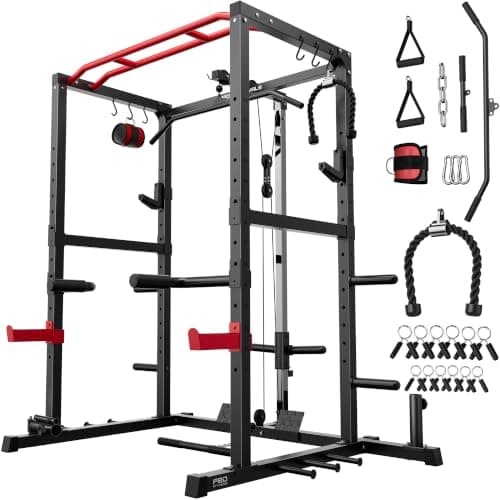
SPORTSROYALS SPORTSROYALS Power Rack with Lat Pulldown
SPORTSROYALS Power Rack with Lat Pulldown

A cage with the cable stack already attached — the most gym-in-one-box on this list.

Best rack with cables
7.4
$319.99Amazon
02
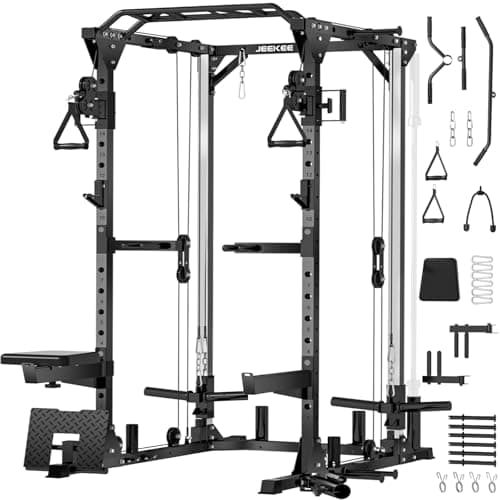
JEEKEE JEEKEE Power Cage with Cable Crossover (2,000 lb)
JEEKEE Power Cage with Cable Crossover (2,000 lb)

Independent dual pulleys and a seat make this the closest thing here to a commercial functional trainer.

Best cable crossover rack
7.4
$469.99Amazon
03
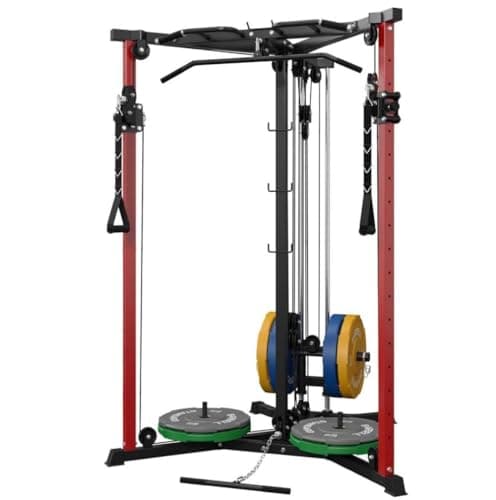
Mikolo Mikolo Cable Crossover Functional Trainer (17 positions)
Mikolo Cable Crossover Functional Trainer (17 positions)

Plate-loaded dual pulleys at a fraction of stack-machine money — and with far less inside it to break.

Best value functional trainer
8.0
$429.99Amazon

#ad · Live prices from the Amazon Product API, as of Sep 8, 2026. Where we have no verified live price, we show none — we would rather leave a gap than print a number that has rotted.

In detail

The picks, in full

01
SPORTSROYALS SPORTSROYALS Power Rack with Lat Pulldown

Best rack with cables

SPORTSROYALS Power Rack with Lat Pulldown

Pulley + lat systemLow-row + high-pulldownMulti-function cageJ-hooks
7.4/10

A cage with the cable stack already attached — the most gym-in-one-box on this list.

Build & steel
7
Capacity
7
Expandability
8
Footprint
6
Value
9

Pros

  • The integrated pulley, lat pulldown and low row turn a squat cage into a near-complete gym
  • One purchase covers pressing, pulling and cable work — strong value per square foot
  • Adjustable hooks and safeties handle the barbell basics as well as a plain cage

Cons

  • Cable systems add moving parts — pulleys and cables are the components most likely to need service first
  • Heavier and more involved to assemble than a bare cage

Don't buy this if…

you already own a functional trainer or cable machine. You would be paying for a pulley stack you don't need — a plain cage is cheaper and has fewer parts to wear.

$319.99View on Amazon

$389.9918% off

Price as of Sep 8, 2026. Prices change — Amazon's is the one that counts.

#ad · we may earn a commission from this link to SPORTSROYALS Power Rack with Lat Pulldown

02
JEEKEE JEEKEE Power Cage with Cable Crossover (2,000 lb)

Best cable crossover rack

JEEKEE Power Cage with Cable Crossover (2,000 lb)

2,000 lb ratedIndependent dual pulleysLat pulldown + seat20+ attachments
7.4/10

Independent dual pulleys and a seat make this the closest thing here to a commercial functional trainer.

Build & steel
7
Capacity
8
Expandability
9
Footprint
5
Value
8

Pros

  • Independent dual pulleys mean each side moves on its own — the feature that separates a crossover from a lat tower
  • Includes a seat cushion and a large attachment set, so you are not buying handles for a year
  • One frame replaces a cage, a lat machine and a crossover station in a garage that has room for one thing

Cons

  • The most complicated rack on this list, and complexity is the enemy of a buy-it-for-life purchase
  • Big footprint and a long assembly — this is a build-it-once, never-move-it machine

Don't buy this if…

your training is squat, bench, deadlift and press. You would be buying and eventually maintaining a cable system to do accessory work a $40 set of bands covers.

$469.99View on Amazon

Price as of Sep 8, 2026. Prices change — Amazon's is the one that counts.

#ad · we may earn a commission from this link to JEEKEE Power Cage with Cable Crossover (2,000 lb)

03
Mikolo Mikolo Cable Crossover Functional Trainer (17 positions)

Best value functional trainer

Mikolo Cable Crossover Functional Trainer (17 positions)

17 adjustable pulley positionsHigh + low pulleyPlate-loadedLat pulldown + seated row
8.0/10

Plate-loaded dual pulleys at a fraction of stack-machine money — and with far less inside it to break.

Build & hardware
7
Cable + pulley quality
7
Range of positions
9
Serviceability
8
Value
9

Pros

  • Plate-loaded rather than stack-loaded, which removes the selector pin, the guide rods and the proprietary stack — the three parts that end a cable machine's life
  • Seventeen pulley heights cover the whole crossover and pulldown range rather than the two or three a budget tower offers
  • You load it with the Olympic plates already in the room, so nothing new is proprietary

Cons

  • Loading plates between exercises is slower than moving a selector pin, and that friction is real
  • The listing does not publish a cable rating or a steel gauge, so it is a home-duty frame rather than a commercial one

Don't buy this if…

you want to change resistance between sets in two seconds. That convenience is exactly what a weight stack buys, and it is the reason to pay for one.

$429.99View on Amazon

Price as of Sep 8, 2026. Prices change — Amazon's is the one that counts.

#ad · we may earn a commission from this link to Mikolo Cable Crossover Functional Trainer (17 positions)

The specs to check on a cable rack

  • The frame rating first. A pulley bolted to a frame that flexes is a bad purchase. The JELENS and JEEKEE cages here publish 2,000 lb; that number describes the rack, not the cable, and it is the one to read first.
  • One tower or two pulleys. A single tower does pulldowns and rows. Independent dual pulleys do those plus crossovers and unilateral work. This is the biggest functional difference inside the category and listings state it clearly when it is true.
  • What is included. A lat bar, a row handle and clips are real money bought separately. The JEEKEE listing states 20+ attachments; a rack that includes them is cheaper than its sticker suggests.
  • Depth, not just width. A cable carriage adds length behind the rack. Measure the room, then measure it again with the plates on the loading pin.

The specs to check on a functional trainer

  • Pulley positions. The number the whole product is about. Two or three is a lat tower; the Mikolo publishes 17, which is a trainer.
  • Plate-loaded or stack. Plate-loaded is cheaper, has far fewer wear parts, and uses plates you already own. A stack is faster to change and adds guide rods, bushings and a selector pin to the list of things that can fail.
  • The cable ratio. Most home trainers reeve at 2:1, so the handle carries roughly half the stack and travels twice as far. A listing that quotes a stack weight without stating a ratio is quoting a number you cannot use.
  • Whether it needs anchoring. Tall, narrow and loaded at height is the geometry that rocks. Find out before it arrives, not after.

The third option neither side mentions

If you own a bare rack, the cheapest route to vertical pulling is not on this page at all — it is a bolt-on lat attachment, covered in the lat pulldown attachment roundup with the upright and hole measurements to take first. It costs a fraction of either product here and takes an evening to fit. We would rather send you there than sell you a second frame.

And if what you actually want is the whole gym in one object, that is a different category again with a different answer — see are all-in-one home gyms worth it, where the same wear-parts argument gets applied to the machine as a whole.

How we picked

We do not run a testing lab

We compiled manufacturer specifications, read the published warranties, checked the relevant standards and aggregated owner reviews, then scored each product against a published rubric. The scores are judgments from documented research — they are not measurements we took, because we do not run a lab and we are not going to pretend we do. Where a number came from a manufacturer or a standard, we name it and link it in Sources.

Questions

Frequently asked

Is a power rack with a cable system as good as a functional trainer?

For pulldowns and rows, yes — that is exactly what a rack tower is built for. For crossovers, unilateral work and anything needing a pulley set at an unusual height, no. A rack tower usually gives you one high and one low point; a functional trainer gives you many, and that range is the only thing you are really paying the second frame for.

Can you squat on a functional trainer?

No. A functional trainer has no J-hooks, no adjustable safeties and no rating for a barbell load. Squatting under a bar needs a rack or a squat stand with catch bars, and nothing about a cable machine substitutes for that.

Which is cheaper overall?

The rack with cables, in almost every comparison. A rack that ships with a tower generally costs less than a bare rack plus a bolt-on attachment, and much less than a bare rack plus a standalone trainer. You are also buying one footprint and one anchoring job instead of two.

Which one lasts longer?

The frames are effectively permanent on both. The cable systems are not, and they fail the same way — the wire frays where it bends at the sheave. What differs is consequence: a dead tower on your rack is bolted to the thing you squat in, while a dead standalone machine can be wheeled out and replaced. Buy from whoever is most likely to still sell you a cable.

Do I need both?

Almost nobody does. If you own a rack with a tower and still want more pulley range, a standalone trainer is a legitimate second purchase — but it is the last thing to buy in a home gym, after the bar, the plates, the bench and the rack itself.

Are plate-loaded cables worse than a weight stack?

Different, and for home use usually better. Plate-loaded costs far less, uses plates you already own and contains far fewer parts — no guide rods, no plate bushings, no selector pin. The cost is convenience: changing weight means moving plates rather than moving a pin.

Keep reading

Receipts

Sources

We do not run a testing lab, and we do not pretend to. Every spec, warranty term and standard above is the manufacturer's or a published source, cited and linked. Where we could not verify something, we say so on the page rather than quietly leaving it out. Read our full method.