Skip to content
Plate&Rack

The method · Buy It For Life Guides

Garage Gym vs Basement Gym

The room decides what you can buy long before the budget does. A garage gives you height and a slab and takes temperature and rust; a basement gives you climate and takes ceiling, stairs and noise.

By Stephen V.Updated How we choose
#ad

We earn a commission when you buy through our Amazon links, at no extra cost to you. It never affects our rankings, and we say so when the cheaper product is the better buy. How this works.

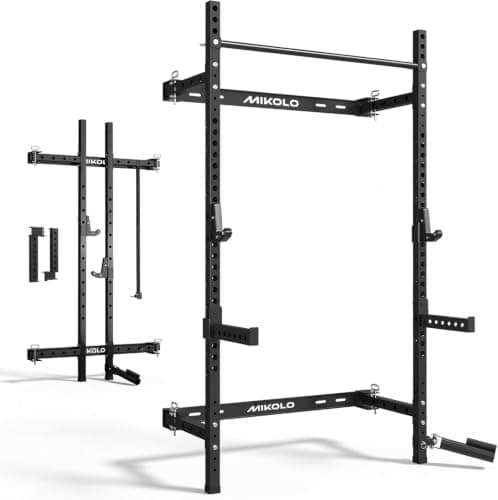
Choose the garage if you have the ceiling height and the floor for it: a concrete slab takes dropped weight and anchors anything, and headroom is what lets you press overhead and use a pull-up bar. Choose the basement if you want to train in January without a coat, and accept that a lower ceiling, a staircase and the noise travelling through the house will shape what you buy. If the garage has to stay a garage, a wall-mounted folding rack like the Mikolo is the pick that gives the bay back. If the basement ceiling is low, measure before you buy anything at all.

The six decisions, in the order they bind

1. Ceiling height — usually decides it outright

A full power cage with a pull-up bar needs roughly seven and a half feet plus the clearance to actually use the bar; overhead pressing needs your locked-out reach plus the bar. Garages are usually taller than finished basements, and basements with ductwork, joists and pipes often lose another foot in the worst possible places. Measure the lowest obstruction, not the ceiling.

If the number is tight, the equipment answer is a short rack rather than a compromise on form — the ranked options are on best power racks for low ceilings, and the measuring routine is in power rack dimensions.

2. The floor — a slab beats a deck

A garage slab is the best gym floor there is: it carries any load you can assemble, takes anchor bolts, and does not transmit impact into the house. A basement floor is usually also a slab, in which case it is just as good. A basement over a crawlspace, or a room above grade, is a framed deck and a completely different question — floor loading, dropped weight and how to spread the load are covered in putting a home gym on a second floor, and the same arithmetic applies to any suspended floor.

On concrete, solid rubber is the right surface. On a framed floor, interlocking foam distributes load and deadens sound but will not survive dropped plates — which is itself an argument for the slab.

3. Climate — the basement wins, the garage can be fixed

An unheated garage is the temperature outside plus a few degrees. In cold climates that means warming up longer and lifting in layers; in hot ones it means a fan is not optional. A basement is close to house temperature year-round, which is the single biggest reason basement gyms get used more consistently in extreme climates.

The garage's climate problem is not just comfort: condensation on cold steel is what rusts a garage gym, and it is entirely preventable. The four fixes are on how to keep gym equipment from rusting in a garage. Basements have their own humidity problem in summer, with the same answer: move the air and keep iron off the floor.

4. Noise — the basement loses

A dropped deadlift in a detached garage is an outdoor noise. The same rep in a basement is transmitted through the structure into every room above it. If anyone in the house sleeps while you train, this is often the deciding factor, and the mitigations are real but partial: a plywood-and-rubber platform, controlled lowering instead of dropping, and bumper plates rather than iron.

5. Access — can the equipment get in?

A garage has a door the size of a car. A basement has a staircase with a turn in it. Rack uprights ship in long boxes, a 7 ft barbell does not go round a tight landing, and a 300 lb machine assembled in the wrong room stays there. Measure the narrowest point of the route and the longest box on the listing before ordering, and assemble in the room where the thing will live.

6. The car

The honest one. A permanent cage in a one-car garage ends the garage as a garage. If that is not acceptable, a wall-mounted folding rack gives the bay back in thirty seconds and is the only equipment category designed for exactly this problem — see best folding power racks and, if you also want cables, functional trainers for small spaces.

Side by side

FactorGarageBasement
Ceiling heightUsually higher, unobstructedOften lower; ducts and pipes
FloorSlab — takes drops and anchorsSlab if below grade; deck if not
TemperatureOutdoor, plus a few degreesClose to house temperature
Corrosion riskHigh — condensation on cold steelLower, but summer humidity is real
Noise to the houseLow, especially if detachedHigh — structure-borne
Getting equipment inCar-sized doorStaircase, often with a turn
Cost of the roomThe parking spaceThe storage or living space

What to buy once you have chosen

Garage: bias towards coated steel and rubber over painted iron, get everything off the slab, and decide early whether the car still parks there — that one answer picks between a full cage and a folding rack.

Basement: measure the lowest obstruction and the staircase before anything else, prefer a short rack over a tall one, and plan the noise mitigation on day one rather than after the first complaint. Bumper plates and controlled lowering are cheaper than regret.

Neither room available: a spare bedroom or an apartment works with the right constraints, and those are their own page — building a home gym in an apartment.

If the garage wins, the rack you buy for it is chosen on constraints no other room applies. We rank five against them — fold-away frames, short frames and full cages — on the best power racks for a garage gym.
The short answer

Quick picks

#ProductBest forScorePrice
01
Mikolo Mikolo 2×2 Folding Wall-Mounted Squat Rack (1,000 lb)
Mikolo 2×2 Folding Wall-Mounted Squat Rack (1,000 lb)

The folding rack to buy if you want the wall back — a real 1,000 lb frame that swings flat in seconds.

Best folding rack overall
8.0
$264.92Amazon
02
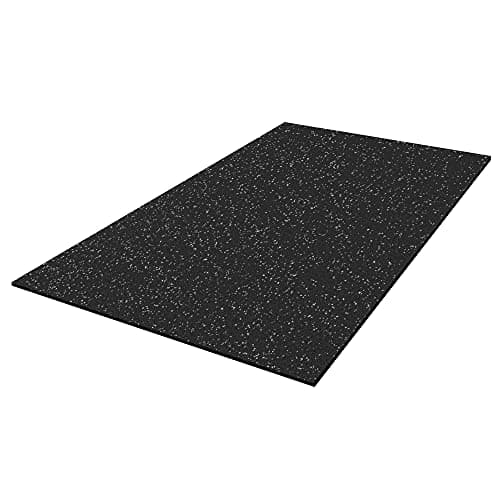
IncStores IncStores 4 × 6 ft Premium Rubber Gym Mat
IncStores 4 × 6 ft Premium Rubber Gym Mat

Solid vulcanized rubber, the flooring that outlasts the gym on top of it. Buy this where the bar lands.

Best flooring for dropped weight
7.6
$176.61Amazon
03
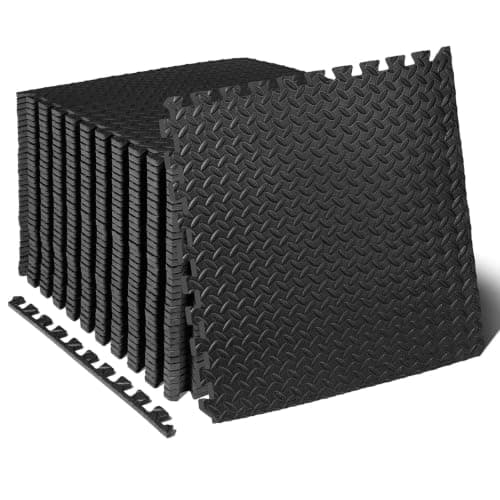
ProsourceFit ProsourceFit ½ in EVA Interlocking Puzzle Mat (144 sq ft)
ProsourceFit ½ in EVA Interlocking Puzzle Mat (144 sq ft)

The cheapest way to cover a whole room — just don't ask it to catch a dropped plate.

Best budget floor coverage
7.6
$139.99Amazon

#ad · Live prices from the Amazon Product API, as of October 23, 2026. Where we have no verified live price, we show none — we would rather leave a gap than print a number that has rotted.

In detail

The picks, in full

01
Mikolo Mikolo 2×2 Folding Wall-Mounted Squat Rack (1,000 lb)

Best folding rack overall

Mikolo 2×2 Folding Wall-Mounted Squat Rack (1,000 lb)

1,000 lb rated2×2 in uprightsSafety catches + J-hooksPull-up bar + landmine
8.0/10

The folding rack to buy if you want the wall back — a real 1,000 lb frame that swings flat in seconds.

Build & steel
7
Capacity
8
Expandability
7
Footprint
10
Value
8

Pros

  • A published 1,000 lb capacity on 2×2 uprights, which is a genuine rack rating rather than a stand rating
  • Ships with safety catches, J-hooks, a pull-up bar and a landmine attachment — no shopping list after the box
  • Folds flat against the wall, so a single-car garage stays a garage between sessions

Cons

  • It bolts into your wall studs, so the wall becomes part of the rack — a bad wall is a dealbreaker no spec sheet warns you about
  • 2×2 tubing flexes more than the 3×3 uprights on a permanent cage

Don't buy this if…

…you can't hit solid studs or concrete where the rack needs to go. A folding rack transfers load into the wall; on drywall-over-metal-stud it is not safe at any price, and a free-standing cage is the honest answer.

$264.92View on Amazon

$299.9912% off

Price as of October 23, 2026. Prices change — Amazon's is the one that counts.

#ad · we may earn a commission from this link to Mikolo 2×2 Folding Wall-Mounted Squat Rack (1,000 lb)

02
IncStores IncStores 4 × 6 ft Premium Rubber Gym Mat

Best flooring for dropped weight

IncStores 4 × 6 ft Premium Rubber Gym Mat

4 × 6 ft matSolid rubberCommercial-gradeSingle mat
7.6/10

Solid vulcanized rubber, the flooring that outlasts the gym on top of it. Buy this where the bar lands.

Durability
10
Impact protection
10
Install
6
Coverage
5
Value
7

Pros

  • Solid rubber, not foam with a rubber skin — the only construction that genuinely survives dropped loaded bars
  • Commercial-grade material with a service life measured in decades, not years
  • A 4 × 6 ft mat is the standard lifting-platform module; two side by side make a full platform

Cons

  • Extremely heavy — moving one is a two-person job, and shipping cost reflects that
  • New rubber has a strong smell that takes weeks to fade in an unventilated room

Don't buy this if…

…you need to cover a whole room on a budget. Solid rubber is the wrong tool for wall-to-wall coverage; use it under the rack and tiles elsewhere.

$176.61View on Amazon

$189.997% off

Price as of October 23, 2026. Prices change — Amazon's is the one that counts.

#ad · we may earn a commission from this link to IncStores 4 × 6 ft Premium Rubber Gym Mat

03
ProsourceFit ProsourceFit ½ in EVA Interlocking Puzzle Mat (144 sq ft)

Best budget floor coverage

ProsourceFit ½ in EVA Interlocking Puzzle Mat (144 sq ft)

½ in thick144 sq ft (36 tiles)EVA foamInterlocking
7.6/10

The cheapest way to cover a whole room — just don't ask it to catch a dropped plate.

Durability
5
Impact protection
4
Install
10
Coverage
10
Value
9

Pros

  • 144 sq ft covers an entire small garage bay for less than a few square feet of solid rubber
  • Light enough that one person can lay the whole floor in an afternoon and cut it with a utility knife
  • Comfortable for floor work, stretching and bodyweight training

Cons

  • EVA foam only — plate edges gouge it and rack feet sink into it permanently
  • Foam absorbs sweat odor over years in a way a rubber surface does not

Don't buy this if…

…a loaded rack or dropped plates will land on it. Foam is a comfort layer, not an impact layer; put rubber under the lifting zone and use foam for the rest.

$139.99View on Amazon

Price as of October 23, 2026. Prices change — Amazon's is the one that counts.

#ad · we may earn a commission from this link to ProsourceFit ½ in EVA Interlocking Puzzle Mat (144 sq ft)

How we picked

We do not run a testing lab

We compiled manufacturer specifications, read the published warranties, checked the relevant standards and aggregated owner reviews, then scored each product against a published rubric. The scores are judgments from documented research — they are not measurements we took, because we do not run a lab and we are not going to pretend we do. Where a number came from a manufacturer or a standard, we name it and link it in Sources.

Questions

Frequently asked

Is a garage or a basement better for a home gym?

A garage is better on ceiling height, floor strength and noise; a basement is better on temperature and year-round comfort. If your garage has the headroom and you can live with the climate, it is usually the stronger room — but the basement is the one people actually use in January.

What ceiling height do you need for a home gym?

Enough for a full cage and its pull-up bar, which is roughly seven and a half feet plus usable clearance, and enough for your overhead press lockout with the bar. Measure the lowest obstruction — in a basement that is usually a duct or a pipe, not the ceiling.

Can you drop weights in a basement?

On a below-grade slab, physically yes — but the noise is transmitted through the structure into the rooms above. Use bumper plates, build a plywood-and-rubber platform, and lower controlled reps rather than dropping them.

Do garage gyms get too cold to use?

They get as cold as outside. Most people solve it with layers and a longer warm-up rather than heating the space. The equipment consequence matters more than the comfort one: cold steel attracts condensation, which is what rusts a garage gym.

How do you stop a basement gym smelling damp?

Move the air and keep iron off the floor. A fan on a timer plus a dehumidifier if the room holds a setting, and rubber flooring rather than foam, which absorbs sweat and holds it.

Keep reading

Receipts

Sources

We do not run a testing lab, and we do not pretend to. Every spec, warranty term and standard above is the manufacturer's or a published source, cited and linked. Where we could not verify something, we say so on the page rather than quietly leaving it out. Read our full method.