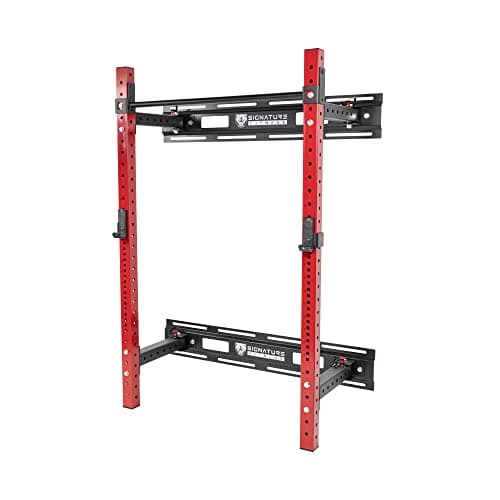
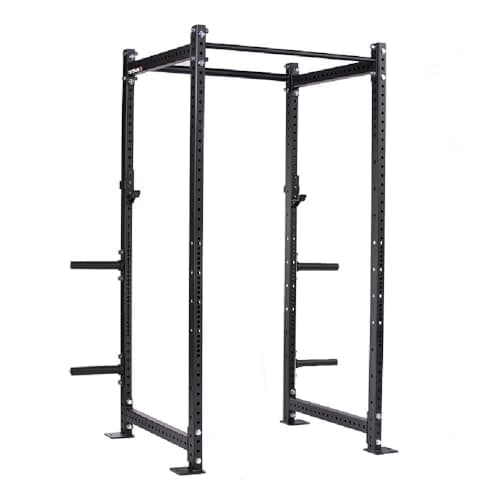
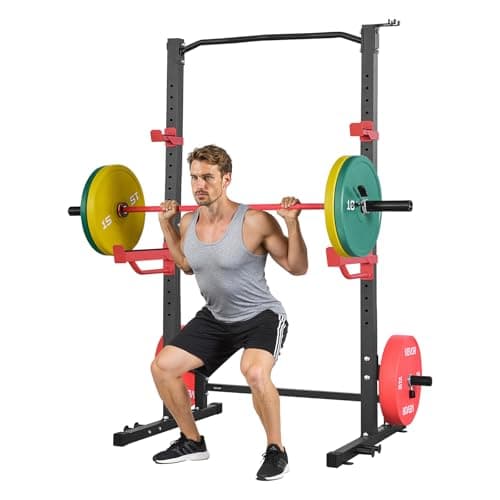
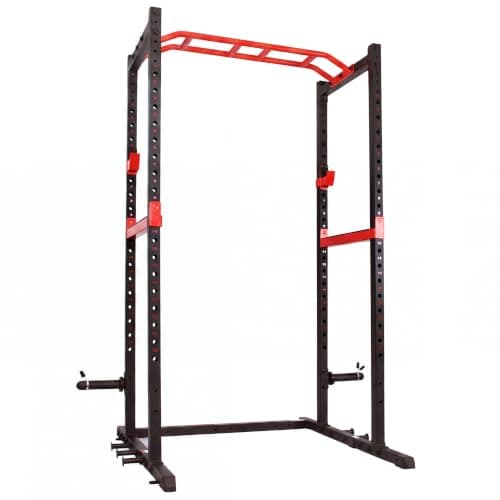
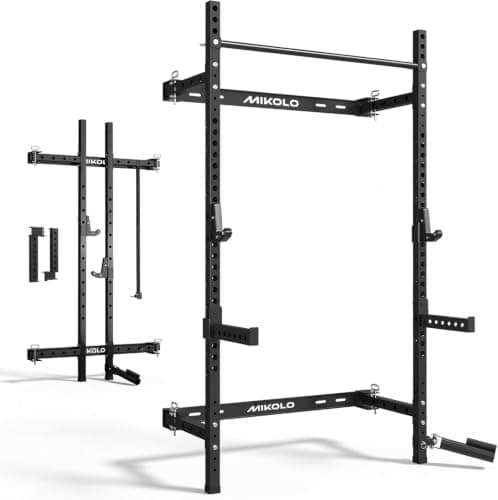
Buy the Mikolo 2×2 folding wall-mounted rack if the car still has to come back in: it is a published 1,000 lb frame on 2 × 2 inch uprights with safety catches, J-hooks, a pull-up bar and a landmine, and it swings flat against the wall in seconds. Buy the Signature Fitness 3×3 fold-in rack if you want commercial-size steel that also folds — 3 × 3 inch uprights, an adjustable pull-up bar, and it goes flat to the wall. Buy the Titan T-3 short rack if the garage ceiling is the binding constraint: a short frame with a published 1,100 lb capacity and a 36 inch depth, from the only brand here that publishes warranty terms you can read before ordering. Buy the VEVOR cage if the budget decides it — a complete 1,000 lb bolt-together cage with eleven J-hook positions and safeties in the box. And buy the Sunny Power Zone cage if the garage is permanently yours and you want a frame that grows with lat and cable add-ons later.
This page exists because a garage asks four questions the general power rack roundup does not. If price is your only constraint, start at the budget rack roundup instead.
The four constraints a garage adds
1. The car usually has to come back in
This is the constraint that decides most garage gyms, and it is the reason two of the five picks here fold flat to the wall. A full cage in a single-car garage is a decision to stop parking in it. That might be the right decision — but it should be made deliberately rather than discovered on delivery day.
A wall-mounted fold-back frame gives you a real rack during the session and your floor back afterwards, at the cost of needing solid framing to bolt into. The full ranking of that category is on the folding rack page; what this page adds is the garage-specific reading of when the fold is worth the fasteners.
2. The ceiling has a door track in it
Garage ceilings are often lower than the rest of the house, and worse, the useful height is interrupted: a sectional door's track and springs run horizontally right where a pull-up bar wants to be. Measure to the underside of the track, not to the ceiling, and measure with the door open.
If that number is tight, a short frame is the only fix money can buy — which is why the Titan T-3 short rack is here, and why the broader problem has its own page at power racks for low ceilings. A folding wall rack also helps, because you choose the mounting height.
3. The floor is concrete, which is an advantage
Almost every other room in a house has a floor you cannot drill. A garage slab is the one place a home lifter can genuinely anchor a rack, and anchoring removes rack movement entirely — no rocking on a heavy rack pull, no walking under a kipping pull-up. It is the single biggest stability upgrade available and it costs the price of four wedge anchors.
It is not mandatory. A loaded cage does not go anywhere under normal lifting. But if you have the slab, the option is yours and the method is in do you need to bolt down a power rack. The one thing to check first is what is in the slab — conduit and radiant heat lines are both real hazards.
4. The air is unconditioned, and steel notices
A garage swings through a wider temperature and humidity range than any room in the house, and the consequence is condensation on cold steel. That is a rust problem, and it is the single most common long-run complaint from garage lifters — not about racks, which are powder-coated, but about the bar and the plates that live on them.
No rack listing in this category publishes its coating specification, so we cannot rank on it and we will not pretend otherwise. What we can tell you is that the management is behavioral rather than a purchase, and it is covered in how to keep gym equipment from rusting in a garage and, for the bar specifically, in how to stop barbell rust.
The five, side by side
| As published | Mikolo fold rack | Signature 3×3 fold-in | Titan T-3 short | VEVOR cage | Sunny Power Zone |
|---|
| Frame type | Wall-mounted, folds | Wall-mounted, folds | Freestanding, short | Freestanding cage | Freestanding cage |
| Rated capacity | 1,000 lb | Not published | 1,100 lb | 1,000 lb | Not published |
| Uprights | 2 × 2 in | 3 × 3 in | Not published | 2 × 2 in | Not published |
| Gets the floor back | Yes, folds flat | Yes, folds flat | No | No | No |
| Needs to be drilled in | Yes, into framing | Yes, into framing | No | No | No |
| Depth | Not published | Not published | 36 in | Not published | Not published |
| Safeties included | Yes, safety catches | J-hooks included | Not published | Yes | Safety-bar ready |
| Pull-up bar | Yes | Yes, adjustable | Not published | Pull-up handle | Multi-grip |
| Attachment ecosystem | Landmine included | Not published | T-3 / X-3 line | No | Sunny add-on line |
| Published warranty terms | Not published | Not published | Yes | Not published | Not published |
| Coating specification | Not published | Not published | Not published | Not published | Not published |
Every cell is quoted from the manufacturer listing linked in Sources, and where a listing does not state a figure the cell says so. The last row is the honest headline of this page: not one rack in the category publishes what its finish is, which is exactly the spec a garage buyer most wants. Treat rust as something you manage rather than something you buy your way out of.
Which of the four constraints is actually yours
The constraints are not equal, and they resolve in a fixed order. Work down the list and stop at the first one that binds:
- If the car has to come back in, buy a folding wall rack. Nothing else satisfies this, and no amount of money changes it. Your decision is then only whether you want 2 × 2 or 3 × 3 steel.
- If the ceiling or door track is under about seven feet, buy a short frame. A standard cage will not fit, and the pull-up bar is the part that collides first.
- If neither binds, buy on budget and ecosystem. You are in the lucky case where the room does not constrain you, and the question becomes the ordinary one answered on racks by budget.
One more garage-specific note: whatever you buy, something belongs between the rack and the slab. Concrete is hard on feet, plates and bars, and a dropped plate on bare concrete chips both. The options are in our home gym flooring guide, and the wider case for a garage over a basement is in garage gym vs basement gym.
How to buy a rack for a garage
Measure three heights, not one
Ceiling, underside of the door track with the door open, and your own reach standing on the floor you will actually lift on — remember that rubber flooring raises you an inch or more. The binding number is usually the track, and it is the one nobody measures.
Find the framing before you fall in love with a folding rack
A fold-back rack transfers everything you lift into your wall, so it needs real studs or masonry, located and verified. If your garage has an unfinished wall you can see the framing in, you are in the best possible position. If it is a single-skin block wall or finished drywall over an unknown cavity, resolve that before ordering.
Decide about anchoring on purpose
The slab is an advantage you only get in a garage, and a freestanding cage that is bolted down stops being a frame that can move at all. Check what is in the slab first, and read the method rather than improvising it.
Buy safeties with the rack, not later
A garage gym is usually a gym you train in alone, which makes the safeties the most important accessory in the room — more important than any attachment. Two of these racks state they include catches and one is described as safety-bar ready; confirm what is in the box and fill the gap at once. The options are compared on safety bars vs safety straps.
Plan the rust management, then forget about it
Since no listing publishes a coating, assume the frame is powder-coated steel that will be fine and that your bar and plates are the exposed items. A cover for the bar, a wipe-down habit and keeping the bare steel off the floor handles it. That is the whole maintenance load of a garage gym, and it is smaller than the internet suggests.