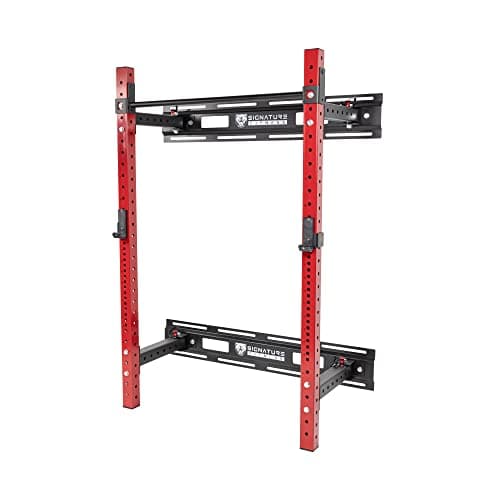
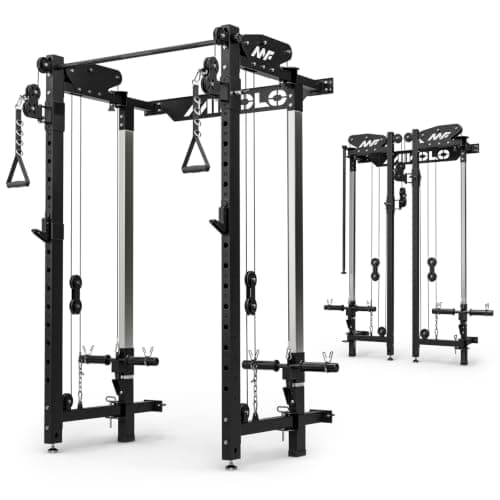
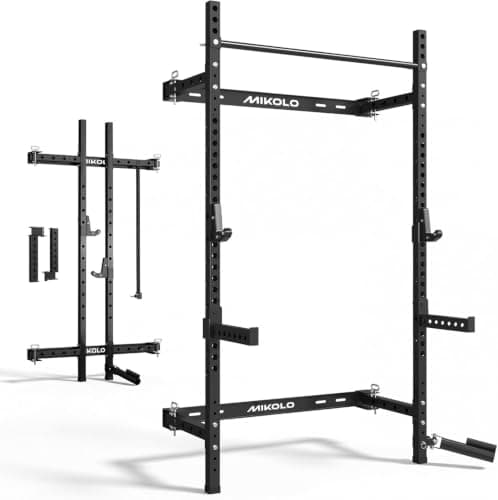
Buy the Mikolo 2×2 folding rack if you want the most rated capacity per square foot, or the Signature Fitness 3×3 fold-in cage if you want the heavier steel and expect to keep it forever. Both bolt to the wall and swing flat when you are done, which turns a garage bay back into a garage bay in about ten seconds.
A folding rack is half rack, half wall
This is the one category where the product you buy is not the whole structure. A free-standing power cage carries its own load into its own footprint. A folding rack transfers a large part of that load into whatever it is bolted to. The steel can be excellent and the rack can still be unsafe, because the wall behind it was never rated for anything.
That changes what you should evaluate. On a normal cage we rank steel gauge, upright size, hardware and warranty. On a folding rack all of those still matter, and then a fifth criterion sits above them: can you get the mounting bolts into solid wood studs, a concrete wall, or a steel-framed structural wall? If the answer is no, no rack on this page is the right purchase, and a free-standing squat stand is. If the reason you want a folding frame is cables rather than barbell work, the wall-mounted pulley racks are ranked on their cable systems in the best functional trainers for small spaces.
What we rank on
- Published rated capacity.Folding racks span a huge range — some publish a genuine 1,000 lb figure, others publish nothing at all. We cite the maker's number and treat a missing number as a red flag rather than an average.
- Upright size. 2×2 inch tubing is the folding-rack norm; 3×3 is rarer, heavier and considerably stiffer. Our steel gauge guide explains why the dimension matters at least as much as the wall thickness.
- What comes in the box. A rack without J-hooks and safeties is not a rack. Several of these ship with a pull-up bar and a landmine as well, which is real money you do not spend later.
- Depth when folded. The entire point is the wall profile when it is closed. A rack that folds to four inches is a different object from one that folds to eight.
- Cost per year. Price divided by realistic service life. Steel folding racks have almost nothing to wear out; the ones with cable systems have plenty.
Folding rack or free-standing cage?
Be honest about which problem you have. If the problem is floor area — you park a car where you lift, or the room has another job — a folding rack is genuinely the right answer and there is no compromise in the steel that matters at home loads. If the problem is only budget, a free-standing budget cage gives you more rack for the same money, because you are not paying for a hinge mechanism.
The third case is the one people get wrong: low ceilings. A folding rack does not solve a low ceiling. The uprights are still full height when deployed, and the pull-up bar still needs headroom. Measure the ceiling first, then decide — and if the ceiling is the binding constraint rather than the floor, the short frames that actually fit are ranked in the best power racks for low ceilings.
The cable question
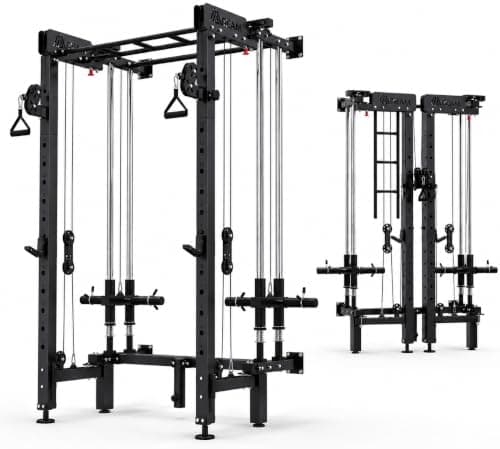
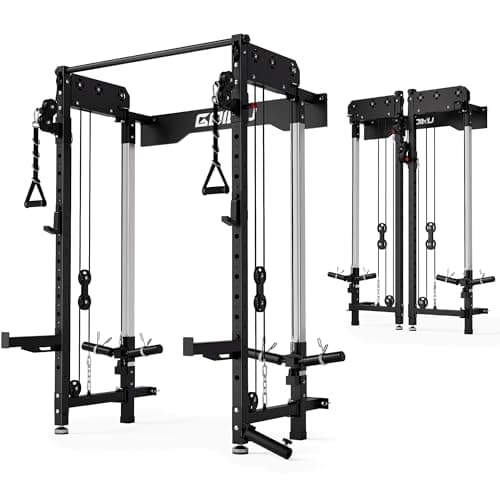
Three of the racks here add pulleys. That is a genuine capability upgrade — a lat pulldown and a crossover cover the pulling and isolation work a barbell alone leaves out — but it changes the durability picture. A bare folding rack is steel, bolts and a hinge; there is essentially nothing on it that has a service life shorter than yours. Add cables and you have added pulleys, cable ends, and a coated steel cable that will fray somewhere between year five and year fifteen depending on use.
We do not treat that as a reason to avoid them. We treat it as a reason to know it before you buy, and to prefer the brand more likely to still sell you a replacement cable. That is the same standard we apply to every rack attachment.
A folding rack is bought for one reason more often than any other: the car has to come back in. If that is your situation, the garage-specific version of this decision — including ceiling and door-track height, anchoring into a slab and what the air does to steel — is on power racks for a garage gym.
How to buy a folding rack without regretting it
Find your studs before you find your rack
Wood studs are typically 16 inches on center in a US home, and most folding racks are designed around that. Before you order anything, find the studs where the rack will live and confirm they are real structural timber, not furring strips over masonry or a non-structural partition. In a concrete or block garage wall you will use sleeve anchors instead, which is fine and often stronger — but it is a different set of hardware and a hammer drill.
Check the folded depth against the actual obstruction
"Space saving" is not a measurement. Measure from the wall to the thing you are trying to clear — the car mirror, the door swing, the shelving — and compare it to the rack's folded depth plus the J-hooks if they stay mounted. A rack that folds to five inches but has seven-inch hooks hanging on it folds to seven inches.
Buy the safeties, always
Folding racks are frequently sold as bare uprights with the catches as an upsell. Training alone without safeties is the risk a rack exists to remove. If the listing does not clearly include safety catches or straps, add safety strapsto the order in the same session — not "later".
Re-torque after the first month
A folding rack has more fasteners under cyclic load than a static cage, because the whole frame moves every time you deploy it. Check the wall bolts and the hinge hardware after the first few weeks and then annually. This is the single maintenance habit that decides whether a folding rack is a ten-year purchase or a three-year one.
Do the cost-per-year math
A $280 folding rack kept twelve years costs a little over $23 a year — cheaper than most gym memberships are per month. A $160 rack you replace after four is $40 a year. The cheaper rack is the more expensive rack. That calculation is the whole method behind how we choose.