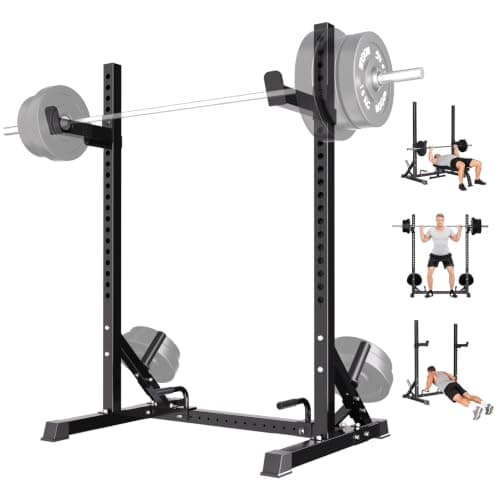
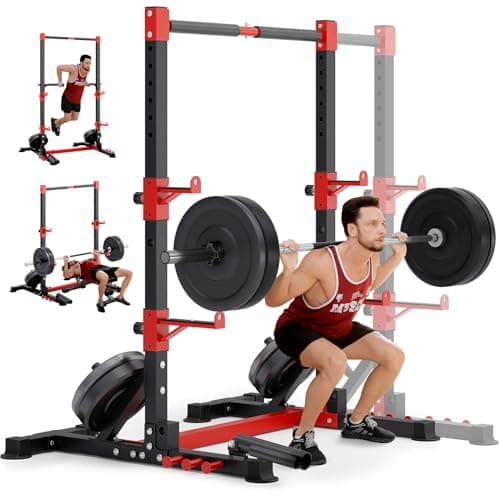
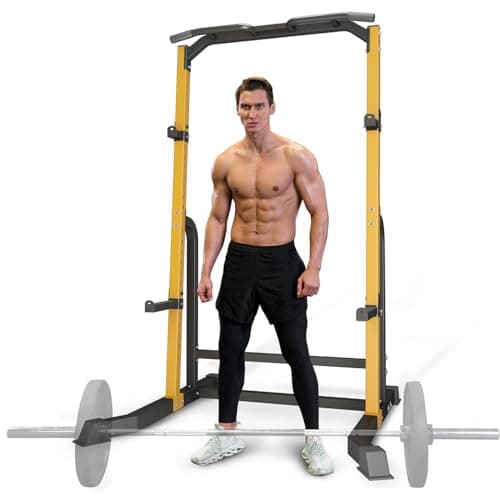
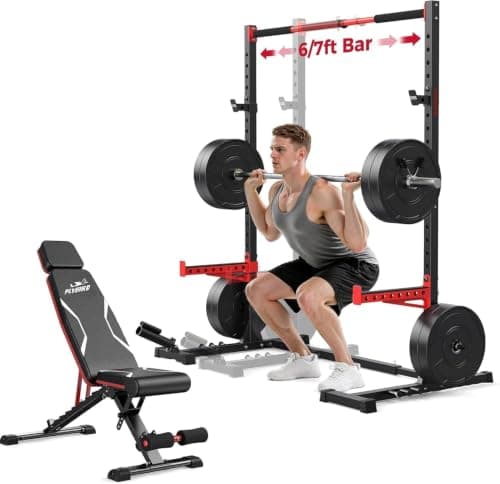
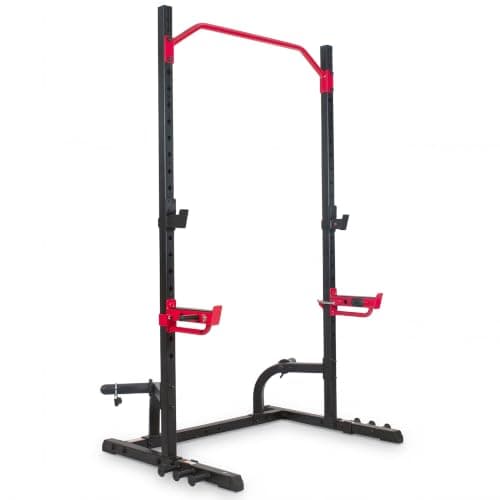
Buy the Sunny Health & Fitness full-size rack if you want an open frame from a brand that still sells parts, or the Garvee if you want the most complete rack in the box. A half rack gives you full-height uprights and a real pull-up bar without the depth of an enclosed cage — which is exactly the compromise most garages actually need.
What a half rack is, and what it isn't
A half rack has full-height uprights, a pull-up bar across the top, and J-hooks with spotter arms that project forward — but no back uprights and no full-length enclosure. That geometry is the whole story. You get the height and the catch range of a full cage, in roughly half the depth.
What you give up is the enclosure. In a cage, a failed rep lands on safeties that run the length of the rack, and you step out from under it. On a half rack, the bar lands on forward-projecting arms, and you have to be in the right place for that to work. It is a real difference and we are not going to soften it: if you train heavy singles alone, the cage is the honest answer.
Against a plain squat stand, though, the half rack wins on almost everything. Two independent stands can drift apart; a half rack is one structure. That single fact is why it is the format we recommend most often for a first serious rack.
What we rank on
- Published capacity.Half racks in this bracket publish anywhere from 690 lb to 1,000 lb. We quote the maker's figure. Any rated frame clears home loads; the number is most useful as a proxy for how the frame is built.
- Upright size and gauge. Most half racks at this price use 2×2 tubing. Anything heavier is a genuine upgrade — see the gauge guide.
- Resistance to tipping. A half rack carries load forward of its uprights, so base depth, base weight and the ability to bolt it down matter more than they do on a cage.
- Adjustability. Width-adjustable racks fit both 6 ft and 7 ft bars and narrow for storage. Every adjustment point is also a joint that can develop play — that trade-off is real.
- Parts and ecosystem. A rack whose maker still sells J-hooks in five years is worth more than one that is a hundred dollars cheaper today.
The tipping question
The one thing half-rack listings never discuss is what happens when you rack a bar hard on one side, or when a failed squat drops onto one spotter arm. Load applied forward of the uprights creates a tipping moment; the rack resists it with base depth and its own weight.
Three practical fixes, in order of effectiveness: bolt it to the floor (best, and most racks have base holes for exactly this); load the base with plates if your rack has base pegs or a plate shelf; or simply keep the heaviest work centered and controlled. A bolted-down half rack is as secure as a cage for everything a home lifter does — see our anchoring guide for how to do it properly on concrete and on wood.
Half rack, cage, or stand — the two-minute decision
If you have the depth and the ceiling and you train heavy alone: buy the cage. If your ceiling is fine but the floor is contested: buy the half rack. If neither works because the space has another job entirely: buy a folding wall-mounted rack and get the floor back completely.
Whatever you choose, spend what is left on the things that outlast the rack — iron plates and a good bar are the two purchases most likely to still be in your gym in twenty years.
How to choose a half rack
Measure the ceiling, then the depth
Half racks are full height — most want about 7'6" of ceiling for the pull-up bar to be usable. Depth is the number that makes them attractive: many sit under 30 inches deep versus 45 or more for a cage. Measure both against the room before comparing prices.
Prefer spotter arms to short pins
The catch mechanism is the safety system on a half rack. Long, properly rated spotter arms give you a margin for error; short pins do not. If a rack lists "extended safety arms" and publishes a rating, that is a meaningful spec, not marketing.
Decide about adjustability honestly
Width-adjustable racks are genuinely useful in a shared room and genuinely less rigid than a fixed frame. If the rack lives in one spot forever, buy fixed. If it has to narrow so a car can get past, buy adjustable and accept the trade.
Check for base bolt holes
Even if you never use them, base holes mean you can anchor the rack later. A half rack with no way to bolt down is permanently limited by its own weight, and that is a specification worth checking before you buy rather than after.
Run the cost per year
A $180 half rack kept a decade is $18 a year. A $250 rack you keep twenty is $12.50. The more expensive rack is the cheaper rack, provided it is built to last and the parts stay available — the reasoning behind how we choose everything here.