Skip to content
Plate&Rack

The uprights · Squat Racks & Stands

Squat Stand vs Half Rack

A stand is two uprights. A half rack adds depth behind them and long spotter arms. That extra foot of floor buys most of the safety a full cage gives you.

By Stephen V.Updated How we choose
#ad

We earn a commission when you buy through our Amazon links, at no extra cost to you. It never affects our rankings, and we say so when the cheaper product is the better buy. How this works.

If you can give up about another foot of depth, buy the half rack. The extra frame behind the uprights is what makes long spotter arms and a real pull-up bar possible, and it is the difference between a rack that catches a failed rep properly and one that catches it if you fail in the right direction.

The site already compares cage against stand and half rack against full cage. This page fills the remaining gap — the two smallest options against each other, which is the decision most people in a tight room are actually making.

The difference in one table

Squat standHalf rack
StructureTwo uprights on a shallow base, or two separate standsTwo uprights plus a rear frame or extended base
Typical depthRoughly the width of the base — often under 2 ftAround 2–4 ft, depending on the arms
How it catches a failed repShort spotter arms or pins in front of youLong spotter arms running the depth of the frame
Tipping resistanceLowest — the load sits near the front edgeBetter — the rear frame moves the tipping point back
Pull-up barSometimes, and often close to the uprightsUsually, with room to hang clear
AttachmentsLimited — dip bars at mostLat towers, dip bars, landmines on many models
AnchoringStrongly recommendedRecommended
PriceLowestModerately higher

Depth is the whole argument

Every difference in that table comes from one thing: how much frame there is behind the uprights.

On a squat stand, you stand in front of the uprights or just under them, and the spotter arms are short because there is nothing to hang a long arm from. A failed squat has to land on those short arms, which means it has to land close to where you unracked it. That works — people train on stands safely for decades — but it asks something of you.

A half rack puts a frame behind the uprights, which does three things at once. It gives the long spotter arms something to bolt to, so the catch surface runs the whole depth you might drift into. It moves the tipping point backwards, so a forward pull on the uprights has more leverage to fight. And it creates space for a pull-up bar you can actually hang from without kicking the frame.

The tipping problem, honestly

This is the failure mode nobody demonstrates in a product photo. Rack a heavy bar on the J-hooks of a light squat stand and the whole load sits at the front of a shallow base. Re-rack it hard, or catch the hooks on the way in, and the stand wants to rotate forward.

Three fixes, in order of how much they help. Anchor it — bolting to concrete removes the problem entirely, and the method is in how to anchor a squat rack. Load the base — plate pegs at the rear of the frame are the cheapest ballast there is, and it is why we score plate storage on a rack as a stability feature rather than a convenience. Buy depth — which is the half rack.

Where the stand genuinely wins

Floor space, obviously. A stand can live against a wall in a room that has to be something else for the other twenty-three hours of the day. If you are working with a corner of a bedroom, this is decisive and the rest of the page is academic — go to the best squat racks for small spaces.

Getting in and out. There is no frame to step through, which matters more than it sounds if you are moving a bench in and out around it.

Price at the same steel quality. Less frame is less steel. A stand from a decent maker can cost what a half rack from a poor one costs, and the better steel is usually the better buy — the reasoning is in the steel gauge guide.

Moving house. A stand is a two-person lift and fits in a car. A half rack is a project.

Where the half rack wins

Catching a bad rep. Long spotter arms across real depth are simply a better catch surface than short arms at the front.

Growing. Half racks generally have the hole pattern and the frame to take a lat tower, dip bars and a landmine. Most stands take almost nothing. If you expect to add capability, the half rack is the platform.

Pull-ups that are not a compromise. A bar with clearance behind it is a usable bar.

The rule

Measure the depth you can permanently give up. If it is under about two feet, buy the best squat stand you can and anchor it. If it is three feet or more, buy the half rack — you are getting most of a cage's safety for a fraction of a cage's footprint, and a platform that grows. If it is four feet or more, stop reading this page and go and look at full cages, because you can fit one.
The short answer

Quick picks

#ProductBest forScorePrice
01
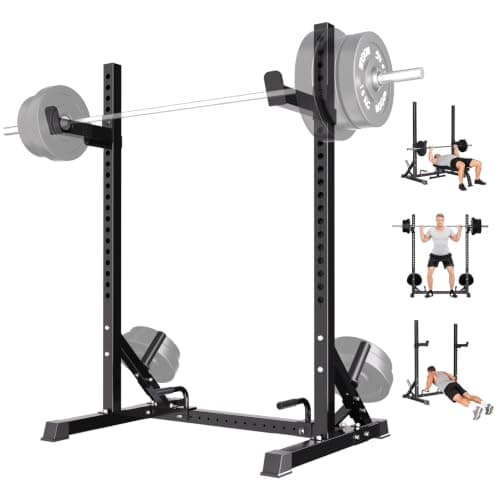
Garvee Garvee Half Rack with Push-Up Bars & J-Hooks
Garvee Half Rack with Push-Up Bars & J-Hooks

A half rack that arrives complete — J-hooks and push-up handles in the box rather than on a wish list.

Most complete starter half rack
6.8
$149.99Amazon
02
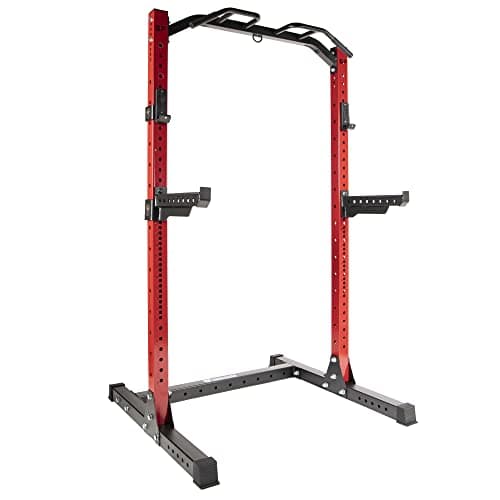
Signature Fitness Signature Fitness SF-SS1 3×3 Squat Stand (1,000 lb)
Signature Fitness SF-SS1 3×3 Squat Stand (1,000 lb)

3×3 uprights and a 1,000 lb rating in a squat stand — commercial steel without the cage.

Sturdiest squat stand
8.0
$567.24Amazon
03
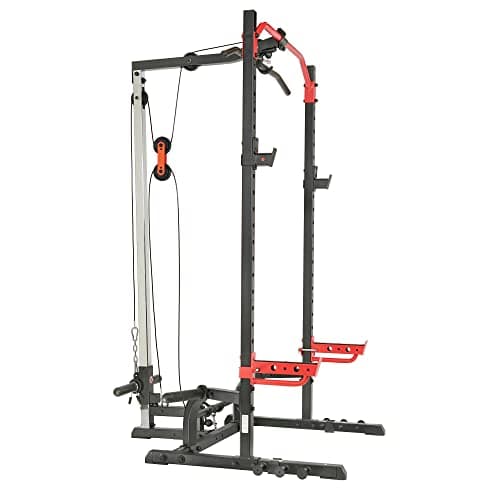
Sunny Health & Fitness Sunny Health & Fitness Power Zone Squat Stand + Lat
Sunny Health & Fitness Power Zone Squat Stand + Lat

A squat stand that already includes the lat pulldown most stands make you add later.

Squat stand with cables
7.2
$518.99Amazon

#ad · Live prices from the Amazon Product API, as of Sep 8, 2026. Where we have no verified live price, we show none — we would rather leave a gap than print a number that has rotted.

In detail

The picks, in full

01
Garvee Garvee Half Rack with Push-Up Bars & J-Hooks

Most complete starter half rack

Garvee Half Rack with Push-Up Bars & J-Hooks

Half rack frameJ-hooks includedPush-up barsHome gym footprint
6.8/10

A half rack that arrives complete — J-hooks and push-up handles in the box rather than on a wish list.

Build & steel
6
Capacity
7
Expandability
5
Footprint
8
Value
8

Pros

  • J-hooks are included, which sounds obvious and repeatedly isn't at this price
  • Push-up handles add floor work without another purchase or another thing to store
  • Half-rack geometry sits between a stand and a cage — more stable than a stand, smaller than a cage

Cons

  • No published steel gauge and a young listing, so the long-term parts picture is unproven
  • Half racks put the load forward of the uprights, so anchoring or a loaded base matters more than on a cage

Don't buy this if…

you want a rack that grows. This is a complete small rack, not the first stage of a system — plan to keep it as-is or move on from it.

$149.99View on Amazon

$179.9917% off

Price as of Sep 8, 2026. Prices change — Amazon's is the one that counts.

#ad · we may earn a commission from this link to Garvee Half Rack with Push-Up Bars & J-Hooks

02
Signature Fitness Signature Fitness SF-SS1 3×3 Squat Stand (1,000 lb)

Sturdiest squat stand

Signature Fitness SF-SS1 3×3 Squat Stand (1,000 lb)

3×3 in uprights1,000 lb ratedJ-hooks + spotter armsConversion-kit ready
8.0/10

3×3 uprights and a 1,000 lb rating in a squat stand — commercial steel without the cage.

Build & steel
9
Stability
8
Footprint
8
Expandability
8
Value
7

Pros

  • 3×3 inch uprights rated to 1,000 lb — this is the heavy tubing size in a stand format
  • Ships with J-hooks and safety spotter arms, so you can bail a failed squat
  • Optional conversion kits turn it into a full rack later, so it grows with you

Cons

  • Priced above the budget stands — you are paying for the heavier steel
  • A two-post stand still needs to be loaded evenly; it is more tip-sensitive than an anchored cage

Don't buy this if…

you want the lightest, cheapest way to start. This is the buy-it-once stand; if the budget is tight today, a lighter stand gets you lifting for less.

$567.24View on Amazon

Price as of Sep 8, 2026. Prices change — Amazon's is the one that counts.

#ad · we may earn a commission from this link to Signature Fitness SF-SS1 3×3 Squat Stand (1,000 lb)

03
Sunny Health & Fitness Sunny Health & Fitness Power Zone Squat Stand + Lat

Squat stand with cables

Sunny Health & Fitness Power Zone Squat Stand + Lat

Squat stand + cageLat pulldown includedPower Zone ecosystemAdjustable hooks
7.2/10

A squat stand that already includes the lat pulldown most stands make you add later.

Build & steel
7
Stability
7
Footprint
7
Expandability
8
Value
7

Pros

  • Comes with the lat pull-down attachment built in, so you get pulling work without a separate tower
  • Part of the Power Zone line, so it shares attachments with the Sunny cages
  • Compact stand footprint with a real cable station bolted on

Cons

  • The most expensive squat option here — the cable hardware is what you pay for
  • Cables and pulleys are the parts most likely to need attention over a decade

Don't buy this if…

you only want to squat and press. The lat stack is dead weight and dead cost if you never use it — a plain stand is cheaper and simpler.

$518.99View on Amazon

$649.9820% off

Price as of Sep 8, 2026. Prices change — Amazon's is the one that counts.

#ad · we may earn a commission from this link to Sunny Health & Fitness Power Zone Squat Stand + Lat

How we picked

We do not run a testing lab

We compiled manufacturer specifications, read the published warranties, checked the relevant standards and aggregated owner reviews, then scored each product against a published rubric. The scores are judgments from documented research — they are not measurements we took, because we do not run a lab and we are not going to pretend we do. Where a number came from a manufacturer or a standard, we name it and link it in Sources.

Questions

Frequently asked

Is a half rack safer than a squat stand?

Generally yes, and the reason is geometry rather than steel. A half rack has frame behind the uprights, so its spotter arms run the depth you might drift into and its tipping point sits further back. A stand catches the bar on short arms at the front. Both work; the half rack asks less of you when a rep goes wrong.

How much floor space does a half rack need over a squat stand?

Roughly another one to two feet of depth, depending on the spotter arms. Width is often similar. That extra depth is what buys the long arms, the tipping resistance and the attachment mounting points.

Can you do pull-ups on a squat stand?

On some, but often awkwardly — the bar sits close to the uprights and there is little clearance behind you. A half rack usually gives a bar you can hang from cleanly. If pull-ups matter, check the clearance dimension rather than just whether a bar is present.

Do squat stands need to be bolted down?

Strongly recommended. A shallow base puts the load near the front edge, and bolting removes the tipping question completely. Where drilling is impossible, load the rear plate pegs and keep re-racking controlled — see how to anchor a squat rack.

Which is better value?

The half rack, if the floor allows it — you get long spotter arms, a usable pull-up bar and an attachment platform for a modest price step. The stand is better value only when depth is the binding constraint, and in that case it is not really a value question at all.

Keep reading

Receipts

Sources

We do not run a testing lab, and we do not pretend to. Every spec, warranty term and standard above is the manufacturer's or a published source, cited and linked. Where we could not verify something, we say so on the page rather than quietly leaving it out. Read our full method.