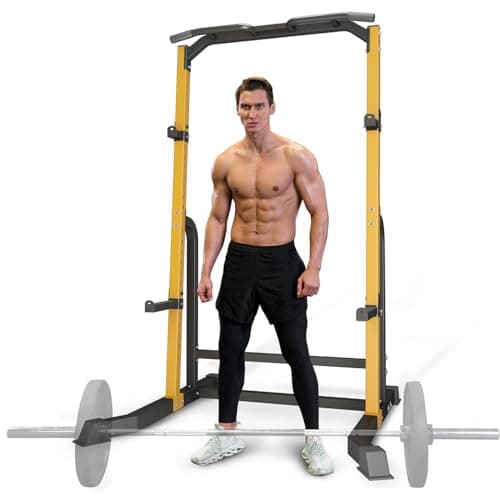
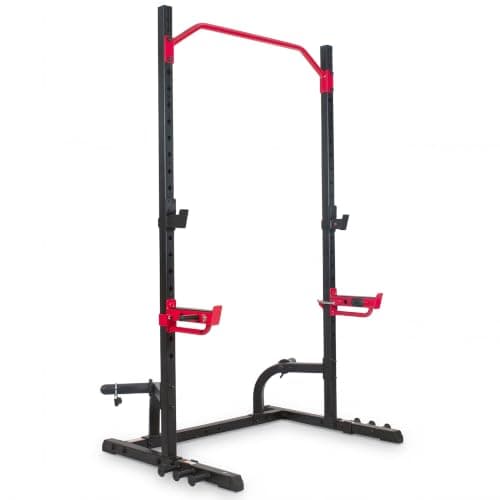
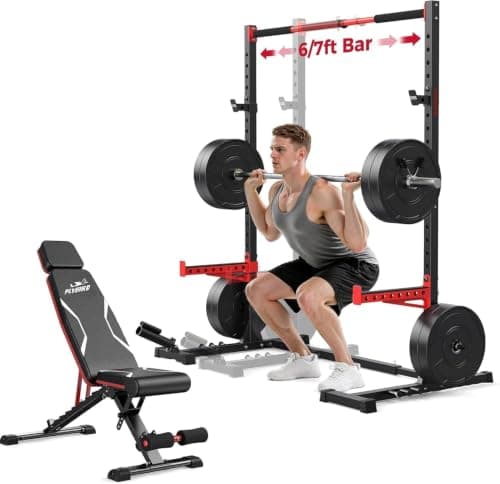
A squat rack is worth it if you own a barbell and cannot give a full cage the floor it wants. It is not worth it if you were going to buy a cage anyway and talked yourself down on price — the gap between the two is smaller than the gap between a stand and no rack at all.
The question people are really asking here is usually one of two things: is this worth the money against a gym membership, or is a stand enough rack. Both have honest answers and they are different answers, so this page takes them separately.
What a squat rack actually replaces
A barbell on the floor gives you deadlifts, rows and cleans. That is a real training program and some people run it for years. What it does not give you is anything that starts with the bar on your back or above your chest — no back squats, no front squats, no bench press, no overhead press from a rack position. Those four are most of a strength program.
A squat rack restores all of them. It is the difference between a barbell and a barbell training setup, and it is why we put it second in the buying order, immediately after the bar and plates.
The safety case, which is the real case
Under a heavy squat there are two ways a failed rep ends: the bar lands on something, or it lands on you. A rack with adjustable safeties or spotter arms is the something. Nothing else about it — the pull-up bar, the plate pegs, the finish — matters next to that.
This is where the honest caveat about stands lives. A full cage encloses you, so a failed rep drops onto safeties on both sides no matter which way you drift. A squat stand catches the bar in front of you on spotter arms, which works, but requires you to fail in roughly the direction you planned to. If you consistently lift close to failure alone, that difference is worth the extra footprint — the full argument is in power rack vs squat rack.
The cost-per-year arithmetic
This is where the answer becomes obvious, and it is the same method we use across the site: price divided by realistic service life.
A steel squat rack has no mechanism. It has uprights, J-hooks, safeties and bolts. Nothing on it wears at a rate you will observe, and the only genuinely consumable part is the plastic liner inside a J-cup. Assign it a fifteen-year life and you are being conservative rather than optimistic — see the reasoning in home gym equipment that lasts.
Run your own numbers with the method on home gym cost per year: take the live price on this page, divide by fifteen, and compare it with a month of gym membership. For every rack we rank, the annual figure comes out below the cost of a single month at a commercial gym. That is not a close comparison, and it is the reason we do not spend long on it — the interesting question is which rack, not whether.
The comparison that does deserve care is the whole-gym one, because a rack alone is not a gym. That is worked through properly in home gym vs gym membership.
When the answer is genuinely no
You do not own a barbell and do not want one
A rack exists to hold a bar. If your training is adjustable dumbbells and kettlebells, a rack is furniture. Buy a bench and better dumbbells instead.
You will move within the year
Racks are bolted, heavy and awkward. If a move is coming, the honest options are a folding wall-mounted rack you can leave behind cheaply, or waiting. A stand you have to disassemble twice in eighteen months loses some of its point.
The ceiling or the floor will not take it
Measure before you buy, not after. A stand with a pull-up bar still needs headroom, and a rack on a soft or uneven floor is a stability problem — the rules are in our flooring guide and in how to anchor a squat rack.
You have the room for a cage and the budget for one
Then buy the cage. A stand is a footprint compromise, and if you do not have the constraint you do not need the compromise. The power rack roundup is the right page for you.
Which kind of stand, if the answer is yes
Three shapes, briefly. A pair of independent squat stands is the smallest and the least stable, and it is a genuine answer for a small room if you bolt or load them. A connected squat rack — two uprights joined by a base — is the sensible default and where most of our picks sit. A half rack adds depth behind the uprights and long spotter arms, which gets you much closer to cage safety for a modest extra footprint. We compare the two ends of that range directly in squat stand vs half rack.
What to buy alongside it
A rack on its own does not finish the job. Budget for adjustable safeties or safety straps if the rack does not include them, a bench that fits between the uprights, and anchoring hardware if the floor allows it. Those three turn a rack into a training station, and collectively they cost a fraction of the rack.