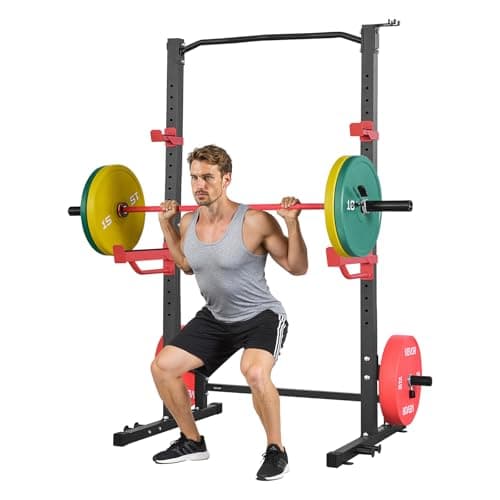
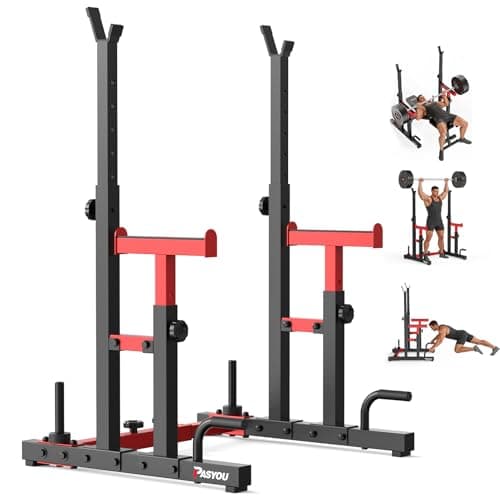
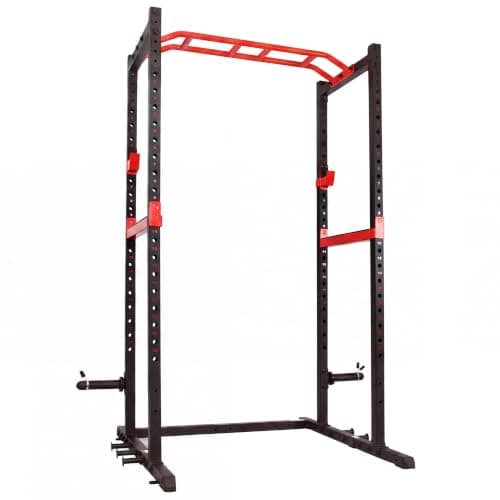
If you squat or bench alone, a power rack is the single highest-value object in the room — it is the only piece of equipment whose job is to catch the bar when you fail. If you train exclusively with dumbbells, or you have a spotter every session, the answer changes completely. The same question about the other big purchase — the cable machine — is answered on are functional trainers worth it, and the short version there is: not until the rack is already paid for.
The safety case, stated plainly
A barbell does not care that you are training alone. Under a heavy squat or bench press there are exactly two ways a failed rep ends: the bar lands on adjustable safeties, or it lands on you. Everything else about a rack — the pull-up bar, the attachments, the storage pegs — is secondary to that one function.
This is why the safeties, not the frame, are the part to scrutinize. A rack with poorly located safety pin holes, or a hole spacing too coarse to catch the bar just below your chest on a bench press, has failed at its primary job no matter how much steel is in it. When you compare racks, set them side by side on hole spacing through the bench-press range first and the marketing second. Our power rack buying guide walks through what to check before you order.
The cost-per-year arithmetic
The buy-it-for-life case for a rack is unusually strong, because a welded or bolted steel frame has almost nothing in it that wears out. There is no motor, no pneumatic cylinder, no upholstery, no electronics. The failure modes are surface rust on a neglected finish and losing the hardware — both recoverable.
That matters because it changes how you should read the price. A rack is not an annual expense; it is a one-time purchase divided by however many years you keep training. Spread a mid-priced cage across ten years and the yearly figure lands somewhere between trivial and invisible. Spread it across one year, because you bought a rack for a habit you had not yet built, and it is an expensive mistake. The rack is not what determines which of those happens — you are. We work the numbers out properly in home gym cost per year.
When the answer is genuinely no
You do not own, and will not buy, a barbell
A rack exists to hold a barbell at height and catch it when it drops. If your training is adjustable dumbbells, kettlebells and bodyweight work, a rack solves a problem you do not have. Buy a bench and better dumbbells instead — the money goes further and the floor stays clear.
Your ceiling genuinely will not take one
Full-height cages commonly need somewhere around seven feet of clearance, and you need headroom above that if you intend to use the pull-up bar. Measure before you fall in love with a model. If the ceiling is the constraint, a squat stand or a folding wall-mounted rack is the honest answer rather than a cage you cannot stand up inside.
You are renting somewhere you will leave within a year
Racks are heavy, awkward and a genuine nuisance to move. That is not a reason never to buy one, but it is a reason to buy a folding or bolt-together model rather than a large welded cage if a move is coming. Resale in this category is strong, which softens the problem, but moving day is still moving day.
What a rack replaces
Part of the value case is subtraction. A cage with a pull-up bar and dip attachment covers squats, presses, bench, rack pulls, pull-ups and dips from one footprint. Buying those capabilities as separate machines costs more, takes more floor and gives you more things that can break. The rack is the cheapest way to get a complete barbell gym into a garage, and it is why the one category that overlaps it most — freestanding bodyweight towers — usually loses the argument. We make that case honestly, including when it does not hold, on are power towers worth it.
It also grows. The better racks are systems rather than objects — a lat tower, dip bars, safety straps and a landmine all bolt to the same uprights, which means your second and third purchases do not require a second and third frame. That is what separates the mid- priced cages from the cheapest ones, and it is covered in the attachments guide.
How much rack do you actually need?
More than most buyers think on safeties, less than most buyers think on rated capacity. Published capacity numbers in this category run well past what a home lifter loads — the PASYOU cage publishes a 1,200 lb total and the VEVOR a 1,000 lb rating, and almost nobody buying their first rack is going to test either. What you will notice every session is whether the J-hooks hold their height, whether the safeties are quick to move, and whether the frame stays planted when you rack a heavy bar carelessly.
So the honest ranking of what to spend on is: safeties and hole spacing first, upright stability second, attachment ecosystem third, headline capacity number last. That order is the opposite of how most listings are written.
The verdict
For a solo barbell lifter, a power rack is worth it in a way very few purchases are: it is the equipment that makes training hard alone survivable, it has effectively no wear parts, and it holds value. For everyone else it is a large steel object solving a problem they do not have. The question is not really whether racks are worth it — it is whether you are going to lift a barbell alone. If yes, buy the rack before you buy anything else except the bar. Start with the best power racks, or compare it against a squat rack if floor space is tight.