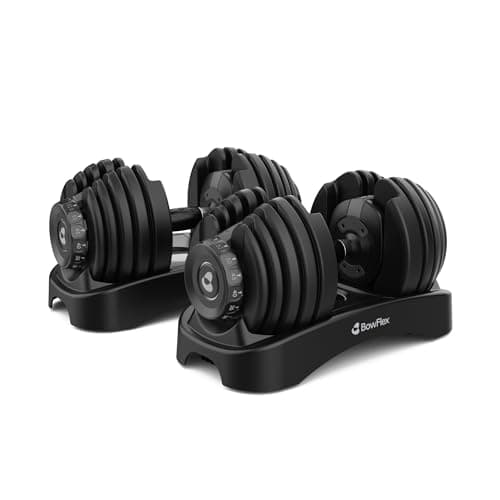
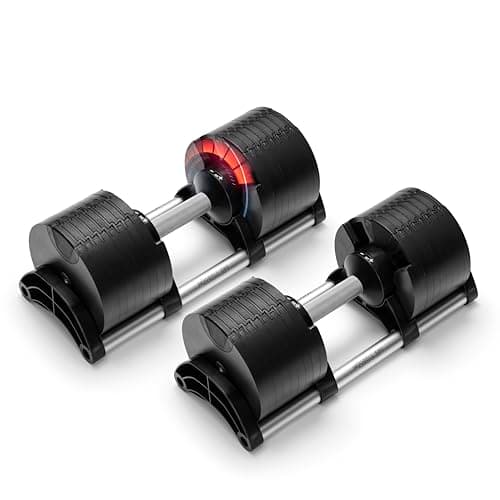
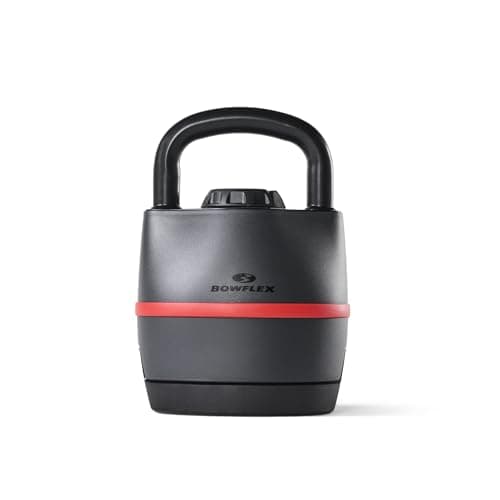
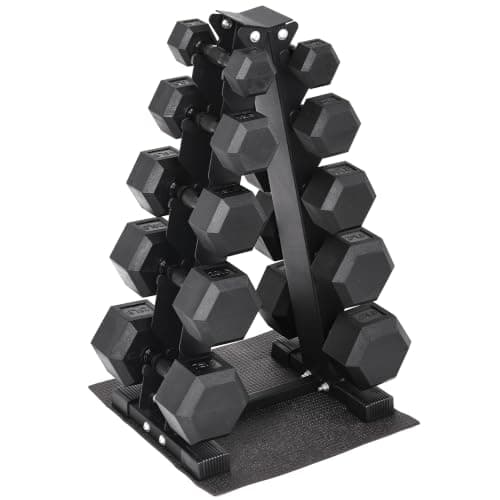
Buy the NÜOBELL if the budget stretches — it is the adjustable that feels closest to a real dumbbell and the one you buy once. If you want the proven default for less, the BowFlex SelectTech 552 has been the category benchmark for years. Either one collapses a whole rack of fixed dumbbells into the footprint of a single pair, which is why, for a small gym, a set of adjustables is usually the best money you can spend. If those two are your shortlist, we settle them head to head in NÜOBELL vs BowFlex 552.
Why one pair of adjustables is the best money in a small gym
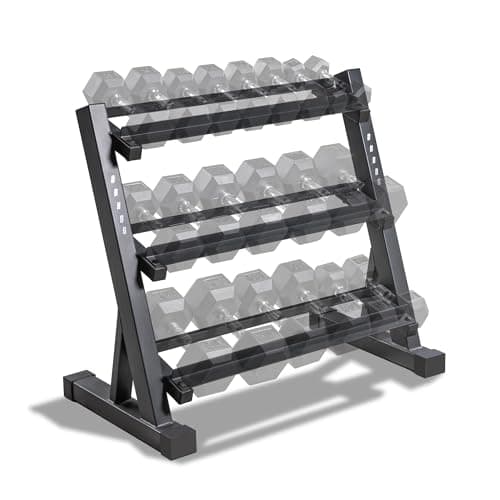
A fixed-dumbbell set in 5 lb jumps from 5 up to 75 lb is fifteen pairs — a literal wall of iron plus a rack to hold it, at a cost and a floor footprint that no home gym can justify. A single pair of adjustables covers that same range from a spot the size of a shoebox. Nothing else in a small room trades so much capability for so little space, which is why we treat adjustables as one of the highest-value purchases a home lifter makes — and, for a first pair bought on what survives rather than on price, the ranking is the best dumbbells for beginners. Only one purchase beats it: a power rack for training you can actually do.
That value only holds, though, if the set survives. A dumbbell that has to be replaced in three years is not cheaper than a fixed rack — it is just cheaper today. So the whole question is durability, and durability in this category is misunderstood.
The plates last forever — the mechanism is what fails
The iron or steel plates inside an adjustable dumbbell are effectively permanent. They are just weight; there is nothing in a lump of cast plate to wear out. What breaks is the selector— the dial, the twist collar, the pin, the tray or the housing that holds those plates together and lets you change the load. When owners report a dead adjustable, it is almost never the weight that failed; it is the mechanism.
That single insight reframes the whole purchase. You are not really buying weight — you are buying a mechanism that holds weight, and the mechanism is the failure point. So ranking these on durability is really ranking their selectors: how they are built, what they are built from, and how much abuse they tolerate before something inside stops locking. The same logic runs through everything that lasts in a home gym.
What we rank on
- The mechanism. Dial (BowFlex, Core), twist-handle (NÜOBELL), selector-pin block (PowerBlock) and spinlock collar each fail differently. A dial is fast but has the most small parts; a twist-handle is quick and well-regarded; a pin-loaded block has the least to bend; a spinlock has essentially nothing to break. Fast is not the same as durable.
- Build material. An all-metal plate stack and housing shrugs off knocks that crack a plastic tray. Where a set leans on a molded plastic cradle to hold the plates, that cradle is the part to worry about.
- Weight range. A set you outgrow in six months is a false economy. We note the real ceiling of each pick so you buy the range you will actually use, not the one on the box — and if you do not yet know which weights that means, start at what dumbbell weights to buy.
- Drop-tolerance. No adjustable likes being dropped, but some survive a bump far better than others. This is where the block and the spinlock pull ahead of the dials.
- Cost per year. Price divided by realistic service life. A pricier set that lasts a decade can be cheaper per year than a budget pair you replace — the only number that serves a buy-it-for-life buyer, and we show it on every pick.
Two questions run underneath this whole list. Whether the compactness of an adjustable is worth what the mechanism costs you is answered on are adjustable dumbbells worth it, and what actually ages on each type — bare iron, rubber coating, chrome, a selector — is on how long dumbbells last.
How to choose adjustable dumbbells
The mechanisms compared
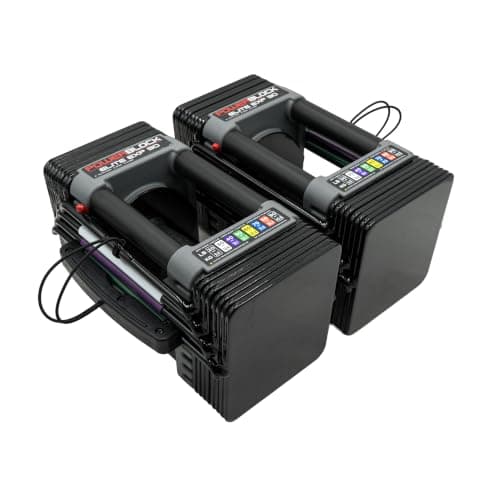
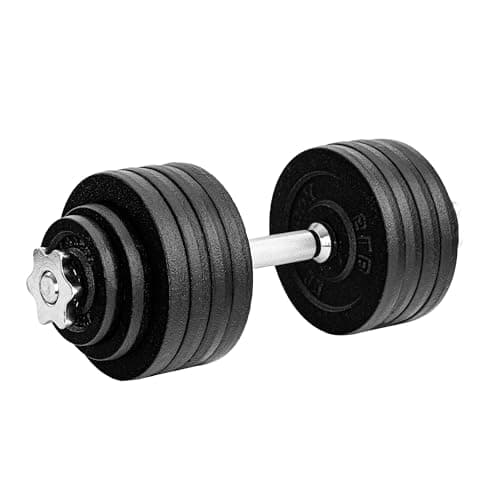
Four selector styles dominate. A dial (BowFlex 552, Core Home Fitness) is the fastest to change and the most common, but it has the most small internal parts and usually a plastic tray the plates rest in — convenient, not rugged. A twist-handle (NÜOBELL) is nearly as fast and pairs a metal build with a loaded shape closest to a real dumbbell. A selector-pin block (PowerBlock) wraps the weight in a steel cage with no long plates to bend, so it takes a knock best of the quick-change designs. A spinlock collar (cast-iron adjustables) is the slowest to change and the hardest to kill. Pick the mechanism, and you have mostly picked the dumbbell.
The weight range you actually need
Most home lifters are served by a set topping out around 50 lb per hand — that covers pressing, rows and most accessory work for a long time. Go to an 80 lb ceiling only if you already press heavy or know you will, because the range costs real money. Going the other way, a light 25 lb set suits a genuine beginner or higher-rep conditioning, but you will outgrow it fast if you keep training. Buy the range you will use in a year, not the widest one on offer. If where the range starts and how finely it steps matter more to you than where it ends, the field is re-ranked on exactly that in the best adjustable dumbbells for women.
Why you must not drop them
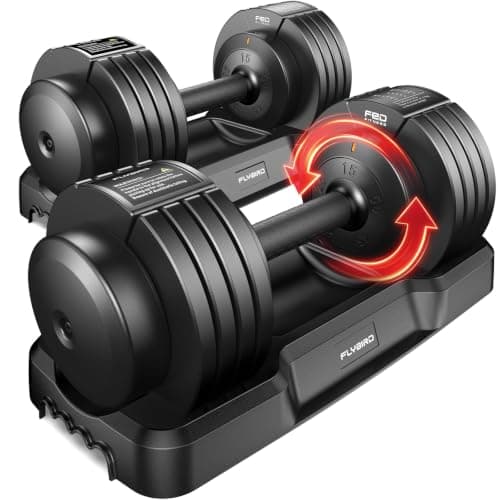
This is the one habit that decides whether an adjustable lasts. The selector mechanism is not built for impact — drop a loaded dial or twist set onto a hard floor and you risk cracking the tray, bending a plate rail or knocking the selector out of alignment. Set them down, do not drop them, and keep them off concrete. If you know you will bail weights at the end of a hard set, an adjustable is the wrong tool; buy fixed hex dumbbells or bumper plates for that.
The durable, simple alternative
If fast changes do not matter to you, the toughest adjustable design is the oldest: a spinlock cast-iron handle. You thread plates onto a bar and lock them with a screw collar. There is no dial, no tray and no housing — nothing to break — and you can set it down far more roughly than any quick-change set. It is slow to adjust and the loaded shape is long, but for pure longevity per dollar nothing beats it. See our budget picks for a spinlock option.