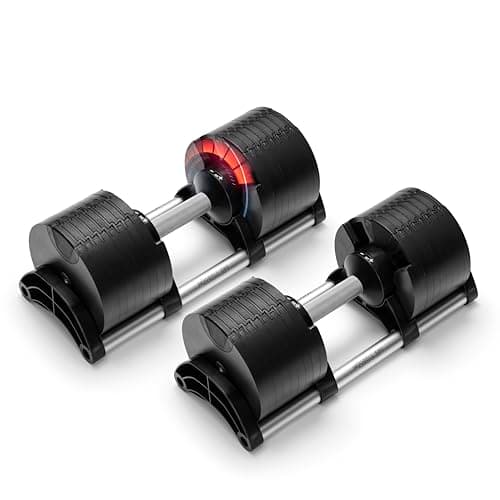
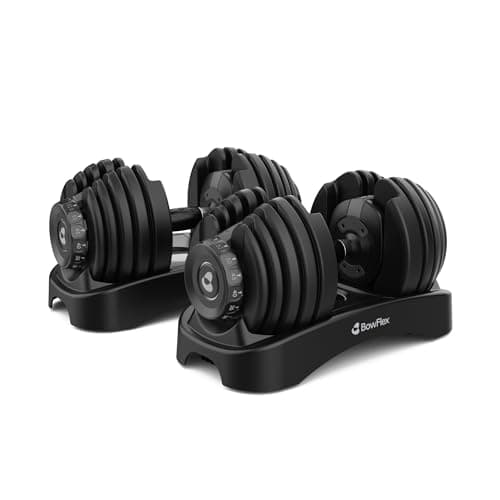
For most home gyms, buy the BowFlex 552. It costs materially less, it does the same job for the weight range most people actually train in, and the money you save buys a bench or plates. Pay up for the NÜOBELL for two specific reasons and no others: you press or row past 52.5 lb a hand, or the way an adjustable handles matters enough to you to be worth real money.
Why these two get compared and the PowerBlock does not
These are the two adjustables shaped like dumbbells. Both put a handle between two stacks of plates, both select weight by turning something, and both look roughly like the fixed dumbbell they replace. That shared silhouette is why they end up on the same shortlist — and it is why the comparison comes down to execution rather than to concept.
The PowerBlock is a genuinely different answer to the same problem: a square cage you put your hand inside. It is not worse, it is not really comparable on feel, and we argue it out separately in BowFlex 552 vs PowerBlock Elite. If shape is not something you care about, that page is the more useful one, because shape is most of what this page is about.
One naming note that trips people up when they go looking: the BowFlex 552 is currently listed as the "Results Series 552 SelectTech". Same 552, current listing.
The comparison in one table
| BowFlex 552 | NÜOBELL |
|---|
| Weight per hand | 5 to 52.5 lb | 5 to 80 lb |
| How you select | Dial at each end | Twist the handle |
| Shape at low weight | Full length whatever you select | Shorter — plates stay in the cradle |
| Load path | More polymer in the housing and tray | More metal |
| Expandable later | No | No |
| Tolerates being dropped | No | No |
| How common it is | The most widely owned adjustable there is | A specialist product |
| Price bracket | Mainstream | Premium |
What the extra money actually buys
Three things, and it is worth being precise about them because the marketing is not.
More metal in the load path. The NÜOBELL carries its load through metal where the BowFlex uses more polymer in the housing and the cradle. On the piece of equipment whose whole weakness is its mechanism, that is a real difference in kind rather than a finish upgrade. It is the single strongest argument for the premium set.
A higher ceiling. 80 lb a hand against 52.5 lb. Whether that matters is a question about you, not about the product, and we work through it below.
A shorter dumbbell at light weights. The NÜOBELL leaves unselected plates behind in the cradle, so a light setting is a physically shorter object. The BowFlex is full length at every setting. For curls, lateral raises and anything where the end of the dumbbell can catch on you, that is the difference people notice first.
What the money does not buy is a set you can drop, a set that expands later, or a meaningfully different training effect. Neither of these tolerates impact, neither takes expansion kits, and a 40 lb dumbbell is 40 lb in both hands.
The ceiling: who actually reaches 52.5 lb?
This is the part that decides the purchase for most people, and it gets answered with wishful thinking more often than with arithmetic.
52.5 lb a hand is a 105 lb dumbbell bench press and a 52.5 lb single-arm row. A lifter who trains consistently reaches that on rows first, usually within a year or two; on pressing it takes longer, and plenty of people never get there at all because dumbbell pressing is the lift most limited by shoulder tolerance rather than by strength.
So the honest split: if dumbbells are your accessory work alongside a barbell and a rack, 52.5 lb is plenty and will stay plenty. If dumbbells are your primary pressing and pulling tool — no barbell, no rack — you will run out, and the cheaper set becomes the more expensive decision the day you do. The wider version of that argument, including what happens past 80 lb, is in the heaviest adjustable dumbbells.
Selection speed and feel
Both are fast enough that it is not a real differentiator. The BowFlex uses a dial at each end, so a weight change is two movements and the set has to be in its tray. The NÜOBELL twists at the handle, which is one movement per end and also wants the cradle.
The practical difference is not speed but what happens when you are sloppy. Both designs expect the dumbbell to be seated correctly in its tray at a valid setting when you turn it. Forcing a selector that is not seated is the most common way either of these gets damaged, and it is a user habit rather than a design flaw — see how long adjustable dumbbells last for what that failure looks like on each mechanism.
What fails, and what you can do about it
On both, the plates are permanent and the selector is the product. Nothing in either set wears out from lifting; they fail from impact and from being forced.
The BowFlex has one genuine advantage here that its price does not suggest: it is the most widely owned adjustable dumbbell in existence, which means parts, cradles and replacement dials are far easier to source, and a failure is more likely to be a repair than a write-off. The NÜOBELL is a specialist product from a smaller channel — better built, harder to get a part for. That is the trade, and on a site organized around whether you can still buy the part it is worth weighing against the metal load path rather than assuming the premium set wins outright.
Neither should be dropped, set down hard, or stored anywhere but its cradle. If you already know you will bail heavy dumbbells on a hard floor, both are the wrong category and fixed hex dumbbells are the right one.
The cost-per-year view
Run it the way our cost per year page does and the premium set only wins on one condition: that it lasts proportionally longer, or that it saves you from buying a second set when you outgrow 52.5 lb.
The second of those is the argument that actually holds. Buying the cheaper set and replacing it in three years costs more than buying the expensive one once — but only if you were genuinely going to outgrow it. If you were not, you have paid a premium for headroom you will never use, which is the most common way money gets wasted in this category.
The verdict, by buyer
Buy the BowFlex 552 if dumbbells are accessory work, if you own or plan to own a barbell, or if you are not yet certain how long you will keep training. It is the default for good reasons and choosing it is not a compromise on the training itself.
Buy the NÜOBELLif you already press or row near 52.5 lb, if dumbbells are your main tool rather than a supplement, or if you have handled both and the shape genuinely matters to you. Those are real reasons. "It seems better made" is a weaker one than it sounds, because the part most likely to end either set is your own handling.
Buy neither if you drop weights, train outdoors, or want something with no mechanism at all. That is the fixed-dumbbell case, and it is argued in adjustable vs fixed dumbbells.
Check these before you buy either
- Where they will live. Both need their cradle to change weight, so they need a permanent floor position at roughly shin height. An adjustable set stored on a shelf is an adjustable set you stop using.
- What is under them. Neither survives being set down hard on concrete or tile. A mat is cheaper than a mechanism — see home gym flooring.
- Your honest working weight. Not your goal weight. What you row and press for sets of eight today, and what that has done over the last year.
- Whether you are buying a whole gym. If the answer is yes, the rack and bar come first and the dumbbells come later — the order is set out in what to buy, in what order.
If you buy the BowFlex
Keep it in the tray, turn the dials only when the dumbbell is seated, and do not park it at a setting mid-session by leaning it against something. The plastic cradle is the part that cracks, and it cracks from the set being dropped into it rather than placed.
Its ubiquity is an asset you should use: if something breaks, look for the part before you assume the set is finished. That is the advantage of owning the most common model in a category.
If you buy the NÜOBELL
The same handling rules apply, and they matter slightly more because the replacement path is narrower. Photograph the model and any sticker on the handle when it arrives — every parts request on any equipment starts with knowing exactly which version you own.
Do not buy it for the 80 lb ceiling unless you are going to use the top of the range. Our full NÜOBELL review is blunt about this: the price is the main argument against it, and the ceiling is only worth paying for if it is a ceiling you will reach.
The option this page deliberately leaves out
The PowerBlock. It is the durability-first answer in this category — fewer things to go wrong, a shape that takes impact on its shell rather than its selector, and expansion kits that raise the ceiling without rebuying the handles. It loses on feel, which is precisely the axis this page is about, so comparing it here would muddle both arguments.
If you have read this far and suspect you care more about what lasts than about what feels like a dumbbell, read the PowerBlock Elite EXP review and then the full adjustable roundup before deciding.