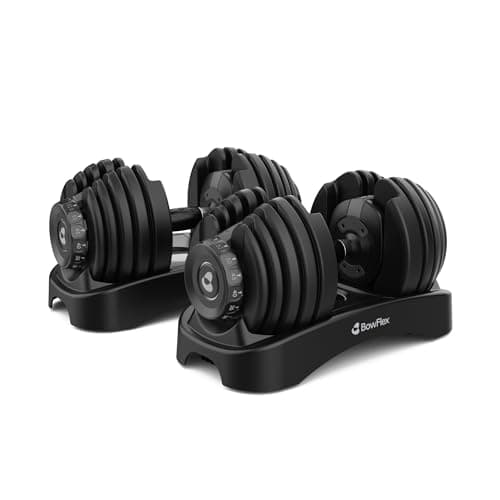
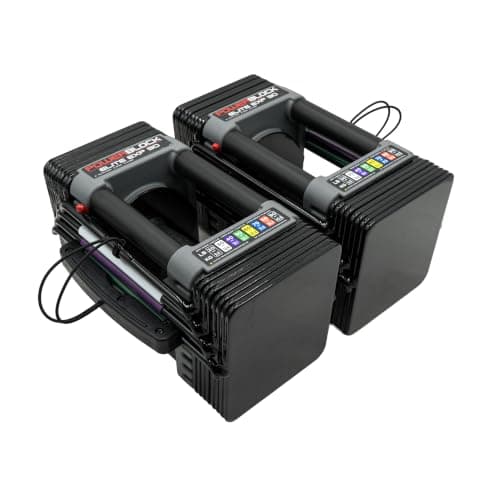
Buy the PowerBlock if durability is your first criterion — the pin-and-cage design has less to go wrong and it expands. Buy the BowFlex if the traditional dumbbell shape and the faster dial matter more to you than the mechanism. Both work. They are different bets.
The comparison in one table
| PowerBlock Elite EXP | BowFlex SelectTech 552 |
|---|
| Selector | Magnetic pin through a nested cage | Twin dials engaging plate teeth |
| Shape | Square block, handle inside the cage | Traditional dumbbell silhouette |
| Expandable | Yes — stage kits extend the range | No |
| Footprint | Compact, stacks squarely | Longer, needs its cradle |
| Drop tolerance | Poor — no adjustable likes being dropped | Poor — same |
| What fails | Pin and selector holes, eventually | Dial mechanism and plate teeth |
The mechanism is the product
This is the point we make in every adjustable dumbbell review and it is worth repeating: the iron in an adjustable dumbbell lasts forever. The selector does not. When people say an adjustable dumbbell "broke", they almost always mean the mechanism stopped engaging plates reliably.
PowerBlock uses a magnetic pin that drops through a stack of nested rectangular weight shells. It is mechanically simple — a pin in a hole — and the load path is through steel, which is why the design has survived largely unchanged for a long time.
BowFlex uses twin dials that rotate to engage teeth on the plates. It is faster to use and more pleasant in the hand, and it has more moving parts doing more work. The dials are the thing that eventually gets sloppy, and the failure mode people report is a plate not disengaging cleanly.
Shape: the difference you feel every session
The PowerBlock is a square block with the handle inside. It is compact, stacks tidily, and takes about one session to stop feeling strange. What it never quite does is behave like a dumbbell for movements where the weight needs to clear your body — some people never fully adapt to it for pressing.
The BowFlex looks and handles like a dumbbell, with the weight distributed along a familiar axis. The cost is length: at low weight settings the dumbbell is still full length, which makes some movements awkward in a way a fixed dumbbell would not be.
Expandability: the quiet advantage
PowerBlock's stage kits let you extend the weight range of the same handle later. For a buy-it-for-life buyer this is genuinely significant — it means outgrowing the dumbbells does not mean replacing them. The BowFlex is a fixed range; when you outgrow it, you buy something else.
That said, be realistic about whether you will outgrow 52.5 lb per hand. For most home lifters doing presses, rows and accessory work, that ceiling is a long way off, and the difference is theoretical.
Neither of them likes being dropped
This is the rule for the whole category. Adjustable dumbbells have mechanisms that are engineered to hold plates, not to absorb impact. Dropping a set from lockout will eventually cause a selector problem regardless of which brand you bought.
If your training genuinely involves failing on heavy dumbbell presses with nobody around, the honest answer is a pair of fixed hex dumbbells or a kettlebell — both are solid castings that do not care. That trade-off is covered in more depth in our adjustable dumbbell roundup.
So which one?
PowerBlock if you want the simpler mechanism, the smaller footprint, and the option to extend the range later. It is the more buy-it-for-life object of the two.
BowFlex if the traditional shape and the faster changeover are what will actually keep you training. A dumbbell you enjoy using is worth more than a marginally more durable one you do not.
And if neither budget stretches that far, our budget adjustable roundup covers the options that cost considerably less — with the compromises stated plainly.
If the BowFlex is not really in contention and what you are weighing is the block against the premium twist-handle set, that is the third edge of this triangle: NÜOBELL vs PowerBlock Elite.