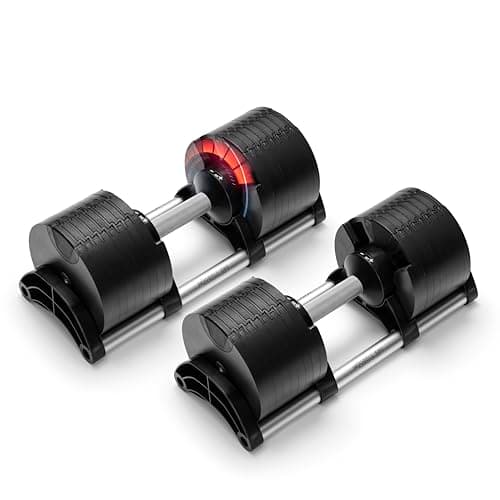
The NÜOBELL is the adjustable dumbbell that feels most like a fixed dumbbell, and it costs accordingly. If you press often and the shape of the tool matters to you, it is worth the money. If you do not, it is not.
What makes it different
Almost every adjustable dumbbell asks you to put it down in a cradle and set the weight there. The NÜOBELL uses a twist handle: you rotate the handle to select the weight, and the plates you do not want stay behind in the stand. The changeover is fast, and — more importantly — the assembled dumbbell is compact rather than full length at low weights.
That compactness is the actual product. A 20 lb setting on a long-bodied adjustable is a strange object to press; a 20 lb NÜOBELL is close to a 20 lb dumbbell. For anyone doing a lot of pressing, rowing and single-arm work, that difference shows up every session.
The construction question
The reason to talk about this one on a durability site is materials. Where most adjustables use substantial polymer housings around the mechanism, the NÜOBELL uses more metal in the parts that carry and select load. Metal-on-metal engagement is generally the more permanent arrangement — provided the tolerances are good, which is what you are paying for.
That is a relative claim and it needs its limits stated. We have not disassembled one and we are not going to pretend otherwise — but published teardown-level reviews describe the connecting pieces, the locking mechanism and the weight-selection device as containing a good deal of plastic, and identify the hard plastic joining the steel plates as the weak point under load moved at speed. "More metal than most" is not the same as "metal throughout", and on a site that ranks on what fails first the distinction matters.
What that changes in practice: the failure reports in this category concentrate on selection mechanisms not engaging cleanly, and a mechanism with fewer plastic load-bearing parts starts from a better position — but no adjustable in this class is a dumbbell you set down carelessly. The published warranty is two years, extended to four when the set is bought direct from NÜO Athletics, which is the longest named term in the category and tells you the maker expects the mechanism to be the thing claimed on.
What will wear out
- The twist mechanism.Every adjustable's eventual failure point. Keep grit out of it, do not force it, and always change weight with the dumbbell seated properly in the stand.
- The plate engagement surfaces. Where the handle meets the plates. Repeated selection under load — that is, twisting while the dumbbell is partly lifted — accelerates this dramatically. Do not do that.
- The stand. Usually the least durable component in any adjustable dumbbell system, and rarely mentioned. Look after it: without a working cradle the dumbbells are unusable.
- The plates themselves. Effectively never. It is metal.
The honest case against
It is expensive. Several times the price of a budget adjustable and a clear step above the mainstream options we compare in BowFlex vs PowerBlock. For that money you could buy a decent bench and a set of iron plates instead.
It also shares the category's hard limit: you cannot drop it. No adjustable dumbbell tolerates being dropped from lockout, and paying more does not change that. If your dumbbell work involves going to failure alone on heavy presses, fixed dumbbells or kettlebells remain the durable answer.
And the mechanism, however well made, is still a mechanism. Measured strictly by how long it will last, a rack of fixed dumbbells beats every adjustable ever made. Adjustables win on space and cost per pound of range, not on permanence — which is the trade our durability guide asks you to make with your eyes open.
Who should buy it
Someone who trains dumbbell movements regularly, has limited space, wants the tool to feel like a real dumbbell, and intends to keep it for a decade rather than a season. Under those conditions the cost per year is reasonable and the daily experience is materially better than the cheaper options.
Someone doing occasional accessory work should buy a budget pair and put the difference into the parts of the gym that genuinely last forever.