Skip to content
Plate&Rack

The method · Buy It For Life Guides

The Best Home Gym Flooring

Flooring is not a comfort purchase — it protects the slab, the plates and the bar. We rank on what each surface actually survives, not on how it looks.

By Stephen V.Updated How we choose
#ad

We earn a commission when you buy through our Amazon links, at no extra cost to you. It never affects our rankings, and we say so when the cheaper product is the better buy. How this works.

Put solid rubber where the bar lands, rubber-top tiles under the rack, and foam only where nothing heavy will ever touch it. Almost every flooring complaint traces back to using one material for all three jobs.

Flooring has three separate jobs

People shop for "gym flooring" as though it were one product. It is three, and they have different requirements.

  • Impact zone. Where a loaded bar or a kettlebell lands. Needs mass and elasticity — that means solid rubber, ideally 3/4 inch.
  • Equipment zone. Under the rack and the bench. Needs compression resistance so feet do not sink in and leave permanent dimples. A rubber-topped tile with a dense core does this well.
  • Everything else. Walking, stretching, floor work. Comfort matters, impact does not. This is where cheap foam is genuinely the right answer.

Buying one material for all three either wastes money (solid rubber wall-to-wall) or fails fast (foam under a rack). Split the room.

What we rank on

  • Construction. Solid vulcanized rubber, rubber-top over a dense foam core, or plain EVA foam. This single fact predicts almost everything else about how the floor will age.
  • Thickness. Meaningful only in context — 1/2 inch of foam and 1/2 inch of rubber are completely different products. For dropped weight, 3/4 inch of solid rubber is the reference point.
  • Compression recovery. Whether the surface springs back or takes a permanent dent from a rack foot. This is the spec that decides how the floor looks in three years.
  • Coverage per dollar. Flooring is bought by area. Cost per square foot is the honest comparison, and it varies by more than an order of magnitude across this page.
  • Install and edges. Interlocking tiles you can cut with a knife versus 100 lb mats that need two people. Both are fine; know which you are buying.

Why the concrete matters more than you think

A bare garage slab does three things to a gym. It destroys anything dropped on it. It transmits every set-down as noise through the structure. And — the one nobody mentions — it holds moisture, which is why iron plates stored on a slab rust from the bottom up and barbells left on the floor corrode at the sleeves.

Flooring solves all three at once, which is why we treat it as a durability purchase rather than a comfort one. The mat under your rack is protecting your equipment at least as much as your slab.

The horse stall mat question

The classic garage gym answer is 4 × 6 ft, 3/4 inch solid rubber stall mats — heavy, cheap per square foot, and effectively indestructible. They are still the right answer for a lifting platform, and the IncStores mat on this page is that product.

Two honest caveats. They are extremely heavy, so shipping and handling are real considerations. And new rubber has a strong smell that takes weeks to fade in an unventilated room — expect it, ventilate, and it does go away.

What thickness do you actually need?

For a rack, a bench and controlled lifting: rubber-top tiles around 1/2 inch are plenty. For deadlifts set down firmly: 3/4 inch solid rubber under the bar path. For dropping bumper plates from overhead: 3/4 inch solid rubber minimum, ideally on a plywood platform that spreads the load — and even then, expect the slab to take some of it.

No home flooring makes dropping iron plates onto concrete a good idea. If you drop weight, buy bumper plates as well as flooring — the two are a pair, not alternatives.

Installing it so it stays put

Interlocking tiles want a boundary. A run of tiles that ends in open floor will creep and lift at the edges over months; the same run boxed in by walls or trapped under a rack's base plates stays flat indefinitely. Plan the layout so the perimeter is constrained, or buy the edge trim pieces.

Solid mats do not need this — they are heavy enough to stay where you put them. What they do need is a flat surface underneath; laid over a badly uneven slab, they telegraph every high spot.

The short answer

Quick picks

#ProductBest forScorePrice
01
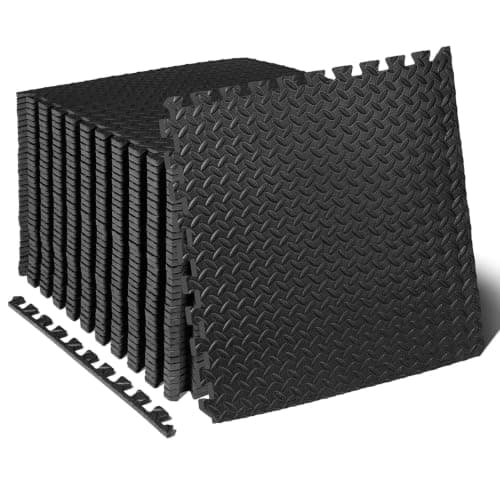
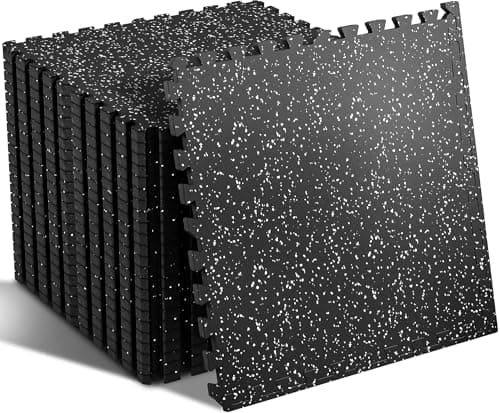
SUPERJARE SUPERJARE 0.56 in Rubber-Top Gym Flooring (48 sq ft)
SUPERJARE 0.56 in Rubber-Top Gym Flooring (48 sq ft)

Rubber where it matters over foam where it doesn't — the sensible middle of the flooring market.

Best home gym flooring overall
7.8
$89.99Amazon
02
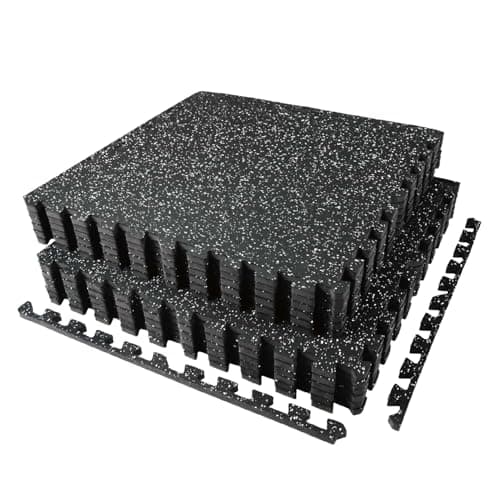
AIRHOP AIRHOP 0.56 in Rubber-Top Exercise Mats (48 sq ft)
AIRHOP 0.56 in Rubber-Top Exercise Mats (48 sq ft)

The same rubber-over-foam formula with a denser core — the pick if a rack is going to live on it.

Best under a rack
7.8
$99.99Amazon
03
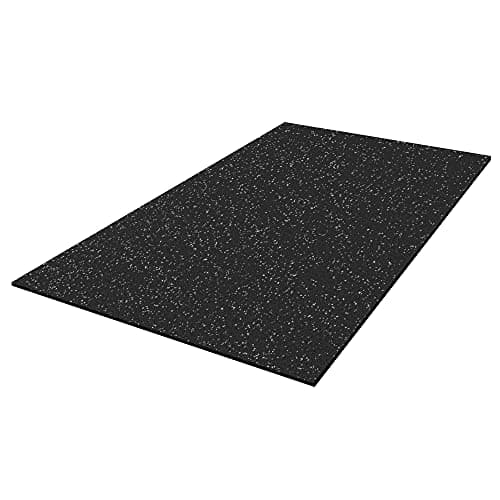
IncStores IncStores 4 × 6 ft Premium Rubber Gym Mat
IncStores 4 × 6 ft Premium Rubber Gym Mat

Solid vulcanized rubber, the flooring that outlasts the gym on top of it. Buy this where the bar lands.

Best flooring for dropped weight
7.6
$176.61Amazon
04
ProsourceFit ProsourceFit ½ in EVA Interlocking Puzzle Mat (144 sq ft)
ProsourceFit ½ in EVA Interlocking Puzzle Mat (144 sq ft)

The cheapest way to cover a whole room — just don't ask it to catch a dropped plate.

Best budget floor coverage
7.6
$139.99Amazon

#ad · Live prices from the Amazon Product API, as of Sep 8, 2026. Where we have no verified live price, we show none — we would rather leave a gap than print a number that has rotted.

In detail

The picks, in full

01
SUPERJARE SUPERJARE 0.56 in Rubber-Top Gym Flooring (48 sq ft)

Best home gym flooring overall

SUPERJARE 0.56 in Rubber-Top Gym Flooring (48 sq ft)

0.56 in thick48 sq ft (12 tiles)Rubber top / foam coreInterlocking
7.8/10

Rubber where it matters over foam where it doesn't — the sensible middle of the flooring market.

Durability
7
Impact protection
7
Install
9
Coverage
8
Value
8

Pros

  • A rubber wear surface takes plate edges and rack feet far better than bare EVA foam
  • Interlocking tiles let you cover exactly the area under the rack rather than a whole room
  • 0.56 in is enough to protect concrete from set-downs without making a rack feel spongy

Cons

  • A foam core still compresses under rack feet over time — expect dents where the uprights sit
  • Not a dropping surface: repeatedly dumping loaded bars needs 3/4 in solid rubber, not a composite tile

Don't buy this if…

you deadlift heavy and drop the bar. Go straight to solid 3/4 in rubber mats under the lifting area; composite tiles will not survive it.

$89.99View on Amazon

$119.9925% off

Price as of Sep 8, 2026. Prices change — Amazon's is the one that counts.

#ad · we may earn a commission from this link to SUPERJARE 0.56 in Rubber-Top Gym Flooring (48 sq ft)

02
AIRHOP AIRHOP 0.56 in Rubber-Top Exercise Mats (48 sq ft)

Best under a rack

AIRHOP 0.56 in Rubber-Top Exercise Mats (48 sq ft)

0.56 in thick48 sq ft (12 tiles)High-density EVA core24 × 24 in tiles
7.8/10

The same rubber-over-foam formula with a denser core — the pick if a rack is going to live on it.

Durability
8
Impact protection
7
Install
8
Coverage
8
Value
8

Pros

  • A high-density core resists the permanent dimpling that rack feet leave in softer tiles
  • 24 × 24 in tiles make the math easy — twelve tiles is a clean 8 × 6 ft platform
  • Rubber top wipes clean, which matters more than anyone expects in a home gym

Cons

  • Heavier and stiffer to cut than plain foam if your space needs trimmed edges
  • Interlocking edges can lift at the perimeter unless the run is boxed in by walls or equipment

Don't buy this if…

you need a cheap surface for bodyweight and yoga only. Plain EVA puzzle mats cost a fraction and are more comfortable to lie on.

$99.99View on Amazon

$119.9917% off

Price as of Sep 8, 2026. Prices change — Amazon's is the one that counts.

#ad · we may earn a commission from this link to AIRHOP 0.56 in Rubber-Top Exercise Mats (48 sq ft)

03
IncStores IncStores 4 × 6 ft Premium Rubber Gym Mat

Best flooring for dropped weight

IncStores 4 × 6 ft Premium Rubber Gym Mat

4 × 6 ft matSolid rubberCommercial-gradeSingle mat
7.6/10

Solid vulcanized rubber, the flooring that outlasts the gym on top of it. Buy this where the bar lands.

Durability
10
Impact protection
10
Install
6
Coverage
5
Value
7

Pros

  • Solid rubber, not foam with a rubber skin — the only construction that genuinely survives dropped loaded bars
  • Commercial-grade material with a service life measured in decades, not years
  • A 4 × 6 ft mat is the standard lifting-platform module; two side by side make a full platform

Cons

  • Extremely heavy — moving one is a two-person job, and shipping cost reflects that
  • New rubber has a strong smell that takes weeks to fade in an unventilated room

Don't buy this if…

you need to cover a whole room on a budget. Solid rubber is the wrong tool for wall-to-wall coverage; use it under the rack and tiles elsewhere.

$176.61View on Amazon

$189.997% off

Price as of Sep 8, 2026. Prices change — Amazon's is the one that counts.

#ad · we may earn a commission from this link to IncStores 4 × 6 ft Premium Rubber Gym Mat

04
ProsourceFit ProsourceFit ½ in EVA Interlocking Puzzle Mat (144 sq ft)

Best budget floor coverage

ProsourceFit ½ in EVA Interlocking Puzzle Mat (144 sq ft)

½ in thick144 sq ft (36 tiles)EVA foamInterlocking
7.6/10

The cheapest way to cover a whole room — just don't ask it to catch a dropped plate.

Durability
5
Impact protection
4
Install
10
Coverage
10
Value
9

Pros

  • 144 sq ft covers an entire small garage bay for less than a few square feet of solid rubber
  • Light enough that one person can lay the whole floor in an afternoon and cut it with a utility knife
  • Comfortable for floor work, stretching and bodyweight training

Cons

  • EVA foam only — plate edges gouge it and rack feet sink into it permanently
  • Foam absorbs sweat odor over years in a way a rubber surface does not

Don't buy this if…

a loaded rack or dropped plates will land on it. Foam is a comfort layer, not an impact layer; put rubber under the lifting zone and use foam for the rest.

$139.99View on Amazon

Price as of Sep 8, 2026. Prices change — Amazon's is the one that counts.

#ad · we may earn a commission from this link to ProsourceFit ½ in EVA Interlocking Puzzle Mat (144 sq ft)

How to buy gym flooring once

Map the room before you shop

Draw the rack, the bench and the bar path. Solid rubber goes under the bar path, dense tiles under the rack and bench, foam or nothing everywhere else. Buying to a plan is usually cheaper than buying one material wall to wall.

Compare cost per square foot, not per box

Boxes on this page range from 48 to 144 sq ft. The sticker price tells you nothing until you divide.

Do not put foam under a rack

A loaded rack's feet concentrate a lot of weight into four small areas. Foam takes a permanent set, and once it does, the rack sits in dimples and can rock. Use a dense rubber-top tile or put the rack directly on the slab.

Buy about ten percent extra

Cuts, edges and the tile you damage while fitting. Running out halfway through a floor and finding the product discontinued is a genuinely annoying way to lose a weekend.

Ventilate the new rubber

Fresh rubber smells strongly. Open the door, run a fan for a few days, and it fades. It is not a defect and it is not permanent, but it will be noticeable in a closed basement for a couple of weeks.
How we picked

We do not run a testing lab

We compiled manufacturer specifications, read the published warranties, checked the relevant standards and aggregated owner reviews, then scored each product against a published rubric. The scores are judgments from documented research — they are not measurements we took, because we do not run a lab and we are not going to pretend we do. Where a number came from a manufacturer or a standard, we name it and link it in Sources.

Questions

Frequently asked

What is the best flooring for a home gym?

It depends on the zone. Solid 3/4 inch rubber where weight lands, dense rubber-top interlocking tiles under the rack and bench, and cheap EVA foam only where nothing heavy will touch it. Using one material everywhere is what causes most flooring regret.

How thick should home gym flooring be?

Thickness only means something alongside the material. Around 1/2 inch of rubber-top tile is fine under a rack and for controlled lifting; 3/4 inch of solid rubber is the reference for dropped weight. Half an inch of plain foam is a comfort layer, not an impact layer.

Can I put a power rack on foam tiles?

It is not a good idea. A loaded rack concentrates weight into four small feet, and foam takes a permanent set — after which the rack sits in dimples and can rock. Use a dense rubber-top tile, a solid rubber mat, or put the rack straight onto the slab.

Are horse stall mats good for a home gym?

Yes — 4 × 6 ft, 3/4 inch solid rubber mats are the classic garage-gym platform and are effectively indestructible. Two caveats: they are very heavy to move, and new rubber has a strong smell that takes a few weeks of ventilation to fade.

Keep reading

Receipts

Sources

We do not run a testing lab, and we do not pretend to. Every spec, warranty term and standard above is the manufacturer's or a published source, cited and linked. Where we could not verify something, we say so on the page rather than quietly leaving it out. Read our full method.