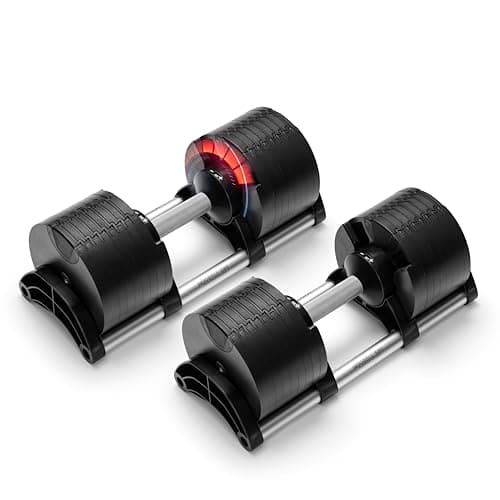
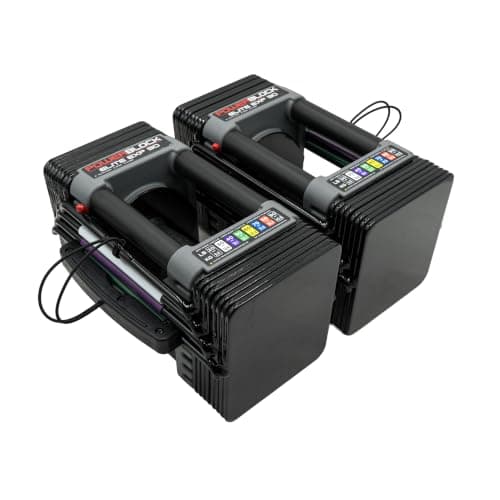
Buy the PowerBlock Elite EXP if you want the one that lasts: the steel block has no long protruding plates to bend, it is the most drop-tolerant adjustable we rank, it stores in the smallest footprint, and expansion kits take it from 5–50 lb to 70 and then 90 lb without rebuying the set. Buy the NÜOBELL if the feel in your hand matters more than that: a twist of the handle changes the weight, the loaded shape is closest to a fixed dumbbell, it goes to 80 lb out of the box, and it carries the longest named warranty in the category — 2 years, extended to 4 when bought direct from NUO Athletics. That is the whole decision, and on a site about equipment that outlives you the block wins on points. The NÜOBELL is still the better dumbbell to train with, and the plastic joining its steel plates is the documented weak point you are accepting in exchange.
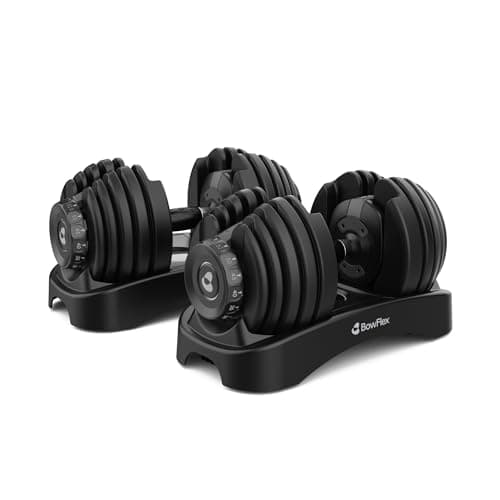
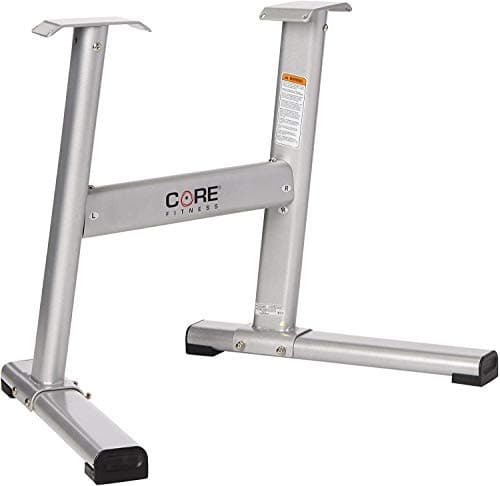
Two context picks sit below them: the BowFlex SelectTech 552 is the category default at 5–52.5 lb per hand with a dial, and the Core Home Fitness set is the mid-priced dial option that includes a stand. If you want the BowFlex compared directly against either of these two, that is NÜOBELL vs BowFlex 552 and BowFlex 552 vs PowerBlock Elite. This page is the third edge of that triangle.
The one difference everything else follows from
A NÜOBELL is built like a dumbbell: a handle with steel plates stacked either side of it, and twisting the handle releases the plates you are not using back into the cradle. A PowerBlock is built like a block: nested steel cages that sit around your hand, selected with a pin.
Every practical difference between them is downstream of that single choice.
- Feel. The NÜOBELL's mass sits either side of your hand, where a fixed dumbbell's does. The PowerBlock's surrounds your hand. Most people who dislike the block dislike it for this reason and nothing else, and it is genuinely an acquired taste rather than a flaw.
- Survivability. Long plates sticking out from a handle are a lever, and levers bend when a loaded dumbbell meets a floor. A block has nothing protruding, which is why it is the toughest adjustable we rank and the NÜOBELL is the one we tell you to set down rather than drop.
- Speed of change. A twist handle is faster than a selector pin. If you superset or drop-set, you will notice; if you take sixty seconds between sets anyway, you will not.
- Where the range goes. The NÜOBELL arrives at 80 lb. The PowerBlock arrives at 50 and is expandable to 70 and then 90 — a different purchasing shape: pay later, or pay now.
The four, side by side
| As published | PowerBlock Elite EXP | NÜOBELL | BowFlex 552 | Core Home Fitness |
|---|
| Weight range per hand | 5–50 lb (Stage 1) | 5–80 lb | 5–52.5 lb | 5–50 lb |
| Expandable | Yes, to 70 then 90 lb | No | No | No |
| Selection | Selector pin | Twist handle | Dial | Dial |
| Shape | Block, hand inside | Dumbbell, plates either side | Dumbbell with tray | Dumbbell with tray |
| Build | Steel block | Steel plates, plastic selector and joints | Dial and tray | Dial and tray |
| Named warranty | Not published on listing | 2 years, 4 if bought direct | Not published on listing | Not published on listing |
| Stand included | No | No | No | Yes |
| Storage footprint | Smallest of the four | Compact | Tray footprint | Stand footprint |
| Sold as | Check listing | Pair | Pair | Set |
Every cell is quoted from the manufacturer listing linked in Sources, and where a listing does not state a figure the cell says so. The row worth staring at is the warranty: only one of these four publishes a term, and on a product whose failure mode is a mechanism rather than a weight, that is the most useful line on the page.
What breaks on each
Neither of these fails as a weight. Steel does not wear out at the loads a home gym applies, and the plates in both will outlive the room. What fails is the part that makes them adjustable, and the two mechanisms fail differently.
On the NÜOBELL the documented weak point is the plastic joining the steel plates, plus the connecting pieces and the locking mechanism, which are substantially plastic. That is not a reason to avoid it — it is the reason it is a dumbbell you set down. Dropped from arm's length onto concrete repeatedly, it will eventually tell you about that plastic.
On the PowerBlock the fiddly part is the selector pin rather than a fragile one: slower to use, but there is no long plate to bend and nothing substantial in plastic. That is why it scores highest of any adjustable we rank on build and on drop-tolerance, and it is the single reason it takes the top slot on this page. The failure modes across the whole category are set out on how long adjustable dumbbells last, and what can be fixed afterwards on can adjustable dumbbells be repaired.
The range question is really a money question
The NÜOBELL starts where the PowerBlock stops: 80 lb against 50. For pressing and rowing that is a real difference, and anyone who will be rowing 70 lb within two years should take it seriously rather than plan to upgrade.
But the PowerBlock's answer is structurally different, and better for some buyers: the expansion kits take the same pair to 70 and then 90 lb, so you buy the range when you need it instead of at the start. If you are not sure you will ever need 80 lb, that is a cheaper and lower-risk path — and 90 is a higher ceiling than the NÜOBELL has at all. Where the whole category tops out is covered on the heaviest adjustable dumbbells.
Who should buy neither
Both of these are expensive, and the honest alternative is fixed dumbbells. A rubber hex set has no mechanism at all, costs less per pound, tolerates anything you do to it, and will still be usable in thirty years — at the price of a rack of them taking a wall. If you have the wall, the argument is strong, and it is made properly on adjustable vs fixed dumbbells and in are adjustable dumbbells worth it.
And if the budget is the binding constraint rather than the shape, neither of these is where to start — the cheaper end of the category is ranked on the best budget adjustable dumbbells.