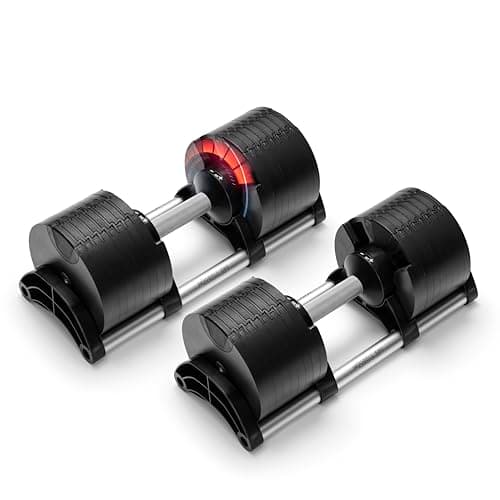
For almost every home gym, adjustables — the space and cost arithmetic is overwhelming. Fixed dumbbells win on durability and on speed between sets, and neither of those is a small thing. There is also a third option most people skip past, and it may be the most buy-it-for-life answer of the three. All of it turns on what the selector is and what it is made of, which is taken apart mechanism by mechanism in how adjustable dumbbells work.
The difference in one table
| Adjustable | Fixed set |
|---|
| Cost for a full range | One pair covers ~15 pairs | Every weight bought separately |
| Floor space | Two dumbbells and a tray | A rack the length of a wall |
| Speed between sets | Seconds to change | Instant — pick up the next pair |
| Failure points | The selector mechanism | Effectively none |
| Drop tolerance | Poor to moderate | High |
| Increment size | Usually 2.5–5 lb steps | Whatever you bought |
Why adjustables usually win
The arithmetic is not close. A single pair of adjustables spanning 5 to 80 lb replaces roughly fifteen pairs of fixed dumbbells. Buying that range in fixed form costs several times more and needs a rack that occupies a wall you probably wanted for something else.
For a home gym where floor space is the binding constraint — which is nearly all of them — that settles it. It is also why adjustables are the highest-value single purchase in a small gym, a point we make in the beginner setup guide.
Why fixed dumbbells are not wrong
Nothing on them can break
A fixed dumbbell is a lump of iron with a handle. There is no mechanism, no selector, no pin, no plastic. Left in a dry room it will outlive the building. Every adjustable dumbbell, by contrast, has a mechanism — and the mechanism is where they all eventually fail, as covered in how long adjustable dumbbells last.
Speed matters more than people admit
Drop sets, supersets and any circuit work involve changing weight constantly. An adjustable takes a few seconds each time and needs two hands. A fixed rack takes as long as reaching. If your training is high-density and metabolic rather than heavy and slow, this is a genuine training difference rather than a convenience preference.
You can actually drop them
Set a fixed dumbbell down hard and nothing happens. Do the same with most adjustables enough times and the selector starts to complain. If you train to failure with heavy dumbbells and need to be able to put them down urgently, that is a real consideration.
The third option: spinlock
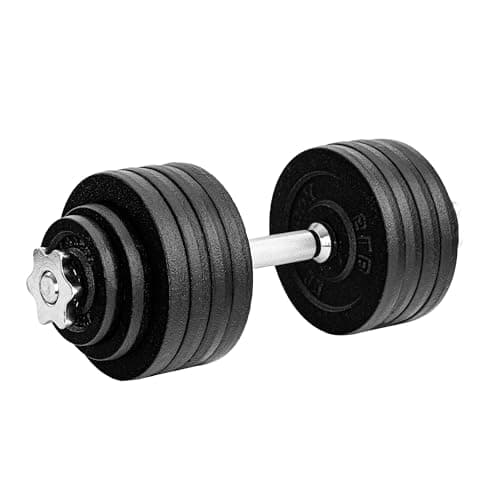
A spinlock dumbbell is a threaded handle with cast iron plates and screw-on collars. No selector, no mechanism, no plastic — the Yes4All is the one we rank.
Judged purely on durability it beats every selector-pin and twist-handle design, because there is nothing to fail. Judged on convenience it loses badly: changing weight means unscrewing a collar, sliding plates off, sliding new ones on and screwing the collar back down, twice.
It is the right answer for a specific person: someone who lifts in a low-tech way, changes weight rarely within a session, and genuinely intends to own this equipment for decades. That is a smaller group than the marketing for premium adjustables suggests, but it is not nobody — and on this site it deserves stating plainly rather than being dismissed as old-fashioned.
How to decide
- Small room, broad weight range needed, normal training: adjustables. This is most people. Start at the adjustable dumbbell roundup.
- Circuit, superset or drop-set heavy training: fixed, if you have the wall for it. The time cost of changing weight is not trivial in that style. Start at the hex dumbbell roundup.
- Durability above all, patient with weight changes: spinlock cast iron.
- Rough handling, concrete floor, still want adjustables: choose the most drop-tolerant design — the PowerBlock.
A common and sensible hybrid: one pair of adjustables for the working range, plus a couple of cheap fixed pairs at the weights you use constantly for warm-ups and accessories. You get the range without paying the time cost on the sets where speed matters most.
If you have read this far and still want the decision put as a yes or a no, with the four cases where adjustables are clearly right and the three where they are clearly wrong, that is are adjustable dumbbells worth it.