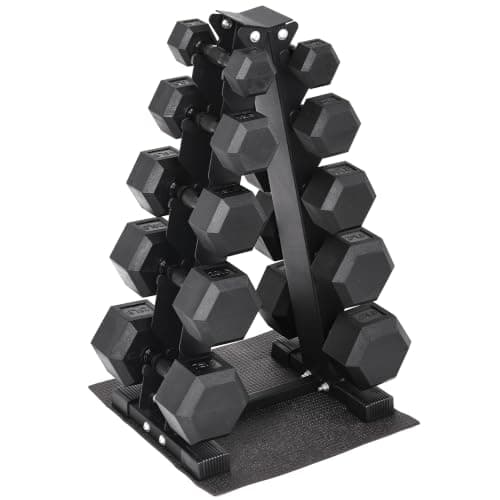
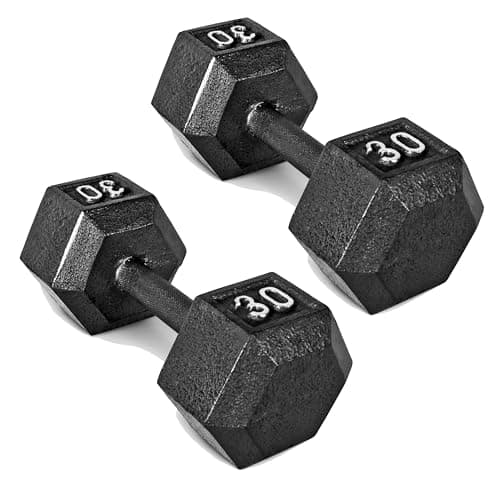
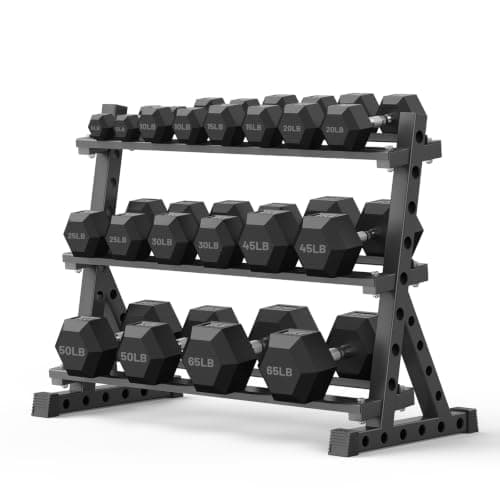
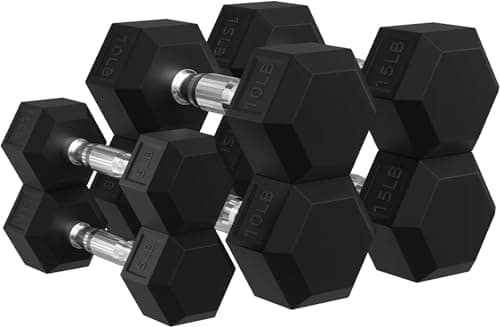
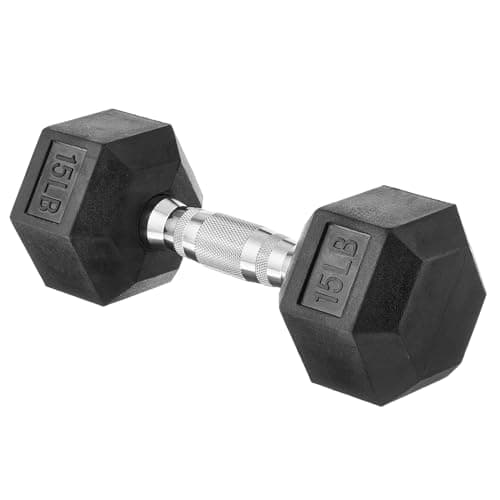
A fixed hex dumbbell is iron with a handle through it. No selector, no pin, no plastic tray, no mechanism of any kind — which makes it the closest thing to a permanent object anywhere in a home gym, and the only dumbbell we are willing to describe that way. So the buying decision is not really about durability. It is about the coating, the handle, and how the listing sells them to you: one at a time, as a pair, or as a set with a rack.
Why we are ranking these at all
The dumbbell hub ranks adjustables, and for most home gyms an adjustable is still the right answer. One pair replaces roughly fifteen pairs of fixed weights, and the space and cost arithmetic is not close. We say so plainly on adjustable vs fixed dumbbells and we are not walking it back here.
But that page concedes something this site had never followed through on: judged purely on how long the object lasts, a rack of fixed dumbbells beats every adjustable ever made. A site built around gear that outlives you had a strong opinion about the most durable dumbbell in existence and no page that ranked one. This is that page.
What a hex dumbbell actually is
A hex dumbbell is a fixed dumbbell whose heads are six-sided rather than round. The shape is not styling. A round head rolls, which is why round fixed dumbbells end up under the bench and why they need a cradle to sit still; flat faces stay where you put them, let you rest a dumbbell on its side mid-set, and stack against a wall without a rack in a way round heads never do.
From there the category splits on one thing: what is on the outside of the iron. Bare or painted cast iron, or iron encased in rubber. Almost everything else on a listing — the grip finish, the color, whether it arrives as a single or a set — is downstream of that one choice.
The four things that actually vary
The coating
Rubber encasement does three jobs: it protects your floor, it quiets the dumbbell down, and it keeps damp air off the iron. It has exactly one cost, and it is a slow one — rubber is a polymer, and polymers age. Given enough years, enough heat and enough direct sun, an encasement hardens and can split at the seam where it meets the handle. That is the only part of a hex dumbbell with any service life at all, which tells you how little there is to go wrong.
Bare cast iron has the mirror-image profile. Nothing on it can perish, and nothing on it protects anything either: it is louder, it marks floors, and it will grow surface rust in a humid garage in exactly the way cast iron plates do. That rust is cosmetic and reversible — the method is the same one on our rusty plate cleaning guide — but you will be the one doing it.
Neither answer is wrong. Rubber is the sane default for a finished room. Bare iron is the right call for a garage where noise and marks do not matter and you would rather own an object with no polymer in it at all.
The handle
The handle is where the comfort lives and where the cheap dumbbells give themselves away. Three things decide it: diameter (a thick handle taxes your grip before it taxes the muscle you meant to train), the clear length between the heads (too short and a large hand is jammed against the casting), and the finish — knurled, chromed, contoured or rubber-wrapped. Listings in this price bracket almost never publish handle diameter, so the honest thing to say is that you are buying a shape you cannot verify in advance. It is also the most common reason a budget dumbbell goes back.
Singles, pairs or a set
This is the decision that costs the most money and gets the least thought. A single is the cheapest unit and the most flexible — it lets you buy the pair of thirties you will actually use instead of a spread somebody else chose. A pair is convenient and priced accordingly. A set with a rack is the fastest route to a usable gym, and also the fastest route to owning three weights you never touch.
Read the listing carefully, because the same words do different work on different pages. Some quote a price per dumbbell and some per pair. Set listings often publish a total weight rather than the pair-by-pair split — where one does that, we say so in its cons rather than guessing at a breakdown we cannot see.
The rack
Fixed dumbbells live on the floor until you buy somewhere for them to live, and a floor covered in iron is a stubbed toe waiting to happen. A rack costs less than one heavy pair. If a set arrives with one, that is worth real money; if it does not, budget for it now rather than later. The options are in our dumbbell storage roundup.
What we rank on
- What the coating is, and what it costs you. Rubber buys quiet and a clean floor at the price of a polymer that eventually ages. Bare iron buys permanence at the price of noise, marks and surface rust. We score both, and we do not pretend one is universally better.
- How the listing sells them. Singles let you build the set you need; pairs and sets are convenient and less flexible. A category where the unit of sale changes the true price by a factor of two deserves to be ranked on it.
- What the listing actually publishes. Almost none of these publish a durometer, a handle diameter or a warranty term. Where a figure is missing we say it is missing. We would rather rank a product on four honest specs than five invented ones.
- Whether storage is solved. A set that arrives with a rack has answered a question the buyer had not asked yet. That is worth points.
- Cost per useful pound. Not per pound — per pound you will train with. A fifteen-pound pair you outgrow in a month is expensive whatever it cost.
The arithmetic nobody runs before buying
Fixed dumbbells are cheap per pound and expensive per range, and confusing those two numbers is how people end up disappointed. A pair of thirties is one purchase. A useful ladder — say 10, 20, 30, 40 and 50 — is ten dumbbells, three hundred pounds of iron, a rack and a stretch of wall. Priced by the pound that is some of the cheapest strength equipment you can buy after cast iron plates. Priced by useful weight range it is several times what one pair of adjustables costs.
That trade is the whole reason we do not tell everyone to buy these. Run it the way our cost per year page does and divide by the years you will own them. Fixed dumbbells have no wear parts, no replacement selector and no plastic cradle to crack, so the denominator is as long as you care to make it. Across twenty years the fixed set is very often the cheaper object. Across the first two, it never is.
Which weights to buy first
- Start with the weight you already row and press. Not the weight you want to press. One pair at your current working weight is more useful than three pairs of aspirations, and you will know within two sessions whether you like the handle.
- Add one pair up before you add one pair down. Progress needs somewhere to go. The light accessory weights get used, but they never become the reason you keep training.
- Buy the light end as a set, not as singles. Five, ten and fifteen pounds are the weights nobody wants to order one at a time, and a small three-weight set is usually cheaper than the same weights bought individually. If the light end is the whole purchase — a light start, small steps, nothing to dial — that case is ranked on its own in the best dumbbells for seniors.
- Stop before you have built a commercial rack. Past roughly five pairs the floor space, the rack and the money all start arguing for a barbell plus one pair of adjustables instead. If your reason for buying fixed is that adjustables stop too light, read the heaviest adjustable dumbbells first — the ceiling may be higher than you think.
The reason a hex set is the buy-once answer in this category is that there is nothing in it to fail: the coating is the only part with a clock on it, and a cracked coating still leaves you a working cast iron dumbbell. The type-by-type reckoning is on how long dumbbells last.
How to read a hex dumbbell listing
Four details decide whether the number on the page is the number you think it is, and every one of them is easy to skim past.
- Single or pair. The Amazon Basics listing here is explicitly a single; the CAP listing is explicitly a pair. Two listings that look similarly priced can differ by a factor of two for that reason alone.
- Which weight is priced. These are weight-variant listings: one page, many weights, a different price behind each one. The live price on this page is the price of the variant the Amazon API returned when it last ran, and it moves as soon as you select a different weight. Treat it as a bracket, not a quote.
- Coated or bare."Rubber hex" and "cast iron hex" are different products with different consequences for your floor, your ears and your rust. The title usually says which; if it does not, assume bare.
- Set total against set split. A set advertised at 150 lb or 530 lb leads with the total, not the ladder. Find the pair-by-pair breakdown before you order — some listings spell it out and some do not — because the total says nothing about whether the heaviest pair is any use to you.
What actually wears out
Very little, which is the point of the category. Rank the consumables and the list runs out fast: the rubber encasement is the only component with a real service life, hardening and eventually splitting at the handle seam after many years of heat and sun; the handle finish wears where your hands live, and on a chromed handle that patch can surface-rust; and painted bare iron chips wherever two heads knock together. That is the entire list.
Compare that with the failure list on an adjustable — selectors that stop engaging, cradles that crack, plate retention that develops play — set out in how long adjustable dumbbells last, and the durability argument makes itself. Our equipment lifespan reference puts fixed iron in the same tier as plates and kettlebells: things with no parts, which only ever develop reversible surface rust.
Maintenance, in full: keep them off a damp concrete floor, wipe the handles after sweaty sessions, and if bare iron starts to bloom, take the rust off and wax it. There is no annual service, because there is nothing to service.
Floors, noise and the people below you
Fixed dumbbells are dense, heavy and dropped more often than their owners admit, and that makes the floor part of the purchase. Bare iron on tile chips the tile; bare iron on sealed concrete leaves a gray smear; bare iron on laminate is a repair bill. Rubber encasement fixes most of that, and a mat fixes the rest — the same reasoning as the home gym flooring roundup, where the mat is cheaper than the thing it protects every single time.
Noise is a separate problem with the same solution. A 50 lb dumbbell set down on concrete is loud through a whole building; the same dumbbell on rubber over concrete is a thud. If you train in an apartment or over somebody's bedroom, buy coated heads and put something under them, and set weights down rather than dropping them regardless of what is on the floor.
The hybrid nearly every home gym ends up with
For what it is worth, the arrangement we see settle in most often is not a full fixed set at all. It is one pair of adjustables covering the working range, plus two or three cheap fixed pairs at the weights used constantly for warm-ups, rear delts and finishers. You get the range without paying the time cost on the sets where speed matters, and the fixed pairs are the part you will still own in thirty years.
If that describes you, buy the fixed pairs as singles at the exact weights you use, skip the set, and put the saved money toward a rack so none of it lives on the floor. If instead you want the whole wall in one delivery and you already know you will use it, the sets ranked above exist for exactly that, and they are the honest way to buy them.