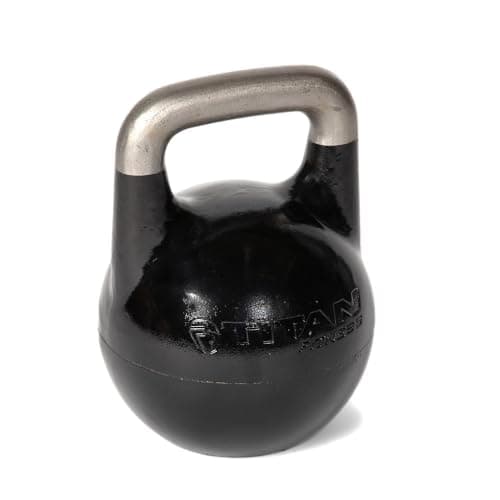
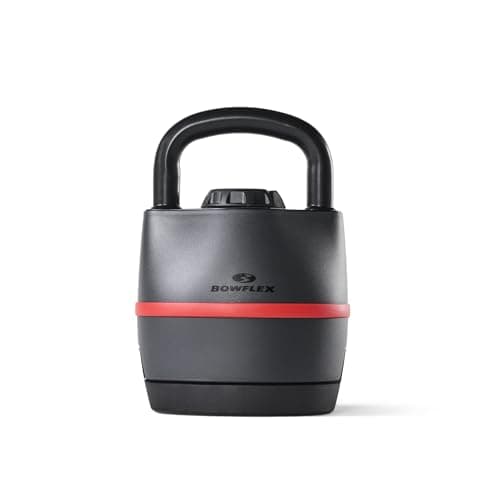
Buy the BowFlex SelectTech 840 if you want one bell you will actually change mid-workout: six published settings from 8 to 40 lb, a dial instead of a tool, and the only named warranty term on this page at 2 years on parts. Buy the Titan 12-32 kg competition-style bell if you are strong enough to need 70 lb and fine setting the weight once per session — it is cast iron, it publishes a 35 mm handle, and its six plates let you land on nearly any kilo in the range. If you only need two or three weights and you intend to drop the bell, stop reading and buy fixed cast iron instead — the reasoning is below.
The one thing to understand before buying
A kettlebell is normally the most durable object in a home gym. It is a single casting with a handle, there is nothing to adjust, nothing to lubricate and nothing to wear out; a cast bell bought today will outlive the house it is in. That is why kettlebells sit in the near-permanent tier of our home gym equipment lifespan reference.
An adjustable kettlebell is not that object. It is a weight stack plus a mechanism, and the mechanism is the product. The plates and the shell will last as long as any casting; the dial, the locking collar or the quick-lock is what decides whether you own the bell in ten years. This is exactly the trade adjustable dumbbells make, and the failure modes are the same ones we document in how long adjustable dumbbells last: forced while not seated, dropped on the mechanism, or a plastic cradle cracked.
So the honest frame for this page is not "which adjustable kettlebell is best built" — all of them are built around a compromise. It is "given that you want one object instead of four, which mechanism gives up the least."
What we rank on
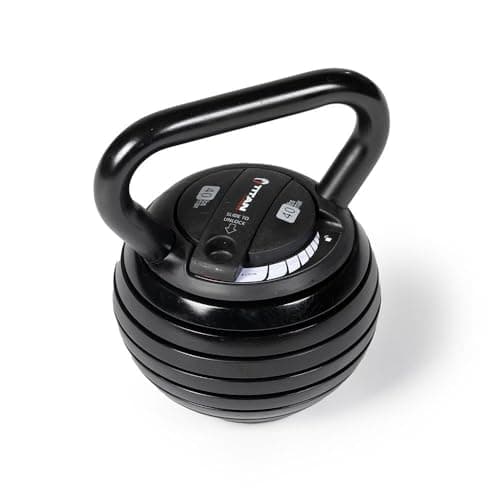
- The selector, and how it is operated. A dial changes weight in a second with one hand. A quick-lock takes a few seconds and both hands. A hex key and wrench means you set the weight for a session. Faster is better for training; fewer parts is better for lifespan, and those pull in opposite directions.
- Whether the handle is published. Handle diameter decides grip comfort, whether the bell suits two-hand swings, and whether it tears your hands on volume. Two picks here publish it (35 mm and 28 mm); the rest do not, and we do not guess.
- Range and step size. A bell that stops at 40 lb and a bell that reaches 70 lb are for different lifters. Equally important is how many usable stops there are between the ends.
- Whether the shape changes. A fixed-shell dial bell feels the same at every setting. A plate-loaded bell gets physically smaller as plates come off, which changes how it sits against your forearm in a rack position.
- Warranty and brand channel. On a product whose mechanism is the failure point, a named warranty term and a brand that sells parts are worth more than a spec. Only three of the five publish a term at all.
The five, side by side
| Pick | Range | Steps | Adjustment | Handle (published) | Warranty |
|---|
| BowFlex SelectTech 840 | 8–40 lb | 6 settings: 8, 12, 20, 25, 35, 40 lb | Dial, no tools | Not published | 2 years, parts |
| Titan 12–32 kg competition style | 12–32 kg (26–70 lb) | 6 plates: 2, 2, 3, 3, 4, 6 kg — near 1 kg resolution | Hex key and wrench | 35 mm dia., 190 mm wide | 1 year |
| Titan 10–40 lb | 10–40 lb (10 lb core) | 6 plates, 4.6–6 lb each | Quick-lock | 28 mm dia., 7 in wide | 1 year |
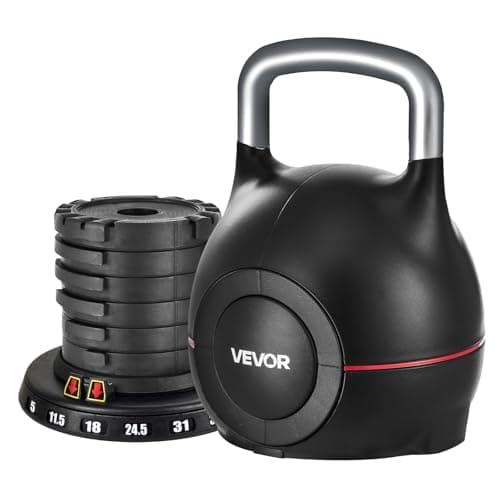
| VEVOR adjustable | 5–44 lb | 7 levels | Not published | Not published | Not published |
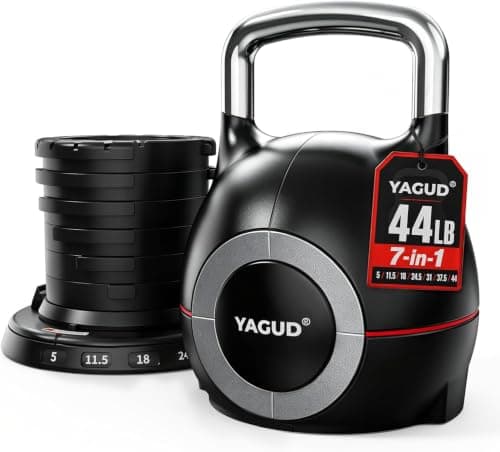
| Yagud adjustable | Up to 44 lb | 7 levels | Not published | Not published | Not published |
The BowFlex and both Titan figures are quoted from the manufacturers' own spec pages, read on 2026-10-04 and linked in Sources. The VEVOR and Yagud rows are what their Amazon listings publish, which is the range and the level count and nothing else — the empty cells are the finding, not an omission.
Why the BowFlex ranks first with the smallest range
It wins on the thing you do most: changing the weight. Kettlebell training lives on ladders and complexes — a set of swings, then presses at a lighter weight, then swings again. A bell that takes a hex key for that is a bell that quietly gets left on one setting, and a bell left on one setting is a fixed kettlebell you overpaid for.
It also publishes the only real warranty term here. On a product where the mechanism is the thing that ends the product, two years on parts from a brand with the largest installed base in adjustable weights is a meaningfully different proposition from a marketplace listing with no stated term. That is the same argument that puts the BowFlex 552 near the top of the adjustable dumbbell rankings.
What it gives up is honest and significant: a 40 lb ceiling it cannot exceed, and jumps of 8 and 10 lb at the top of its range where a plate-loaded bell steps in 2 to 6 lb increments. Anyone swinging a 40 lb bell comfortably today will want a heavier one within a year.
Why the heavy Titan is the pick for a stronger lifter
Titan sells a 12 kg cast iron shell with six plates — 2, 2, 3, 3, 4 and 6 kg — which is the published breakdown that makes the bell interesting. Six plates in those denominations combine to hit nearly every kilogram between 12 and 32, so you are not choosing between six fixed stops. For a 70 lb ceiling at this price, nothing else here is close.
It also publishes the two grip numbers that matter — a 35 mm handle diameter and a 190 mm handle width — which is competition-bell territory, suited to two-hand swings and chalked grip work. The wider conversation about 33 to 35 mm competition handles versus cast handle sizing is in cast iron vs competition kettlebells.
The cost is a hex key and a wrench. You will set this bell at the start of a session and leave it there, which is fine for a program built on one or two working weights and useless for ladders. Six loose plates also need a home: this is the one bell here that creates a small storage problem of its own, and the storage rankings apply.
The honest case for buying fixed cast iron instead
For a lot of people reading this page, the right purchase is not on it. Two or three fixed cast iron bells — say a 26 lb, a 35 lb and a 53 lb — cost about what the better adjustables here cost, have no mechanism, can be dropped on a rubber floor, can be used by two people at once, and will still be exactly as good in thirty years. They are ranked in the best kettlebells, and the starting-weight question is answered in what kettlebell weight to start with.
Three things decide it. Do you need to drop the bell? Snatches, heavy swings and anything where a failed rep ends on the floor are the normal case for kettlebell work, and no adjustable on this page is built to be dropped. A dropped cast bell chips paint; a dropped adjustable is a warranty claim. How many weights do you really use? Most kettlebell programs run on two or three. An adjustable earns its mechanism when you need six. How tight is the floor space? If three bells genuinely do not fit, that is the case for an adjustable, and it is a good one — it is the same logic that makes adjustable dumbbells the right call in an apartment home gym.
We make the general version of this argument at length in adjustable vs fixed dumbbells, and it lands the same way here, only harder — because kettlebell technique involves more dropping than dumbbell training does.
What we did not rank, and why
Kettlebell handle converters. There is a whole category of grips that clamp around a stack of standard weight plates or a dumbbell to make a kettlebell shape. They are cheap and they work for carries and light swings, but the load path runs through a clamp onto a plate stack rather than through a casting, and the shape sits differently in the rack position than a bell does. On a site about equipment that outlives you, a clamp holding 40 lb overhead is not a recommendation we are willing to make. If you already own standard 1 in plates, it is a legitimate way to try the movement pattern for very little money — it is not a kettlebell you keep.
Bells we could not verify as purchasable. Several well-regarded adjustable kettlebells from specialist strength brands were checked for this page and were not showing available stock when it was written. We do not rank equipment we cannot confirm you can buy today, which is why the field here is five and not eight.
Living with an adjustable kettlebell
Four habits make the mechanism last, and they are all the same habit: stop treating it like a casting.
Set it down, never drop it. Hinge and place the bell on the floor. The mechanism is at the top of a tall object with a lot of mass below it, and a drop drives the plates against the lock.
Check the lock every time, and check it loaded. Lift the bell a few inches by the handle and give it a shake before the first swing. A plate that is seated but not locked is the one failure that hurts.
Keep the plates in order. Both plate-loaded Titans number their plates for an assembly order; out of order the stack sits wrong and the lock takes the load unevenly.
Put rubber under it. A tile or mat under the bell turns an accidental knock into a thud rather than a cracked housing, and it protects the floor from a bell that is narrower and heavier per square inch than a dumbbell. The flooring guide covers the options.
Where this fits in a wider gym
One adjustable bell plus a bench covers a surprising amount: swings, presses, rows, carries, goblet squats and single-leg work. What it will not do is let you load a squat or a deadlift heavy, and that is the point at which a bar and a rack stop being optional. If the room is the constraint — a basement, a garage with a low roof — the short-frame options are ranked in the best power racks for low ceilings, and the staged order to buy a whole gym in is in the best home gym equipment for beginners.
How to choose
Count the weights you will actually use this year
Two or three means buy fixed cast iron. Five or six, or two people of different strength sharing one bell, is the case for an adjustable — and then the widest span wins, which is why the 5 to 44 lb VEVOR earns a place despite publishing the least.
Decide whether you change weight mid-session
If yes, you need a dial or a quick-lock and you should rule out the hex-key bell immediately. If you train one working weight per session, the tool is a non-issue and you should buy on range and steel instead.
Prefer a published handle diameter
28 to 35 mm is the usable band, and the number tells you whether the bell suits one hand, two hands or chalked volume work. A listing that does not publish it is asking you to buy a grip sight-unseen on the one piece of equipment that lives entirely in your hand.
Read the warranty as a statement about the mechanism
The plates do not need a warranty; the selector does. A named term — two years, one year — tells you the maker expects to stand behind the part that fails. No stated term on a mechanism-based product is information.
Do not buy an adjustable for the heaviest weight on the box
Buy for the range you will train in for the next year. A 70 lb ceiling is only worth paying for if you are heading there; otherwise it is money spent on headroom plus a bell that is more awkward to move and store.