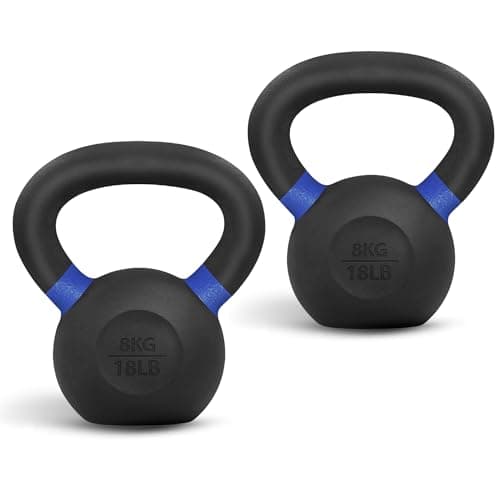
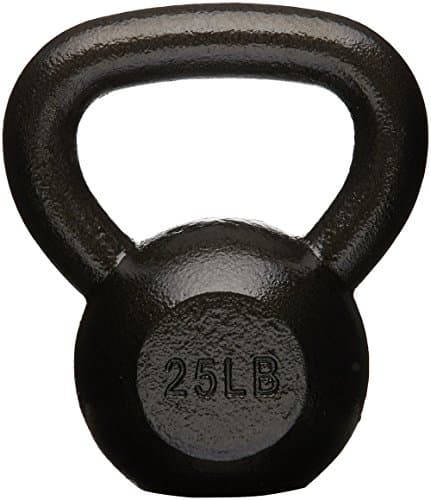
Pick the weight for the swing, not the press. The swing is the movement you will do most, it is a hip movement rather than an arm movement, and it wants far more weight than people expect. In practice that means most beginners are best served by a 16 kg (35 lb) bell, and many smaller or less experienced lifters by 12 kg (26 lb).
The reason this question matters on a buy-it-for-life site is that a kettlebell is close to a permanent object — a single-piece iron casting with nothing to wear out. Buying the wrong one is not a durability failure, it is a sizing failure, and it is the only way this purchase goes wrong. The same sizing question for dumbbells has a different answer, because a dumbbell range can be bought rather than guessed: what dumbbell weights should I buy.
Why the swing decides it
A kettlebell program is mostly swings, and a swing is a hinge driven by the hips and glutes — the strongest muscles you have. Loading it like a dumbbell exercise, where the arms are the limit, gets you a bell that is far too light to produce the hip drive the movement is for.
The presses, get-ups and windmills that the same bell will be used for are all much weaker movements. So you have a choice: size for the strong movement and accept that the pressing work starts hard, or size for the weak movement and end up with a bell that is useless for swinging within weeks. Every experienced kettlebell coach makes the same choice, and it is the first one.
The standard starting weights
Kettlebells are sold in metric increments for historical reasons — the sizes come from Russian weightlifting, where the pood (about 16 kg) was the base unit. That is why 8, 12, 16, 24 and 32 kg are the sizes that exist everywhere and why the gaps between them are large.
| Bell | Approx. | Who it suits as a first bell |
|---|
| 8 kg | 18 lb | Rehabilitation, get-up practice, or a genuinely deconditioned starting point |
| 12 kg | 26 lb | Common first bell for smaller or untrained lifters; light for swings within months |
| 16 kg | 35 lb | The default first bell for most untrained adults who lift at all |
| 20–24 kg | 44–53 lb | A reasonable first bell for someone already strength training with a barbell |
| 32 kg | 70 lb | Not a first bell. This is where a serious swing program ends up |
If you are already squatting and deadlifting with a barbell, size up rather than down. A 16 kg bell will feel trivial for swings within weeks, and there is no gentle way to add 4 kg to a kettlebell — you buy another one.
The test that settles it
If you can try bells before buying, use this: with the bell you are considering, can you do ten two-handed swings where the hips clearly drive the bell to chest height, and can you press it overhead at least once? If the swings feel easy and the press is hard, that is correct — that is what a well-sized first bell feels like.
If you cannot press it at all, it is probably a size too big for a first bell, though it will be the right swing bell soon. If the swings feel effortful in the arms rather than the hips, it is too heavy and your technique is compensating.
What to buy second, and in what order
Do not buy a full ladder up front — that is the advice we give on the kettlebell roundup too, and it is the single biggest money saver here. A three-bell collection covers a serious program for years:
- Your starting bell, sized for swings.
- One size up — bought when swings with the first bell stop being challenging, typically within a few months.
- One size down, if and only if you want a dedicated pressing and get-up bell. Many people never need this.
Note that the order is up first, then down. The swing progresses fastest, so the heavier bell is the one you will actually use.
Should you just buy an adjustable kettlebell?
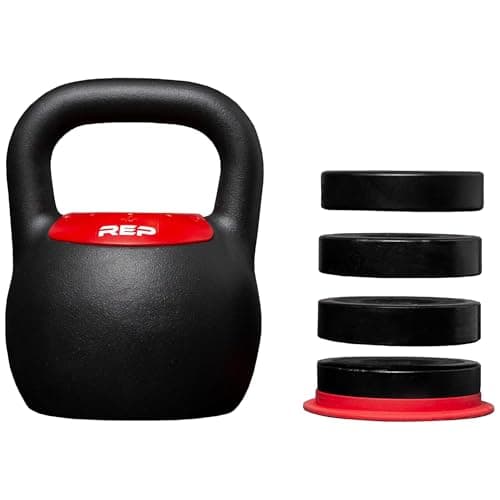
It solves the sizing problem completely, and it is a real option — one bell covering the range means you cannot buy the wrong weight. What you give up is what you always give up on this site: an adjustable bell has a mechanism, and a single-piece cast iron bell does not.
The specific concern with an adjustable kettlebell is that a kettlebell gets swung, dropped and rested on its base far more roughly than a dumbbell does, and the handle-to-body joint is carrying all of that. If you are certain you want kettlebell training and want to skip the sizing question, it is a reasonable buy. If you want the thing that will still be in the room in thirty years, buy cast iron — the argument is in cast iron vs competition kettlebells. If you have decided an adjustable is the right trade for your floor space, the five worth considering are ranked on their mechanisms in the best adjustable kettlebells.
Two things that matter more than the exact number
The handle. Width, thickness and the smoothness of the finish decide whether the bell is usable for two-handed swings and whether it tears your hands. A wide handle takes two hands comfortably; a rough casting seam does not. This is worth more attention than a 2 kg difference in weight.
The base. A flat, wide base means the bell stands up for renegade rows and does not rock. It also means it sits on the floor without pivoting onto an edge.
Both are covered in detail on the kettlebell roundup, and both survive the entire life of the bell — which, for a solid iron casting, is effectively forever.