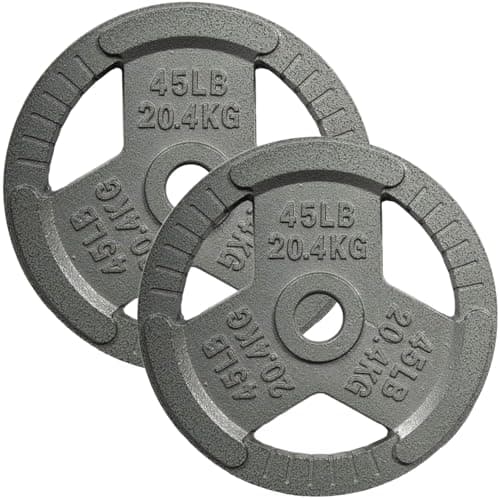
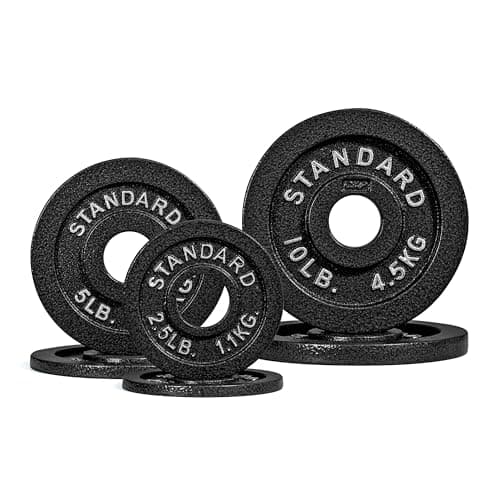
Buy Olympic. The 2 inch hole is the standard every serious bar, rack attachment and plate tree is built around, and it is the only one with a real upgrade path. Standard 1 inch plates are cheaper up front and a dead end — the most expensive kind of saving there is.
The difference in one table
| Olympic | Standard |
|---|
| Center hole | 2 inches (50 mm) | 1 inch (25 mm) |
| Bar sleeve | 2 inch rotating sleeve | 1 inch fixed shaft |
| Typical bar weight | 44 lb / 20 kg full size | Usually much lighter |
| Bar capacity | Commonly 500–1,500 lb published | Usually a few hundred pounds |
| Accessory ecosystem | Racks, trees, collars, landmines, curl bars | Sparse and shrinking |
| Resale | Strong — always in demand | Weak |
How to tell which you own
Measure the hole in a plate, or the sleeve on your bar. Two inches is Olympic; one inch is standard. A quick shortcut: if the ends of your bar spin independently of the shaft, it is almost certainly Olympic. If the bar is one continuous rod with threaded ends and screw-on collars, it is standard.
A second clue is weight. A full-size Olympic bar is 44 lb / 20 kg and is 7 ft long. Standard bars are lighter and usually shorter. If your "barbell" feels light in your hands empty, check before you buy plates.
Why Olympic wins for almost everyone
The bar is genuinely better
An Olympic bar has rotating sleeves, a real published tensile rating, and a knurl designed for lifting. A standard bar is a solid rod. Under a heavy load, that difference is not cosmetic — the rotating sleeve is what stops rotational force being transmitted into your wrists, and the published capacity is what tells you the bar will not take a permanent bend. Our Olympic barbell specs guide covers the numbers.
Everything else is built around 2 inches
Plate trees, collars, landmine attachments, plate-loaded cable systems, curl bars — the accessory world assumes a 2 inch sleeve. Buying standard means every future purchase has a narrower, worse selection, and some categories are simply unavailable.
Iron is iron either way
Here is the part that makes the decision easy: standard plates are not meaningfully cheaper per pound than Olympic plates. You are not saving on the material, you are only saving on the bar — once. Then you are locked into a system that limits every subsequent purchase.
When standard actually makes sense
Two cases, and they are narrow. First, if you already own a large standard collection and a working standard bar, and your training is light dumbbell and accessory work — there is no reason to throw that away. Second, a genuinely tiny budget for very light training where the bar will never see more than a hundred pounds.
Everyone else, including every beginner planning to get stronger, should start Olympic. It is the clearest example on this site of a purchase where spending a little more once is the cheaper decision.
What about "Olympic-sized" adapters?
Sleeve adapters let standard plates ride on an Olympic bar. They work, mechanically. What they do not do is make the plates behave properly — the fit is imprecise, the plates can rock, and you have added a part to solve a problem you could have avoided. As a way to use plates you already own during a transition, fine. As a plan, no.
The upgrade path
If you own standard and want to move up: buy the Olympic bar first, then buy Olympic plates in stages, selling or repurposing the standard set as you go. The bar is the piece that unlocks everything else — our barbell roundup is where to start. Then cast iron for controlled lifting, or bumpers if you drop the bar.