Skip to content
Plate&Rack

The frame · Power Racks & Cages

The Best Power Racks for a Low Ceiling

Most rack listings do not publish a height, so most low-ceiling buyers guess and then return a pallet. These five publish it. We rank them by what fits first and what the steel is second, because a rack that does not stand up is worth nothing.

By Stephen V.Updated How we choose
#ad

We earn a commission when you buy through our Amazon links, at no extra cost to you. It never affects our rankings, and we say so when the cheaper product is the better buy. How this works.

Under a 7 ft ceiling, buy the Titan T-3 Short Squat Stand: 72 in uprights, 73.5 in overall, 2 x 3 in 11-gauge steel and a published 1,000 lb rating. If you want an enclosed cage instead of two posts, the CAP 6-foot full cage is the only one here that fits at all, and you accept lighter steel to get it. With a true 8 ft ceiling, skip both and buy the Titan T-3 Short Power Rack — 82 in overall, 1,100 lb rackable, a real cage. If the ceiling is under about 6 ft 6 in, or ducts and joists cut into it, the F2C stands at 41 to 66 in are the only thing on this page that will stand up at all.

Measure three things before you shop

A low-ceiling rack purchase goes wrong in a specific way: the buyer measures the ceiling, finds a rack listed as "short" and assumes the two numbers are compatible. They frequently are not, because "short" in rack marketing means short relative to the same brand's 91 in version, not short in absolute terms. Take three measurements instead.

  • Floor to the lowest thing above the rack's footprint. Not the ceiling — the lowest obstruction. A duct, a joist, a garage door track or a light fitting is the real number, and in a basement it is often 4 to 10 in below the ceiling itself.
  • Your own overhead lockout. Stand where the rack will go, hold a broom handle or an empty bar at arms' length overhead, and have someone measure the bar. That number decides whether you can press standing in this room at all, and no rack changes it. If it is above your obstruction height, overhead work happens seated or outside.
  • Assembly clearance. A four-post cage is built upright, which means the frame has to be tipped or raised into position. Allow a few inches above the finished height or plan to assemble it lying down and walk it up with a second pair of hands.

Those three numbers, against a published rack height, settle the decision. The ranking below is ordered by that fit first — which is a different order from our main power rack rankings, where steel and capacity lead.

What we rank on

  • Published overall height. Every pick on this page publishes one, either on the manufacturer spec sheet or in the listing title. That is the entry requirement — a rack whose height is not published is not a low-ceiling candidate, because you cannot check it.
  • Whether there is anything overhead. A squat stand has two posts and nothing joining them at the top. A cage has a crossmember and a pull-up bar at full height. In a room with 7 ft of clear space that distinction is the whole purchase.
  • Rackable capacity, and how the number was arrived at. A tested rackable rating from a brand that publishes a parts list is worth more than a larger "recommended maximum" from one that does not. The difference is explained in what power rack steel gauge actually means.
  • Catch safety. Short racks tend toward stands, and stands tend toward no safeties. Training alone under a low ceiling is still training alone — see safety bars vs safety straps.
  • Footprint. A basement with a low ceiling usually also has posts, a furnace and a stairwell. The base dimensions matter as much as the height.

The five, by published height

PickPublished heightTypeCapacity (as published)Overhead member?
F2C adjustable stands (pair)41–66 in (adjustable)Two independent posts550 lb max loadNo
CAP 6-foot full cage72 in (6 ft option)Four-post cage600 lb recommended maxYes — pull-up bar at cage height
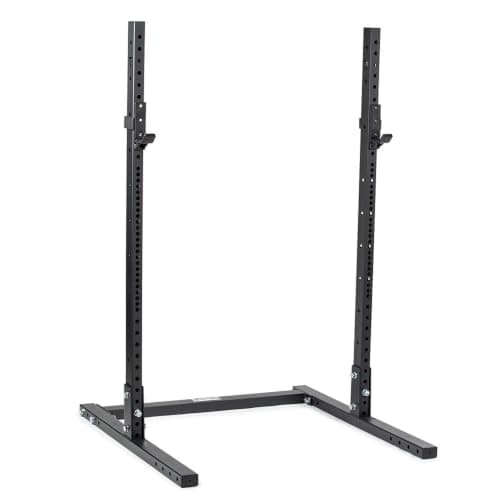
Titan T-3 Short Squat Stand72 in uprights / 73.5 in overallTwo-post stand, shared base1,000 lb rackableNo
YOLEO squat rack83 in frame; pull-up bar 71.5–80.5 inOpen rack, adjustable widthNot publishedYes — adjustable height
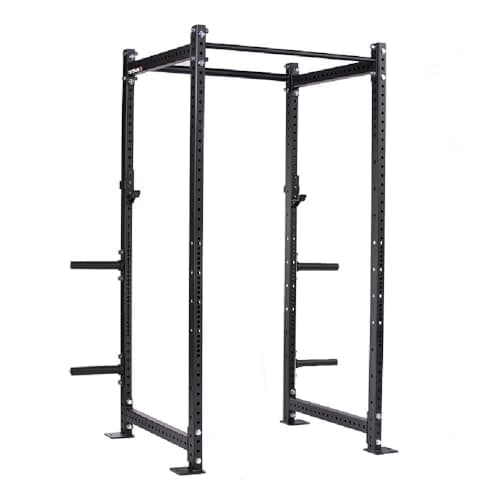
Titan T-3 Short Power Rack82 in overall; pull-up bar 78 inFour-post cage1,100 lb rackableYes — two pull-up bars

Heights for both Titan products and the CAP cage are quoted from the manufacturers' own spec pages, read on 2026-10-04 and linked in Sources. The YOLEO and F2C figures are printed in their Amazon listing titles. Where a capacity is not published we say so rather than estimate one.

Why 72 inches is the number that matters

A barbell back squat does not need much height. The bar sits on your upper back, so for most adults the bar is somewhere between 50 and 60 in off the floor at the top of the rep, and the J-hooks need to be an inch or two below that. A 72 in upright has more adjustment range than almost anyone uses — the top third of the holes on a tall rack sit unused for life.

What tall racks buy you is overhead work: a pull-up bar you can hang from with straight legs, and the vertical room to press a bar to lockout inside the frame. Both of those need roughly your standing reach plus the bar, and that is the thing a 7 ft room cannot give you no matter which rack goes in it. So the honest framing of a low-ceiling purchase is not "which rack still does everything" — it is "which rack does the squatting and pressing properly, and where does the overhead work go instead."

That is why the 73.5 in Titan stand ranks above the 82 in Titan cage here even though the cage is the better rack. Under a 7 ft obstruction the cage does not fit; under an 8 ft one, buy the cage. The full comparison of what you give up moving from a cage to a stand is in power rack vs squat rack.

Why the folding racks are not the answer

The obvious suggestion for a tight room is a wall-mounted folding rack, and for floor space it is the right answer — it is why we rank them in the best folding power racks. For ceiling height it is the wrong answer, and the numbers say so plainly. The Mikolo 2 x 2 folding rack publishes an 85.8 in open height with its pull-up bar 89 in off the ground. The uprights are a fixed length; mounting the unit lower on the wall just lifts the bottom of the frame off the floor and takes the J-hook range with it.

So a folding rack solves the garage that has to stay a garage. It does not solve the basement with 7 ft of headroom. If both constraints apply at once, the answer is a short stand plus a bar you can store vertically, not a folding frame you cannot mount.

Where the pull-ups go

Three of the five picks here either have no pull-up bar or put it too low to hang from properly. That is a real loss, and the fix is not a rack attachment — it is a separate bar mounted where the ceiling is highest, or a doorway bar, both ranked in the best pull-up bars. A ceiling-mounted bar in the one spot where a basement opens up often gives more usable hang height than any rack in the room.

If pulling work is non-negotiable and the ceiling is fixed, the YOLEO is the compromise pick on this page: its pull-up bar adjusts between 71.5 and 80.5 in, so you can set it to the highest position your room allows rather than accept whatever the frame came with. The trade is that it publishes no rackable capacity, and every adjustment point on an open rack is a joint that can develop play.

The capacity trade you are making

Fitting a low ceiling costs capacity more often than it costs money. The two Titan products publish 1,000 and 1,100 lb rackable ratings on 2 x 3 in 11-gauge steel. The CAP cage publishes a 600 lb recommended maximum on 12 and 14-gauge tubing, and the F2C stands publish 550 lb across the pair. Those are not small differences, and the weaker two are the ones that fit the tightest rooms.

For most home lifters this is academic — a 600 lb recommended maximum is well clear of what gets racked in a home gym. It stops being academic if you are chasing a heavy squat, and in that case the right move is to find the 8 ft of headroom somewhere in the house rather than buy the lighter frame. The long version of this argument, including why capacity claims differ so much between brands, is in the steel gauge guide and in barbell weight capacity explained.

What a low ceiling does to the rest of the gym

Two knock-on effects are worth planning for. First, the bar itself: a 7 ft Olympic bar is 86 in long and has to be stored somewhere, and in a low room the easy vertical wall holder suddenly does not fit. Horizontal holders and floor racks are covered in the best barbell storage. Second, floor height: rubber tiles add 0.25 to 0.75 in under the whole rack, which comes straight off your clearance. That is usually worth paying — the case for it is in the best home gym flooring — but measure after the floor goes down, not before.

If the room in question is a basement in a house with people above it, the noise and floor-loading side of the problem is a separate question, and it is answered in building a home gym on an upper floor and the apartment home gym guide.

The short answer

Quick picks

#ProductBest forScorePrice
01
Titan Fitness Titan Fitness T-3 Series Short Squat Stand (1,000 lb)
Titan Fitness T-3 Series Short Squat Stand (1,000 lb)

72 in uprights on 2 x 3 in 11-gauge steel with a 1,000 lb rating — the only serious rack here that a 7 ft ceiling can hold with room to spare.

Best under a 7 ft ceiling
8.8
$324.99Amazon
02
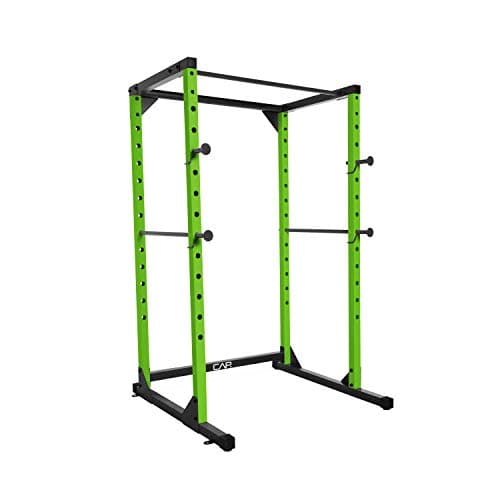
CAP Barbell CAP Barbell Full Cage Power Rack, 6-Foot
CAP Barbell Full Cage Power Rack, 6-Foot

The only genuinely enclosed cage on this page that fits under a 7 ft ceiling — bought for its 72 in height, not its steel.

Best enclosed cage for a low ceiling
7.0
$271.78Amazon
03
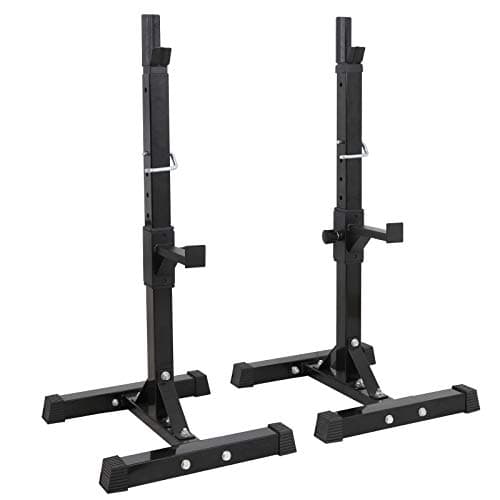
YOLEO YOLEO Squat Rack with Extended Safety Arms
YOLEO Squat Rack with Extended Safety Arms

The adjustable-width rack for a room that has to fit both the rack and the car.

Best adjustable-width rack
7.2
$169.99Amazon
04
Titan Fitness Titan Fitness T-3 Series Short Power Rack (36 in depth)
Titan Fitness T-3 Series Short Power Rack (36 in depth)

A genuine enthusiast-tier rack with Westside spacing and published numbers, at a price the marketplace brands cannot match on spec.

Best rack for a low ceiling
8.4
$629.99Amazon
05
F2C F2C Adjustable Squat Stands, 41-66 in (pair)
F2C Adjustable Squat Stands, 41-66 in (pair)

Two independent posts that top out at 66 in — the answer when the ceiling is too low for any frame at all.

Best for a very low ceiling
5.4
$66.98Amazon

#ad · Live prices from the Amazon Product API, as of October 22, 2026. Where we have no verified live price, we show none — we would rather leave a gap than print a number that has rotted.

In detail

The picks, in full

01
Titan Fitness Titan Fitness T-3 Series Short Squat Stand (1,000 lb)

Best under a 7 ft ceiling

Titan Fitness T-3 Series Short Squat Stand (1,000 lb)

72 in uprights73.5 in overall height2 x 3 in 11-ga steel1,000 lb rated
8.8/10

72 in uprights on 2 x 3 in 11-gauge steel with a 1,000 lb rating — the only serious rack here that a 7 ft ceiling can hold with room to spare.

Build & steel
9
Capacity
9
Low-ceiling fit
10
Parts & support
9
Value
7

Pros

  • Titan publishes 72 in upright height and 73.5 in overall height, so you can check it against a tape measure before you buy instead of guessing
  • 2 x 3 in 11-gauge steel and a 1,000 lb rackable capacity — enthusiast-tier steel in a frame short enough for a basement
  • Westside hole spacing through the pressing zone and a documented Titan parts channel, so a worn J-cup is an order rather than a dead rack

Cons

  • No pull-up bar, and at 72 in of upright there is nowhere sensible to add one — overhead pulling has to happen somewhere else
  • A two-post stand, so a failed squat is bailed rather than caught unless you add spotter arms separately
  • 144 lb and a 47 x 48 in base: it is not a thing you slide out of the way between sessions

Don't buy this if…

…you want to do pull-ups on your rack. A 72 in upright cannot carry a bar you can hang from, and no attachment fixes that — buy a doorway or wall-mounted bar for the pulling work instead.

$324.99View on Amazon

Price as of October 22, 2026. Prices change — Amazon's is the one that counts.

#ad · we may earn a commission from this link to Titan Fitness T-3 Series Short Squat Stand (1,000 lb)

02
CAP Barbell CAP Barbell Full Cage Power Rack, 6-Foot

Best enclosed cage for a low ceiling

CAP Barbell Full Cage Power Rack, 6-Foot

6 ft (72 in) tall option44 in W x 48 in D600 lb recommended max12 and 14-ga steel
7.0/10

The only genuinely enclosed cage on this page that fits under a 7 ft ceiling — bought for its 72 in height, not its steel.

Build & steel
6
Capacity
5
Low-ceiling fit
9
Enclosed safety
8
Value
7

Pros

  • CAP publishes a 6 ft height option and a 44 x 48 in footprint, which is the rare case of a cage listing telling you whether it will fit
  • A real four-post cage with safety catches and bar catches included, so a failed squat lands on steel rather than on you
  • Gusseted uprights and a pull-up bar in the box at a price well under the enthusiast racks

Cons

  • 12 and 14-gauge tubing and a 600 lb recommended maximum — this is the lightest-rated frame on the page by a wide margin
  • The pull-up bar on the 6 ft version sits at roughly cage height, so most adults cannot hang from it with straight legs
  • CAP publishes a recommended maximum rather than a tested rackable capacity, which is a weaker claim than Titan's

Don't buy this if…

…you squat anywhere near 500 lb. A 600 lb recommended maximum for the whole rack is a different thing from a 1,000 lb rackable rating, and this is the wrong frame to find the edge of.

$271.78View on Amazon

Price as of October 22, 2026. Prices change — Amazon's is the one that counts.

#ad · we may earn a commission from this link to CAP Barbell Full Cage Power Rack, 6-Foot

03
YOLEO YOLEO Squat Rack with Extended Safety Arms

Best adjustable-width rack

YOLEO Squat Rack with Extended Safety Arms

35–67 in adjustable width83 in frame heightPull-up bar 71.5–80.5 inFits 6 ft & 7 ft bars
7.2/10

The adjustable-width rack for a room that has to fit both the rack and the car.

Build & steel
6
Capacity
7
Expandability
6
Footprint
9
Value
8

Pros

  • Width adjusts from 35 to 67 inches, so it narrows for storage and widens for a 7 ft bar
  • Adjustable pull-up bar height between 71.5 and 80.5 inches suits low-ceiling garages and tall lifters alike
  • Extended safety arms rather than short pins — the difference between catching a bar and watching it miss

Cons

  • Every adjustment point is a joint, and joints are where an open rack develops play over years
  • Fixed 83 in frame height means you still need real headroom for pull-ups

Don't buy this if…

…you want the stiffest possible frame. Adjustability and rigidity trade against each other; a fixed-width rack of the same money will feel more solid.

$169.99View on Amazon

Price as of October 22, 2026. Prices change — Amazon's is the one that counts.

#ad · we may earn a commission from this link to YOLEO Squat Rack with Extended Safety Arms

04
Titan Fitness Titan Fitness T-3 Series Short Power Rack (36 in depth)

Best rack for a low ceiling

Titan Fitness T-3 Series Short Power Rack (36 in depth)

1,100 lb capacity36 in depthShort frameWeight plate holders
8.4/10

A genuine enthusiast-tier rack with Westside spacing and published numbers, at a price the marketplace brands cannot match on spec.

Build & steel
9
Capacity
9
Expandability
9
Footprint
8
Value
7

Pros

  • A published 1,100 lb capacity and a 36-inch depth make this a full cage that still fits a basement or a low garage
  • Titan runs a documented replacement-part process and sells attachments across the T-3 line, so a worn J-cup is an order rather than a dead rack
  • Integrated plate holders load the base, which is exactly what stops a short rack from wanting to move

Cons

  • A short rack means the pull-up bar sits low — measure your reach before you assume you can hang from it
  • 36 inches of depth is tight for rack pulls or anything you want to walk around inside

Don't buy this if…

…your ceiling is high enough for a full-height cage. The short frame exists to solve a headroom problem — if you do not have that problem, a standard-height rack gives you a usable pull-up bar for the same money.

$629.99View on Amazon

Price as of October 22, 2026. Prices change — Amazon's is the one that counts.

#ad · we may earn a commission from this link to Titan Fitness T-3 Series Short Power Rack (36 in depth)

05
F2C F2C Adjustable Squat Stands, 41-66 in (pair)

Best for a very low ceiling

F2C Adjustable Squat Stands, 41-66 in (pair)

41-66 in adjustable height550 lb max loadSteel posts, sold as a pairNo overhead structure
5.4/10

Two independent posts that top out at 66 in — the answer when the ceiling is too low for any frame at all.

Build & steel
4
Capacity
4
Low-ceiling fit
10
Enclosed safety
2
Value
7

Pros

  • A published 41 to 66 in height range, so it works in a basement where even a 72 in upright will not stand up
  • No crossmember and no pull-up bar means nothing above bar height, which is the whole point in a room with pipes or joists in the way
  • Light enough to carry out of the way, which no other pick here can claim

Cons

  • 550 lb max load across the pair, and the listing does not publish a steel gauge — this is the lightest-duty option on the page
  • Two independent bases have no shared frame, so uneven loading or a knock can move one post while the bar is on it
  • No safeties of any kind: a failed rep is dumped on the floor, which rules it out for solo heavy work

Don't buy this if…

…you train alone and push close to failure. Independent posts with no catch bars offer nothing to bail onto — a short cage or a stand with spotter arms is the honest choice.

$66.98View on Amazon

Price as of October 22, 2026. Prices change — Amazon's is the one that counts.

#ad · we may earn a commission from this link to F2C Adjustable Squat Stands, 41-66 in (pair)

How to choose

Start from your obstruction height, not your ceiling height

Write down the single lowest measurement over the rack's footprint and subtract the thickness of any flooring you plan to lay. Compare that to the published overall height, not the upright height — the two differ by about 1.5 in on the Titan stand and by more on cages with a raised pull-up bar.

Decide whether you actually need a cage

A cage buys you catch bars that work without you thinking about them. A stand buys you height and footprint. If you train alone and go close to failure, the cage is worth hunting 8 ft of clearance for. If you train with margin, or you add spotter arms, the stand is the better fit in a short room.

Treat the capacity number as a claim, not a measurement

Prefer a rackable rating with a tube spec and gauge attached to it. Where a listing publishes only a "recommended maximum" or a bare number with no steel spec, read it as the manufacturer's opinion and leave headroom.

Plan the overhead work before you buy, not after

Pull-ups, overhead presses and anything with a bar above your head are the things a low ceiling takes away. Decide now whether they move to a separate wall or ceiling bar, to a seated press, or out of the program. A rack choice made without that decision usually gets re-made.

Check the base against the floor plan

The Titan stand has a 47 x 48 in base and weighs 144 lb; the CAP cage is 44 x 48 in. In a basement with a support post or a narrow stairwell, measure the path in as well as the footprint — a built cage does not come apart easily once it is up.
How we picked

We do not run a testing lab

We compiled manufacturer specifications, read the published warranties, checked the relevant standards and aggregated owner reviews, then scored each product against a published rubric. The scores are judgments from documented research — they are not measurements we took, because we do not run a lab and we are not going to pretend we do. Where a number came from a manufacturer or a standard, we name it and link it in Sources.

Questions

Frequently asked

What is the minimum ceiling height for a power rack?

For an enclosed cage, plan on the rack's published overall height plus a few inches for assembly — so roughly 76 in of clear space for the 72 in CAP cage and about 86 in for the 82 in Titan T-3 short rack. For a squat stand with no overhead member, the rack itself needs only its own height; what limits you then is your own overhead reach, not the frame.

Can I use a power rack in a basement with 7 foot ceilings?

Yes, but only a short one. At 84 in of clear height the Titan T-3 Short Squat Stand (73.5 in overall) and the 6-foot CAP cage (72 in) both fit; the 82 in Titan cage is too tight once you allow for assembly and flooring. Measure to the lowest duct or joist rather than the ceiling.

Can you do pull-ups on a short power rack?

Not properly. A 72 in bar leaves most adults unable to hang with straight legs, and a 78 in bar is marginal. The usual fix is a separate wall or ceiling-mounted bar in the highest part of the room — options are ranked in the best pull-up bars.

Is a folding wall-mounted rack good for a low ceiling?

No. Folding racks solve floor space, not height: the Mikolo folding rack publishes an 85.8 in open height with its pull-up bar at 89 in, and the uprights are a fixed length, so mounting it lower only raises the bottom of the frame off the floor.

Do I lose capacity by buying a short rack?

Not necessarily — the Titan short rack publishes 1,100 lb rackable and the short stand 1,000 lb, both on 2 x 3 in 11-gauge steel. You lose capacity when you buy the lightest frames that fit the tightest rooms: the CAP cage publishes a 600 lb recommended maximum and the F2C stands 550 lb.

Can I overhead press in a room with a low ceiling?

That depends on your lockout height, not the rack. Stand where the rack will go and hold an empty bar overhead at arms' length; if the bar is above your lowest obstruction, standing presses are out and the work moves to a seated press on a bench. No rack changes this.

Should I buy a shorter rack or cut the uprights down?

Buy the shorter rack. Cutting an upright removes the hole pattern you paid for, voids any warranty, and leaves a raw edge in a load-bearing member. Every pick on this page exists so that modifying a tall rack is not necessary.

Keep reading

Receipts

Sources

We do not run a testing lab, and we do not pretend to. Every spec, warranty term and standard above is the manufacturer's or a published source, cited and linked. Where we could not verify something, we say so on the page rather than quietly leaving it out. Read our full method.