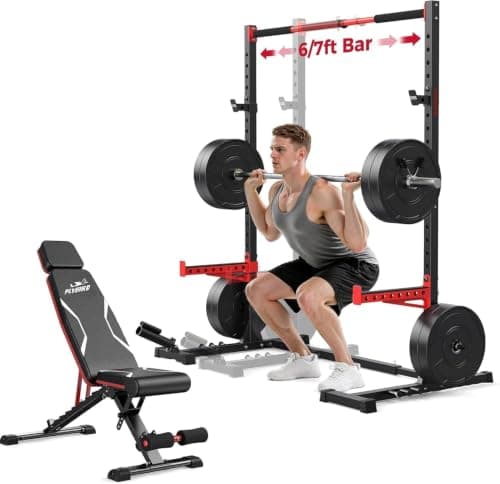
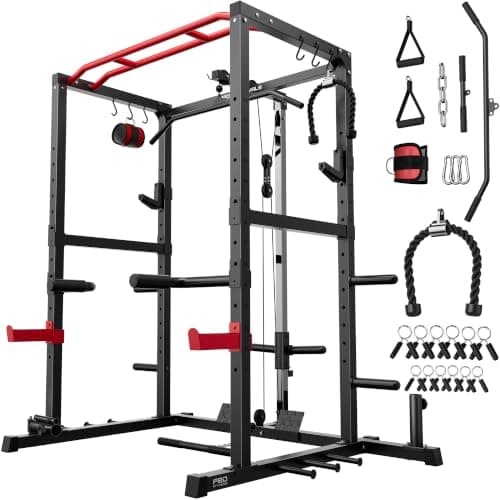
If you train heavy singles alone and want to fail safely, buy the power rack. If space and budget are tight and you're disciplined with spotter arms, the squat rack does most of the job for less. That's the whole decision — the rest is detail. Below, the SPORTSROYALS cage and the FLYBIRD SR1 stand for the two ends of that choice.
A power rack (a full cage) encloses you on four posts with safety bars that catch a missed rep from any angle. A squat rack (a two-post stand) holds the bar and gives you spotter arms to bail into, but it doesn't enclose you. Both are steel, both last if built right — the difference is how much frame you're paying for and how much floor it eats.
Dimension by dimension
| Dimension | Power rack (cage) | Squat rack (stand) |
|---|
| Safety alone | Best — safeties catch a failed squat or bench from every side | Good — spotter arms bail a rep, but no full enclosure |
| Footprint | Large — a fixed cage that stays put once built | Small — fits a corner or a shared room |
| Price | Higher — you're paying for the full frame | Lower — less steel, less money |
| Expandability | High — lat towers, dip bars and cable stacks bolt on | Moderate — spotter arms, conversion kits, some add-ons |
| Ceiling needed | More — the pull-up bar wants real headroom | Less — many stands are shorter or barless |
| Best for | Heavy solo lifting, one-box expansion | Small rooms, tight budgets, disciplined lifters |
Where the cage earns its footprint
The enclosure is the point. When you miss a heavy squat inside a cage, you sit the bar down on the safeties and step out — no spotter, no drama. A stand can't do that; you bail the bar forward or backward, which works but demands better judgment about what you attempt alone. The SPORTSROYALS cage goes further and bolts a lat pulldown and low row onto the frame, so one purchase covers pressing, pulling and cable work. That's the case for the cage: more safety and a near-complete gym, if you have the room and the ceiling.
Where the stand is the smarter buy
The FLYBIRD SR1 makes the opposite case. It squats, presses and racks in a corner, costs less, and needs less ceiling — and for a lifter who trains within themselves and uses the spotter arms, that's enough rack. The stand is not a downgrade so much as a right-sizing: you buy the frame your training and your room actually justify, and spend the difference on plates or a better bar. If you go this way, the best squat stands shortlist is where to start.
Still deciding? Measure your ceiling and floor first, then be honest about whether you fail heavy reps alone. That one question settles it more often than any spec. The full picks live in our power rack roundup and squat racks & stands roundup.