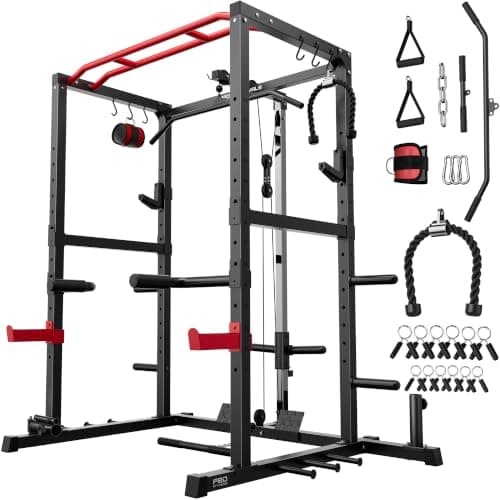
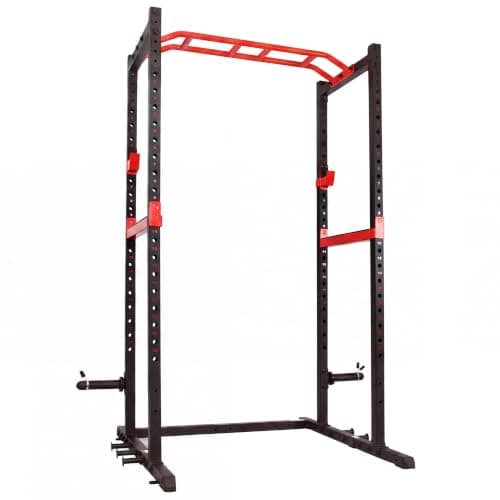
For almost every home gym, the power rack. It trains the bar path you actually have to control, it has no moving parts to fail, and it costs less for the same footprint. A Smith machine earns its place in narrow cases, and this page is honest about which. If the machine you are actually weighing the rack against is a cable station rather than a guided bar, the comparison you want is functional trainer vs Smith machine.
The difference in one table
| Power rack | Smith machine |
|---|
| Bar path | Free — you control it | Fixed on rails |
| Stabilizer training | Full | Substantially reduced |
| Moving parts | None in the frame | Bushings or bearings, hooks, counterweight |
| Failure catch | Adjustable safeties | Rotate-to-lock hooks |
| Transfers to free weights | Directly | Partially |
| Typical home footprint | Cage-sized | Cage-sized or larger |
| Attachment ecosystem | Broad and cheap | Narrow and model-specific |
Why the free bar usually wins
You are training the thing you have to do
A Smith machine removes the side-to-side and front-to-back control problem from the lift. That is genuinely useful if the goal is to isolate a muscle without also managing balance. It is a problem if the goal is to squat and press well, because the control you are not practicing is part of the lift. Strength built on rails does not fully arrive when you step up to a free bar.
Nothing on a rack wears out
This is the durability argument, and on a site about equipment that outlives you it is the decisive one. A rack is steel, bolts and pins. A Smith machine adds a carriage that slides on bushings or bearings, a set of rotating hooks and, on counterbalanced models, a cable and pulley system. Every one of those is a wear item, and every one of them is model-specific if it fails — which is a real risk on budget machines from brands that may not be selling parts in five years.
The accessory market is on the rack side
Lat towers, dip bars, landmines, safety straps and plate storage are designed around standard rack uprights. Our attachments guide covers the upgrade path. Smith machine accessories are far narrower and rarely cross-compatible.
Where a Smith machine genuinely makes sense
Three cases, and they are real. First, if you train alone, lift close to failure on purpose, and want a fixed path you can bail out of by rotating the bar — some lifters find that psychologically easier than trusting safeties. Second, for hypertrophy-focused training where removing balance is the point rather than a compromise. Third, for rehabilitation or limited mobility, where a controlled path is a genuine requirement rather than a shortcut.
Note what is not on that list: saving space or saving money. A Smith machine is rarely smaller and almost never cheaper than a comparable cage. If you are in one of those three cases and have decided on a guided bar, the machines worth buying are ranked on the best Smith machines page, which ranks them on what each listing publishes about the carriage and the rails.
The hybrid option, and its catch
Combination units exist that bolt a Smith carriage onto a cage. They look like the answer to this whole page. The catch is that combining them usually compromises both: the cage gets narrower because the rails eat the width, and the Smith carriage is generally the cheapest version of the mechanism the manufacturer could fit. If you want cable work alongside a free bar, a cage with an integrated pulley stack — the SPORTSROYALS is the one we rank in racks with cables — adds capability without putting your squat on rails.
The recommendation
Buy the rack. It is the more durable object, the more transferable training tool, and the one with the cheaper and longer-lived accessory path. Consider a Smith machine only if one of the three narrow cases above is genuinely yours, and if it is, budget for a model from a brand you expect to still be selling replacement parts in a decade — because unlike a rack, this is a machine that will eventually need them. If you are still deciding how much rack you need, is a power rack worth it covers the cost case.