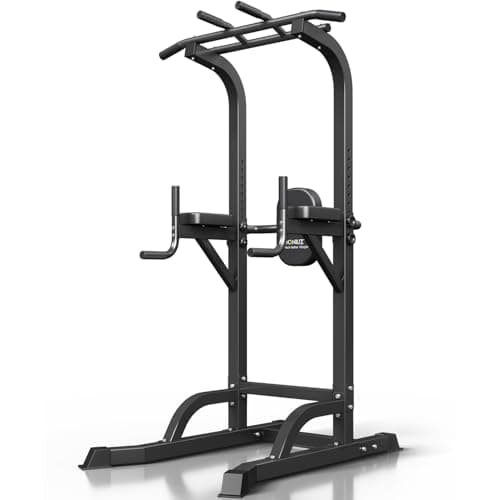
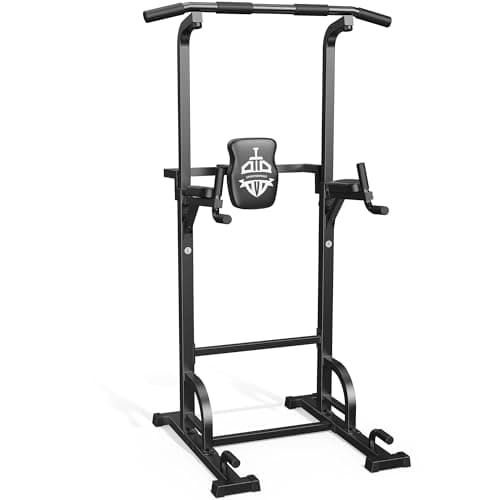
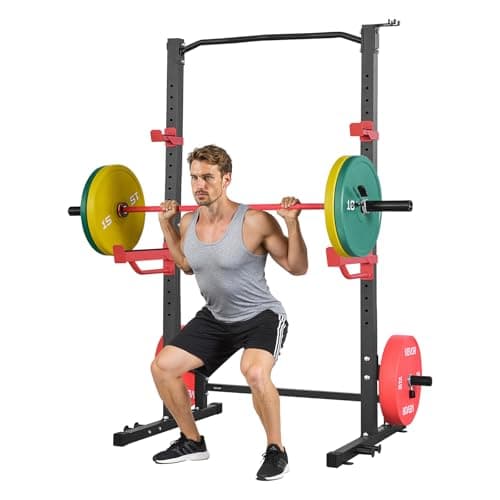
If you own a barbell, or ever will, buy the rack — most racks in this price range include a pull-up bar and take a dip attachment, which makes the tower redundant. The power tower is the right buy for one specific person: someone who trains bodyweight only, has no barbell and does not want one, and needs pull-ups and dips off a frame rather than a mounted pull-up bar. If that is you, the towers themselves are ranked on rigidity in the best power towers.
They are not the same category
A power rack is a load-bearing frame for a barbell. Its job is to hold a bar at a height you can unrack it from, and to catch it when a rep fails. Everything about it — the gauge steel, the J-hooks, the safeties, the depth — exists to serve a loaded bar.
A power tower is a bodyweight station. Its job is to give you a bar to hang from, dip handles to press between, and usually a back pad for knee raises. Nothing on it is designed to take a barbell, and no amount of wishing changes that.
The confusion is understandable — both are tall steel frames with a bar at the top, and marketplace listings use "power" on both. But the buying decision is really: do you lift a barbell?
The comparison in one table
| Power rack | Power tower |
|---|
| Holds a loaded barbell | Yes — that is the point | No |
| Squat and bench | Yes, with safeties | No |
| Pull-ups | Yes, on almost every cage | Yes |
| Dips | With a bolt-on attachment | Built in |
| Knee raises / push-up handles | No | Usually built in |
| What the rating describes | Barbell load on the frame | User weight on the frame |
| Footprint | Large — a cage is a permanent installation | Small; some models move easily |
| Grows with attachments | Extensively — lat towers, dip bars, landmines | Barely |
| Typical price | Higher | Lower |
The capacity numbers describe different things
This trips people up when comparing listings. A rack's rated capacity is the barbell load the frame is stated to hold — commonly 700 to 1,000 lb on home cages, higher on heavy 3×3 frames. A tower's rating is a user weight: what the frame is stated to support with a person hanging on it. The DONIUZ tower here publishes 660 lb; a tower that publishes nothing at all is leaving out the only number on its spec sheet that matters.
Comparing a 1,000 lb rack rating with a 660 lb tower rating and concluding the rack is "stronger" is comparing two unrelated measurements. What you can conclude is narrower and more useful: a tower without a published user capacity has told you nothing, and you should buy the one that publishes a figure.
Stability: the real difference you will feel
A power rack is heavy, wide-based and usually loaded with plates, so it does not move. A power tower is tall, comparatively light, and takes its load at the very top through a person who is swinging. That geometry is the tower's only genuine weakness.
Three things reduce it, in order of effectiveness: put the tower against a wall; put it on a flat hard floor rather than foam (the same rule we give for racks in our flooring guide); and control the movement instead of kipping. A tower that rocks under a strict pull-up is under-built. A tower that rocks under a violent kip is being asked to do something no home tower does well.
What a rack does that a tower cannot
Everything involving a barbell — which is to say, the whole of barbell strength training. Squat, bench press, overhead press, rack pulls. And because a rack is a platform rather than a finished object, it also grows: a lat tower, dip bars, a landmine, safety straps. That expandability is a large part of why we treat the rack as the buy-once purchase in the room.
What a tower does that a rack cannot
Honestly, not much — but the little it does is real. Most cages give you one pull-up bar position and no dip station without an attachment. A tower gives you dips, knee raises and often push-up handles out of the box, in a footprint a fraction of the cage's, at a fraction of the price, and it can be moved by one person. In a rented flat where a cage is not happening, that is not nothing.
The verdict
Buy the rack if a barbell is in your plans, now or later. It is the more expensive purchase and the one that makes the other unnecessary.
Buy the tower if you genuinely train bodyweight only, or you need dips and hanging work in a space or a tenancy that will not take a cage. Buy one with a published user capacity, put it against a wall, and do not kip on it — and read what that capacity figure actually covers first, because it is not the spec that decides whether the frame stays planted. If the only station you want is the hang, the cheaper answer is in power tower vs pull-up bar.
Buy the cage and a dip attachment if you want both and have the room — it is the cheaper of the two "have everything" routes, and the attachments are covered in the rack attachments roundup.