Buy the SPORTSROYALS tower if you want the one that stays planted: a 2 mm steel frame, a 39.7-inch base, eight floor contact points and a published 450 lb rating, on a frame that weighs 62 lb. Buy the DONIUZ if the number you care about is the rating itself — 660 lb is the highest of the three. Buy the RELIFE only if the budget is the constraint and you accept a lighter frame with no backrest. And if you own, or plan to own, a power rack: stop here, because your rack already has the only part of a tower that matters.
What a power tower is, and what it is not
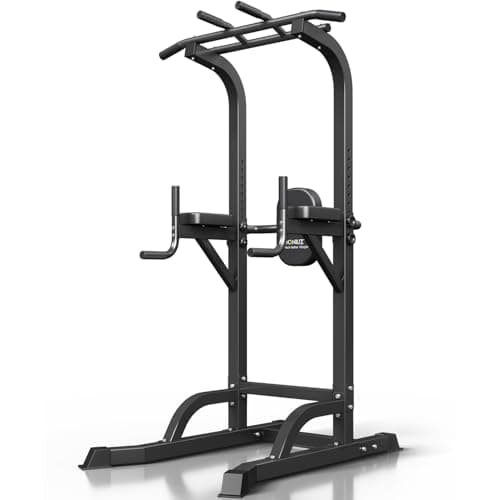
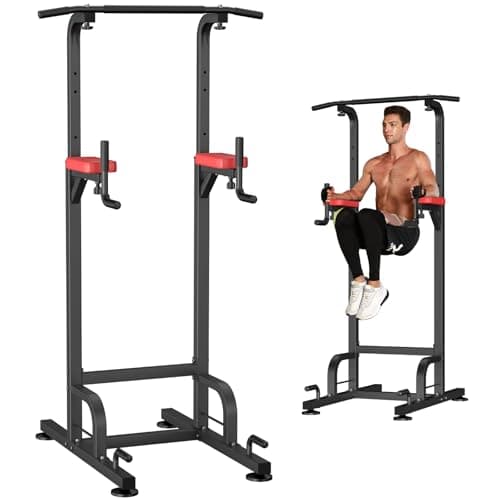
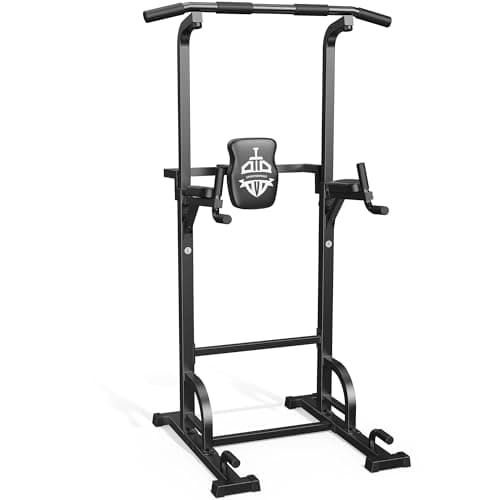
A power tower is a freestanding steel frame with a pull-up bar on top, dip handles partway down, a padded backrest with armrests for hanging knee raises, and usually a pair of push-up handles at the base. It has no J-hooks, no safeties and no plate storage. It does not hold a barbell. Every exercise on it is loaded by your own bodyweight, plus whatever you strap to yourself.
That makes it a genuinely different product from a power rack, even though the two share a pull-up bar and get cross-shopped constantly. The comparison — and the reason the two capacity numbers cannot be read side by side — is worked through in power rack vs power tower. The short version: a rack rating describes what the frame will catch when a barbell is dropped on it; a tower rating describes what it will hold still under. If you will ever squat or bench with a barbell, the rack is the piece to buy and the tower becomes redundant the day it arrives.
If you will not — if your training is pull-ups, dips, rows and core work, and you want it off the door frame and away from the wall — a tower is the right tool, and this page is about choosing one that does not walk across the floor while you use it.
What we rank on
A tower has no mechanism to fail. There is no selector, no cable, no pulley, no hinge. The frame is bolted tube steel, the pads are vinyl over foam, and the whole thing either stands still under a swinging body or it does not. So the ranking is about rigidity, and rigidity on a freestanding frame comes from four things the listing will usually tell you:
- Tube wall thickness. Two of the three publish it: 2 mm on the SPORTSROYALS and 2 mm on the DONIUZ. The RELIFE says "thickened steel pipe" and gives no figure, which we count as a spec not published rather than as a thin wall — but a number you can check beats an adjective every time.
- Base footprint. The longer the base runs front to back, the more it resists the forward-and-back tip that a kipping pull-up or a dip lockout produces. SPORTSROYALS publishes a 39.7-inch base and, unusually, argues on the listing that shorter 34-inch bases tilt forward. The DONIUZ publishes a 32 by 41 inch footprint. The RELIFE publishes 34 by 26.4 inches.
- Frame weight. A heavier frame is a more planted frame, all else equal. The SPORTSROYALS weighs 62 lb by its own listing, and it makes the point that typical towers come in under 50 lb. The other two do not publish a frame weight.
- Published capacity. 450 lb (SPORTSROYALS), 660 lb (DONIUZ), 400 lb (RELIFE). We treat these as the manufacturer's own statement of what the frame supports, and we rank frame weight and footprint above them, because a rating without a footprint tells you about the steel and nothing about the sway.
Adjustability comes next — the height range decides whether a tall user can hang without bending their knees, and whether a short user can reach the bar — and the pads come last, because pads are the only consumable on the whole product and can be re-covered.
The three, side by side
| Spec (as published) | SPORTSROYALS | DONIUZ DZ-580A | RELIFE |
|---|
| Rated capacity | 450 lb | 660 lb | 400 lb |
| Tube wall | 2 mm | 2 mm | Not published |
| Footprint | 41.2 by 39.7 in | 32 by 41 in | 34 by 26.4 in |
| Height range | 64.56 to 88.18 in, 6 settings | 74.8 to 87 in | 9 settings, top 83 in |
| Frame weight | 62 lb | Not published | Not published |
| Backrest | Yes, 7 positions | Yes | No |
| Floor contact | 8 anti-slip feet | Suction cups (flat concrete advised) | 4 suction cups |
| Warranty stated on listing | Not published | Not published | 1 year |
Every cell is quoted from the manufacturer listing read on 2026-09-18 and linked in Sources. Where a listing does not state a figure, the cell says so rather than guessing.
Why the heaviest rating is not our number one
The DONIUZ publishes 660 lb, the highest rating on the page, and it is a good frame with the same 2 mm wall as our winner. It sits second because the SPORTSROYALS publishes the two numbers that predict sway — a 39.7-inch base and a 62 lb frame — and the DONIUZ publishes one of them. On a tower, the failure you actually experience is not the frame giving way under you; it is the frame rocking on its feet during a set. The spec that governs that is the base and the mass, not the rating.
That is also why the DONIUZ's own listing tells you to use it on flat concrete rather than carpet: its floor contact is suction cups, which need a smooth surface to grip. If your floor is carpet or rubber tile, that advice matters more than the rating does. See home gym flooring for what goes under a freestanding frame.
When a rack, or a wall bar, is the better buy
Three cases, stated plainly.
You will ever lift a barbell. Buy the rack. Every full cage we rank has a pull-up bar, most have dip attachments available, and the rack does the one job a tower cannot. The budget power racks page ranks cages that cost about what a good tower does.
You only need the pull-up bar. A wall- or ceiling-mounted bar is a fraction of the cost, takes no floor space and, bolted into framing, cannot sway at all. Our pull-up bars roundup covers wall, ceiling and doorway mounts, including the no-drill option for renters.
You need dips and knee raises off the wall, in a rented room, with no barbell. That is the tower's case, and it is a real one. It is also the one case where the extra money for the heavier frame is money well spent, because the tower is the whole gym.
Durability: nothing here wears, so buy for rigidity
On a site about equipment that outlives you, a power tower is an easy category: bolted steel tube, powder-coated, with foam pads. The frame lasts as long as you keep it dry. The bolts loosen with use — every listing here tells you to re-tighten after assembly, and you should re-torque after the first month and then twice a year, the same routine we recommend for a rack in home gym equipment lifespan. The pads compress and the vinyl eventually cracks; both can be re-covered by an upholsterer for far less than a new tower.
What you cannot fix later is a light frame on a small base. A tower that sways on day one sways on day one thousand, and there is no upgrade path — you cannot bolt mass onto it. That is why we rank the two published rigidity figures first and treat the capacity number as the tiebreaker.
How to buy a power tower
Measure the ceiling against the top setting
The SPORTSROYALS tops out at 88.18 inches; the DONIUZ at 87; the RELIFE at 83. That is the bar height, and your head has to clear the ceiling with your chin over the bar. Measure standing under the spot with your arms overhead before you order — a tower that only fits at a lower setting is a tower you will do bent-knee pull-ups on forever.
Match the feet to the floor
Suction cups grip smooth, hard floors and do nothing on carpet or textured rubber. Anti-slip rubber feet work on both. If your floor is carpet, put a rubber mat under the tower or choose the frame with rubber feet; the flooring roundup has a 4 by 6 foot mat sized for exactly this.
Weigh the backrest against the price
Hanging knee raises without a backrest are harder on the shoulders and easier to cheat. If knee raises are why you want a tower rather than a wall bar, do not buy the one without a backrest to save money — you will have paid for a pull-up stand.
Check user height, not just capacity
SPORTSROYALS publishes a user height range of 4 ft 8 in to 6 ft 6 in; RELIFE publishes a lowest bar setting designed for children. If a tall lifter and a short one share the tower, the number of height settings matters more than the maximum.
Assemble it with a second person and a torque check
These ship flat and bolt together. Tighten every fastener in sequence, then load the pull-up bar with your bodyweight and go around again — the first hang seats the joints and there is always a quarter turn left. Do it again a month later.