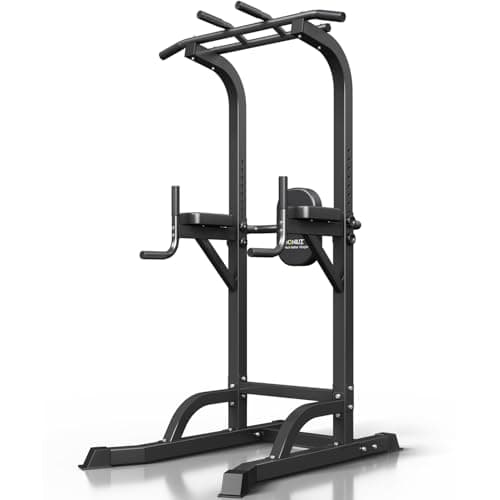
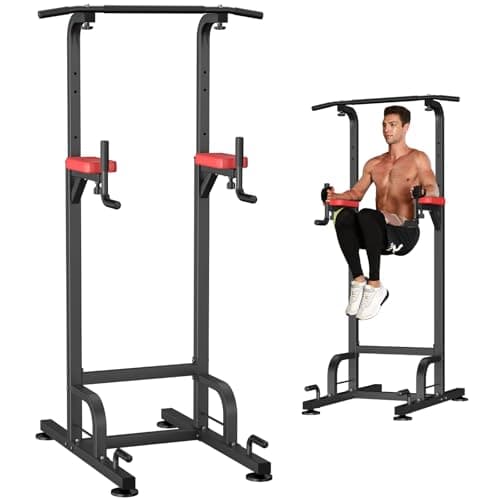
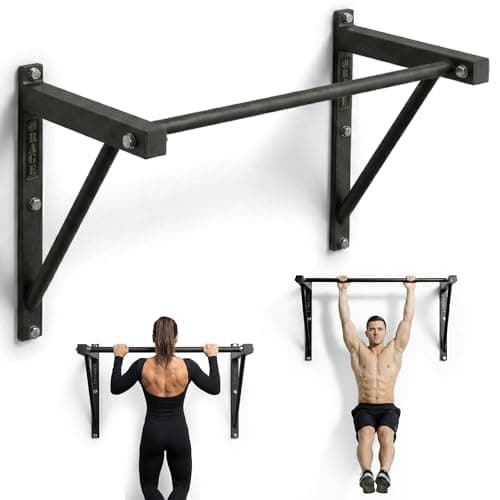
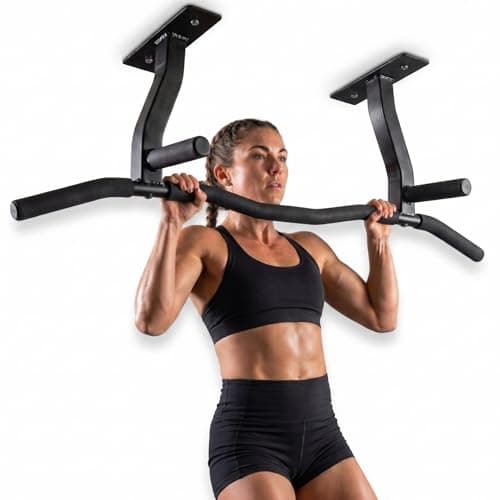
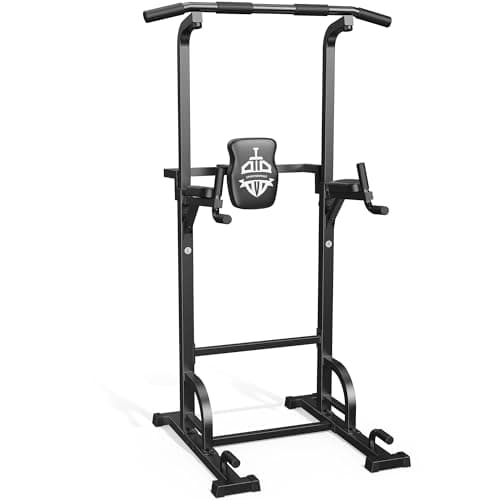
Buy the SPORTSROYALS tower if you train calisthenics: bodyweight work is dynamic, the frame moving under you is the thing that ruins it, and this is the one with the numbers that stop that — a 39.7 inch front-to-back base, a 62 lb frame, eight floor contact points, a 2 mm tube wall and a 450 lb published rating. Buy the DONIUZ DZ-580A if you want the most stations and the highest rating — 660 lb, four stations including the push-up handles most towers leave off, and a pull-up bar adjustable from 74.8 to 87 inches. Buy the RELIFE if budget is the constraint and you can live without a backrest for knee raises. Buy the Rage Fitness R2 wall bar if you can drill into framing and want the strongest hang on this page — 500 lb rated, 11 gauge steel, 36 inches of stated wall clearance — and will solve dips separately. And buy the Ultimate Body Press ceiling bar if your training room has exposed joists, because a ceiling mount leaves open air behind your heels that no tower and no wall bar can match.
If you want these three towers ranked as general-purpose home gym hardware rather than as calisthenics frames, that is the power towers roundup. This page adds the two mounted bars, because for pure bodyweight training a bolted bar beats every tower on the hang — and takes dips away entirely.
Calisthenics asks a frame for something a rack does not
A power rack is designed around a static vertical load: a loaded barbell, sitting on steel, not moving. Bodyweight training loads a frame in the opposite way. You hang off it, you swing, you accelerate and decelerate your whole mass at the bottom of a dip, and on a kipping pull-up you apply a horizontal pull the frame was never drawn for. That is why a tower bought for calisthenics is ranked on different things than the cages on our power racks hub.
Three properties decide it, in this order:
- Resistance to rocking, which means the base and the frame mass. The failure you actually experience on a tower is not the steel giving way — it is the frame tipping on its feet mid-set. The specs that govern that are how far the base runs front to back and how much the frame weighs, and only one of these three publishes both.
- Station count, and which stations. Calisthenics is pulls, dips, knee raises and push-ups. A frame that covers three of those and leaves you improvising the fourth is doing three quarters of the job — and the knee-raise station needs a backrest, which one of these towers does not have.
- Where the load finally lands. A freestanding tower ends in four feet on your floor. A wall bar ends in framing. A ceiling bar ends in joists. Those are three different durability stories, and the last two are stronger than the first — which is why two mounted bars are ranked here alongside the towers.
Published capacity comes after all three. All three towers state one — 450 lb, 660 lb and 400 lb — and a rating tells you about the steel rather than about the sway, which is why the highest number on this page is not the top pick. What a rating does and does not cover is the subject of power tower weight limits explained.
The five, side by side
| As published | SPORTSROYALS | DONIUZ DZ-580A | RELIFE | Rage R2 wall bar | UBP ceiling bar |
|---|
| Type | Freestanding tower | Freestanding tower | Freestanding tower | Wall or ceiling mount | Ceiling mount |
| Rated capacity | 450 lb | 660 lb | 400 lb | 500 lb | 300 lb |
| Base footprint | 41.2 × 39.7 in | 32 × 41 in | 34 × 26.4 in | No floor footprint | No floor footprint |
| Frame weight | 62 lb | Not published | Not published | n/a | n/a |
| Dips | Yes | Yes | Yes | No | No |
| Backrest for knee raises | Yes, 7 positions | Yes | No | Hanging only | Hanging only |
| Push-up handles | Not published | Yes | Not published | No | No |
| Stations stated | 3 | 4 | 2 | 1 | 1, 4 grip positions |
| Bar height | 64.56–88.18 in, 6 settings | 74.8–87 in | 9 settings, top 83 in | Fixed install | Fixed install |
| Floor contact | 8 anti-slip feet | Suction cups, flat concrete advised | 4 suction cups | None | None |
| Has to be drilled in | No | No | No | Yes | Yes |
Every cell is quoted from the manufacturer listing linked in Sources, and where a listing does not state a figure the cell says so. The row that decides this page is the base: 39.7 inches front-to-back against 26.4 on the cheapest frame, which is the difference between a tower that stays put through a set of dips and one that does not.
The dip station is the reason to buy a tower
If all you want is a pull-up bar, a tower is the expensive, floor-hungry way to get one: a bar bolted to a wall or a ceiling is stronger, quieter and cheaper, and we rank those on the pull-up bars page. The tower earns its footprint on dips. Parallel bars at a fixed width, at a height you can get into without jumping, with a frame behind you that does not move — that is the station nothing else in a home gym replaces cheaply.
This is also the honest limit of the two mounted bars ranked here. Both are excellent hangs and neither does dips at all. If you pick one of them, your dip answer is either a pair of parallettes on the floor or, if you own a cage, a bolt-on dip attachment — which is the cheapest dip station there is, because the frame is already standing in your room. Once bodyweight dips stop being hard, the next purchase is a dip belt, which loads plates you already own.
Rocking is the complaint, and the fix is free
Read owner reviews of any freestanding tower and the same sentence appears: it rocks. It does. A tall frame with a small base and a moving human at the top of it will rock, and no amount of steel gauge changes the geometry. Three things reduce it to almost nothing, and all three are free:
- Put it against a wall. The tower cannot tip toward a wall it is already touching, and backwards is the direction it wants to go on a pull-up.
- Put it on a hard, level floor. The DONIUZ listing is explicit that its suction-cup feet want flat concrete rather than carpet or foam tiles. Soft flooring under a small-footprint frame is the single biggest cause of rocking — see our flooring guide for what belongs under a tower.
- Stop kipping. Strict pull-ups load the frame vertically. A kip loads it horizontally, which is the axis a tower is weakest on and the axis nobody publishes a rating for.
What actually wears out
A welded-and-bolted steel tower has almost nothing in it that can fail. There is no mechanism under load, no bearing, no pad that compresses under weight, no cable to fray. What wears are the consumables: the foam on the handles, the pads on the knee-raise station, and the bolts working loose over a few hundred sessions. Re-torque the hardware twice a year and a tower is the kind of object that outlasts the room it is in — the same argument we make about cages on how long power racks last.
The exception is the DONIUZ's suction-cup feet, which are a rubber part in contact with a floor and the one component on any tower here we would expect to replace. Treat it the way we treat every wear item on this site: before you buy, check that the part exists separately. Our replacement parts guide covers how to check, and what to do when the answer is no.
How to buy a frame for bodyweight training
Measure your ceiling before anything else
A tower needs its own height plus enough room above the bar for your head at the top of a rep. All three towers here publish a bar height range — 64.56 to 88.18 inches on the SPORTSROYALS across six settings, 74.8 to 87 on the DONIUZ, and a top setting of 83 inches on the RELIFE — so this is one spec you can check against a tape before ordering. If the ceiling is the binding constraint, a wall bar set low is the better answer, and our low-ceiling page covers the same problem for racks.
Read the base before the rating
The rating tells you about the steel; the base and the frame weight tell you whether the thing stays still. A 39.7 inch front-to-back base on a 62 lb frame resists the forward tip a dip lockout produces in a way a 26.4 inch base cannot, whatever the published capacity says. Where a listing gives a rating and no footprint, you have been told the less useful of the two numbers.
Count the stations you will actually use
Four stations is better than two only if you use four. Most people who buy a tower use the pull-up bar and the dip bars constantly, the knee-raise pads occasionally, and the push-up handles almost never. Do not pay a premium for a station count; pay it for a published rating and a frame that fits the room.
Decide now whether you are drilling
This is the fork that eliminates half the page. If you can drill into real framing, a mounted bar is stronger, quieter, takes zero floor and costs less — and you solve dips separately. If you cannot drill, or you will move within a year, buy a freestanding tower and stand it against a wall. Renters should read building a home gym in an apartment before ordering anything that needs a fastener.
Do not buy a tower if a rack will fit
We say this on every tower page and it stays true. Almost every cage in a tower's price range already has a pull-up bar, accepts a dip attachment, and then also holds a loaded barbell. If the room takes a rack, the rack is the better purchase, and the comparison is laid out in full on power rack vs power tower.