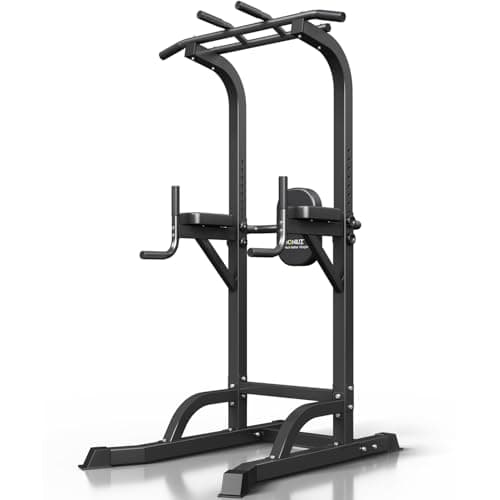
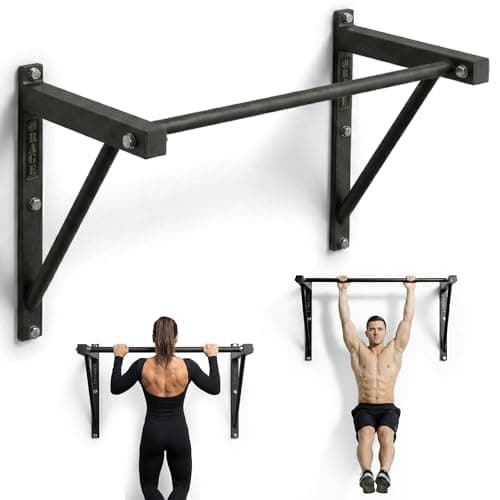
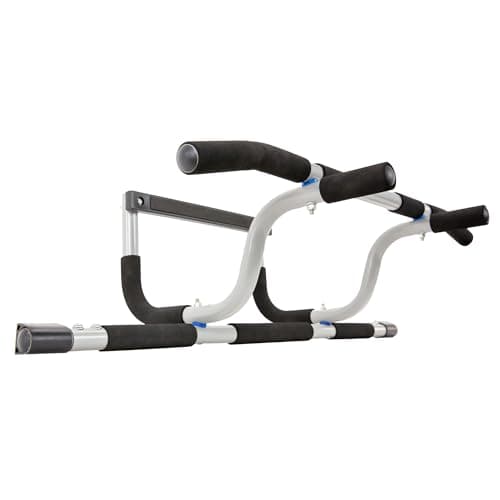
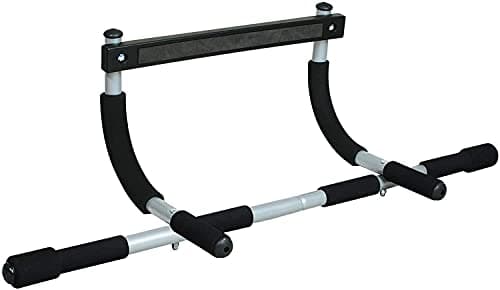
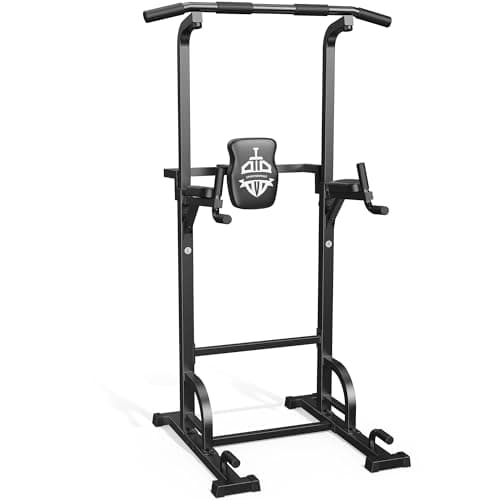
Buy a power tower if you want dips, or if you cannot drill into anything — the SPORTSROYALS is the one we rank first, on a 39.7 inch base, a 62 lb frame and a 450 lb published rating. Buy a mounted pull-up bar if you own the wall: the Rage Fitness R2 publishes 500 lb and 11 gauge steel, costs a fraction of a tower, and takes no floor at all. Those are the two real answers. The doorway bars below are the third answer — for renters who want a hang today and will not leave a hole behind — and they are a compromise rather than a preference.
What each one actually is
A power tower is a freestanding steel frame, roughly six to seven feet tall, that stands on your floor and gives you a pull-up bar at the top, dip handles at the middle, and usually a knee-raise station and push-up handles as well. Nothing gets fastened to the building. The whole load path ends in four feet on your floor.
A pull-up bar is a bar and a bracket. It bolts into wall studs or ceiling joists, or in the cheapest version it hooks over a door frame and tightens under your weight. It gives you one station — the hang — and nothing else.
That is the whole comparison, and it resolves differently depending on which of three things you care about most: the dip station, the strength of the install, or the floor space.
The five, side by side
| As published | SPORTSROYALS tower | DONIUZ tower | Rage R2 wall bar | UBP XL doorway | Iron Gym doorway |
|---|
| Install | None | None | Bolts to studs or joists | Hooks over door frame | Hooks over door frame |
| Rated capacity | 450 lb | 660 lb | 500 lb | 300 lb | 300 lb |
| Load path ends in | Your floor | Your floor | Framing or concrete | Trim and drywall | Trim and drywall |
| Dips | Yes | Yes | No | No | No |
| Stations stated | 3 | 4 | 1 | 1 | 3 (bar plus floor use) |
| Permanent floor space | 41.2 × 39.7 in base | 32 × 41 in base | None | None | None |
| Clearance published | Not published | Not published | 36 in from wall | 10 in from wall, 1 in above trim | Not published |
| Leaves a hole | No | No | Yes | No | No |
Every cell is quoted from the manufacturer listing linked in Sources, and the gaps are stated as gaps. Note which rows have them: both towers publish a capacity and a footprint but no standing clearance, while the bars publish a rating and — in two cases — exactly how far your heels will be from the wall. On the spec that decides whether a hang is pleasant, the bars are the better-documented product class.
Buy the tower if you want dips. That is genuinely the whole argument.
Dips need two parallel bars at roughly shoulder width, set at a height you can mount without jumping, with something solid behind you. A pull-up bar cannot do that at any price, and there is no accessory that makes it do that. If weighted dips are part of your training — and for upper body pressing they probably should be — a tower is not a luxury version of a bar. It is a different product that happens to include a bar.
The exception is if you already own a cage. A rack with a bolt-on dip attachment covers both stations with no new floor space at all, which is why we keep pointing people at the rack attachments page before they buy a tower, and why power rack vs power tower usually resolves in the rack's favour when the room allows it.
Buy the bar if you own the wall
A bolted bar wins on every axis except station count:
- It is a stronger install. Load goes into framing or concrete. There is no base to rock, no feet to slide, no geometry to respect. The Rage R2 publishes 500 lb and 11 gauge steel — the heavier of the two gauges we compare on the steel gauge guide.
- It takes no floor. Nothing stands in your room. For a one-car garage or a shared space, that is often the deciding factor on its own.
- It costs a fraction as much. Check the live prices in the table above — the gap between a wall bar and a tower is wide enough to pay for a bench or a set of plates.
- It is quieter. A tower on a hard floor transmits every rep into the slab. A bar in a stud transmits it into the building, which matters if there is a room below — see putting a home gym on a second floor.
The cost of all that is drilling, and drilling is only free if you own the wall. It also permanently fixes the bar's height and the direction you face, because you cannot rotate a bolted bar to suit the room later.
The doorway bar is the renter's answer, with the renter's caveat
Leverage-mounted doorway bars hook over the frame and tighten under your own weight. Nothing is drilled, nothing is patched, and the bar comes off in seconds. The Ultimate Body Press XL publishes the geometry that matters — a stated 1 inch above the trim and 10 inches out from the wall, which is what buys chin clearance at the top and knee clearance at the bottom — and fits 24 to 36 inch doorways. The Iron Gym publishes three grip positions and lifts off to be used on the floor for push-ups and dips between parallel handles.
The caveat is the load path. Your entire bodyweight ends in door trim and the wall above the opening, and that assembly is only ever as good as the carpentry behind it. Both bars publish a 300 lb rating; neither can publish a rating for your doorway. Check the trim is screwed into framing, not glued to drywall, before you hang from it — and read the depth requirement, because the XL needs a 6 inch deep opening measured trim face to trim face and a shallow modern doorway rules it out entirely.
The durability answer, since that is what this site is for
All five of these are near-permanent objects by home gym standards. None of them has a mechanism under load, a bearing, a cable or a pad that compresses. Ranked on what can actually fail:
- The bolted wall or ceiling bar — one piece of welded steel and some lag screws. There is nothing to wear out. The failure mode is the wall, not the bar.
- The tower — steel frame, bolts that want re-torquing twice a year, and consumable foam on the handles. Feet are the one part we would expect to replace.
- The doorway bar — foam grips and plastic couplers are genuine consumables, and the trim it clamps to takes a small amount of abuse every session.
None of them is a rebuy risk the way a cable machine or a dial dumbbell is. If the service-life question is what brought you here, the honest answer is that this whole category lasts, and the decision should be made on dips, drilling and floor space instead. The same reasoning for the wider category is on the equipment lifespan guide.
How to make this decision in five minutes
1. Do you want to do dips?
If yes, and you do not already own a cage, buy a tower. Stop reading. No bar does dips, and the tower is the cheapest frame that does both.
2. Can you drill into real framing?
If you want only pull-ups and you own the wall or the ceiling joists, buy a bolted bar. It is stronger, cheaper and invisible when not in use. If you rent, or your only wall is a partition over masonry with no accessible studs, you are choosing between a tower and a doorway bar.
3. Measure the clearance, not the bar
The number that decides whether a mounted bar is pleasant is how far it stands off the wall. The Rage R2 publishes 36 inches; the doorway XL publishes 10 inches off the wall and 1 inch above the trim. A bar with no published standoff is a bar you cannot evaluate before it arrives — and heels finding the drywall on every rep is the most common regret in this category.
4. If you are buying a tower, check the floor it will stand on
Hard and level. Foam tiles under a small-footprint frame are the main cause of the rocking people complain about, and at least one tower here states on its listing that its feet want flat concrete. Our flooring guide covers what belongs under a frame and what does not.
5. Spend the difference on what you do not own yet
If the bar covers your training, the money you did not spend on a tower buys a bench or a first set of plates. If you are assembling a gym from nothing, read the beginner equipment guide for the order to buy things in — bodyweight frames are rarely the first purchase.