Skip to content
Plate&Rack

The frame · Power Racks & Cages

The Best Lat Pulldown Attachments for a Power Rack

A lat tower is the single biggest capability jump you can bolt onto a rack. It is also the attachment most often bought in the wrong size — so this page starts with the measurements.

By Stephen V.Updated How we choose
#ad

We earn a commission when you buy through our Amazon links, at no extra cost to you. It never affects our rankings, and we say so when the cheaper product is the better buy. How this works.

Buy the lat attachment your rack's manufacturer sells, and buy the plate-loaded one. Those two rules settle most of this category. Fitment is decided by your upright dimension and your hole diameter, not by whether a listing says "universal"; and a plate-loaded pulley has no weight stack, no selector pin and no proprietary plates to source in a decade.

Why the lat tower is the attachment worth buying

A power rack does squats, presses and pulls from the floor extremely well. What it cannot do, without help, is loaded vertical pulling — the lat pulldown and its close relative the straight-arm pushdown — and seated rowing. Those are the two obvious holes in a barbell-only gym, and a lat tower fills both from one bolt-on frame. Nothing else you can attach to a rack changes what you are able to train by anything like as much.

It is also, in the plate-loaded form, one of the few mechanisms on this site we are comfortable calling near-permanent. A plate-loaded tower is a steel post, one or two pulleys, a cable and a carriage. There is no stack, no guide rod, no selector. The cable is the only genuine consumable, and cable is a stock item you can buy by the foot. Compare that with the wear list on a stack-loaded functional trainer and the durability case makes itself.

Read this before you order anything

Almost every bad review of a lat attachment is a fitment failure, not a quality failure. The attachment did not fit the rack, the buyer blamed the attachment, and both parties were right. Three measurements decide it, and all three take a tape measure and two minutes.

  1. Upright dimension. Measure the tube itself, not the listing photo. A 2×2, 2×3 and 3×3 rack all look similar in a picture and take completely different brackets.
  2. Hole diameter. Put the tape across one hole. 5/8 inch and 1 inch are both common, and a pin that is too fat will not go through no matter how the bracket looks.
  3. Whether your rack is bolted down. This is the one people skip. A lat tower pulls the top of the rack toward you and levers the front feet up. Several makers — Titan among them — state plainly that the tower is for bolt-down racks. If your rack is free-standing on a garage floor, read our guide to anchoring a rack before you order, not after.

The same checklist governs every other bolt-on, which is why we published it in full on the rack attachments roundup.

What we rank on

  • Fitment honesty. An attachment that names the racks it fits scores higher than one that claims to fit everything. Specific is trustworthy; universal is a marketing word.
  • Plate-loaded over stack-loaded. Plates you already own, a carriage that runs on the tower, and no proprietary parts. A stack is more convenient and has five more things in it that can go wrong.
  • Published capacity. A rated pull capacity tells you the pulley and cable were specified rather than assumed. Where a listing does not publish one, we say so.
  • Completeness. A tower that ships with a lat bar and a low-row handle is a station. One that ships bare is a frame plus a second order.

The short answer

Quick picks

#ProductBest forScorePrice
01
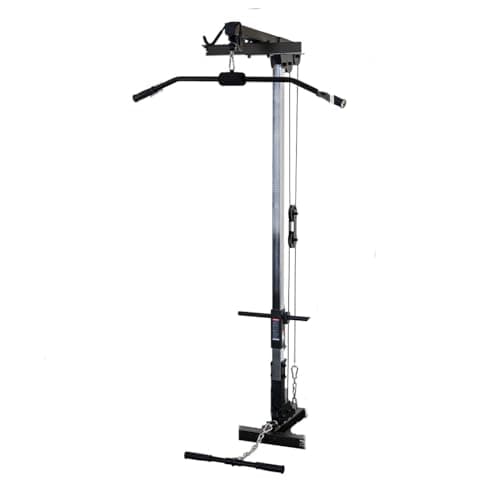
Titan Fitness Titan Fitness Short Lat Tower Attachment (T-3 / X-3)
Titan Fitness Short Lat Tower Attachment (T-3 / X-3)

Plate-loaded, 300 lb rated and bolted to a rack you already own — the version of this that has nothing to wear out.

Best lat tower attachment
8.0
$359.99Amazon
02
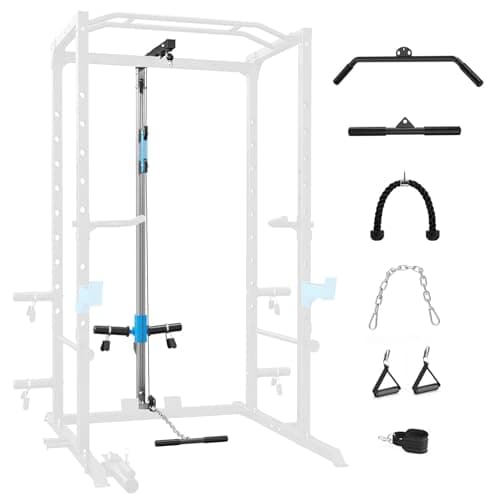
ULTRA FUEGO ULTRA FUEGO Lat Pulldown Attachment for Power Cage
ULTRA FUEGO Lat Pulldown Attachment for Power Cage

The cheapest honest way to add a pulley to a cage — provided it is the cage this was built for.

Cheapest rack pulley system
6.0
$99.99Amazon
03
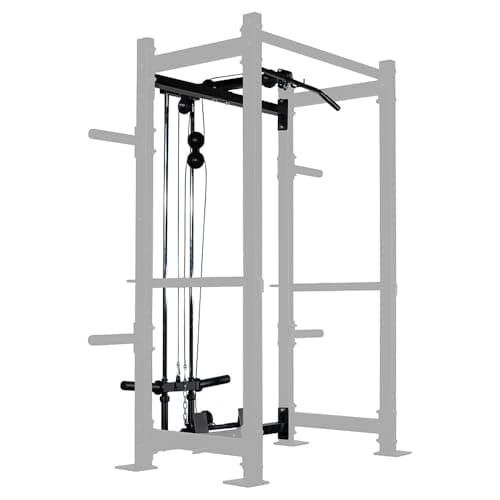
HulkFit HulkFit Pro Series Lat Pulldown Attachment
HulkFit Pro Series Lat Pulldown Attachment

The single attachment that changes what a rack can train — pulldowns and rows without a second machine.

Best rack upgrade overall
7.8
$130.26Amazon
04
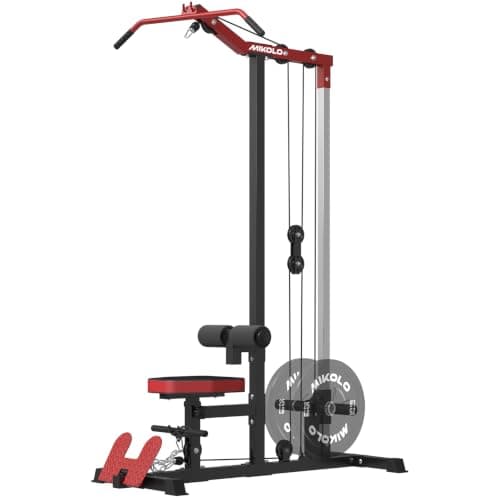
Mikolo Mikolo Lat Pulldown & Low Row Cable Machine
Mikolo Lat Pulldown & Low Row Cable Machine

A freestanding lat tower for anyone whose rack will not take an attachment — no fitment question to get wrong.

Best freestanding lat tower
7.6
$199.99Amazon

#ad · Live prices from the Amazon Product API, as of Sep 8, 2026. Where we have no verified live price, we show none — we would rather leave a gap than print a number that has rotted.

In detail

The picks, in full

01
Titan Fitness Titan Fitness Short Lat Tower Attachment (T-3 / X-3)

Best lat tower attachment

Titan Fitness Short Lat Tower Attachment (T-3 / X-3)

300 lb plate-loadedFits T-3 / X-3 bolt-down racksLat bar includedLow row handle included
8.0/10

Plate-loaded, 300 lb rated and bolted to a rack you already own — the version of this that has nothing to wear out.

Build & hardware
9
Fitment
6
Capacity
9
Completeness
9
Value
7

Pros

  • Plate-loaded rather than stack-loaded, so there is no weight stack, no selector pin and no proprietary plate shape to source in ten years
  • A 300 lb rated capacity is far beyond what anyone pulls down, which means the pulley is not the limiting part
  • Ships with both the lat bar and the low-row handle, so it is a complete station rather than a frame you then buy handles for

Cons

  • Fitment is specific — Titan states T-3 and X-3 bolt-down racks, so this is not a universal attachment
  • You load it with the plates you already own, which means walking plates between the bar and the tower

Don't buy this if…

you do not own a compatible Titan rack. Attachment fitment is decided by upright dimension and hole pattern, not goodwill — buy the attachment your rack's maker sells, or a freestanding tower.

$359.99View on Amazon

Price as of Sep 8, 2026. Prices change — Amazon's is the one that counts.

#ad · we may earn a commission from this link to Titan Fitness Short Lat Tower Attachment (T-3 / X-3)

02
ULTRA FUEGO ULTRA FUEGO Lat Pulldown Attachment for Power Cage

Cheapest rack pulley system

ULTRA FUEGO Lat Pulldown Attachment for Power Cage

Cable pulley systemFor ULTRA FUEGO power cageAttachment onlyMulti-function
6.0/10

The cheapest honest way to add a pulley to a cage — provided it is the cage this was built for.

Build & hardware
6
Fitment
4
Capacity
6
Completeness
5
Value
9

Pros

  • The lowest cost of any pulley system here by a wide margin
  • Attaches to a rack you already own, so it adds no floor space at all
  • A simple plate-loaded pulley has very little in it that can fail

Cons

  • The listing is explicit that it is designed for the maker's own power cage — treat cross-brand fitment as unproven, not likely
  • Attachment only, so budget for a lat bar and a row handle on top

Don't buy this if…

you own another brand's rack and are hoping it fits. Measure your upright and your hole diameter first; a pulley bracket that almost fits is a pulley bracket that does not.

$99.99View on Amazon

Price as of Sep 8, 2026. Prices change — Amazon's is the one that counts.

#ad · we may earn a commission from this link to ULTRA FUEGO Lat Pulldown Attachment for Power Cage

03
HulkFit HulkFit Pro Series Lat Pulldown Attachment

Best rack upgrade overall

HulkFit Pro Series Lat Pulldown Attachment

Lat pulldown + low rowPro Series cagesPlate-loadedBolt-on tower
7.8/10

The single attachment that changes what a rack can train — pulldowns and rows without a second machine.

Durability
7
Fitment
7
Function added
9
Ease of install
7
Value
9

Pros

  • Turns a squat-and-bench cage into a pulling station, which is the biggest single gap in a barbell-only gym
  • Plate-loaded rather than a weight stack, so it uses the plates you already own and has far less to break
  • From a brand whose racks are already common, so fitment guidance and spares are easy to find

Cons

  • Fits HulkFit Pro Series cages — check your upright size and hole spacing before ordering, not after
  • The cable is the wear part; budget on replacing it once over a long ownership

Don't buy this if…

your rack is from another brand and you haven't confirmed fitment. Attachment ecosystems are not interchangeable, and a non-fitting lat tower is an expensive shelf ornament.

$130.26View on Amazon

Price as of Sep 8, 2026. Prices change — Amazon's is the one that counts.

#ad · we may earn a commission from this link to HulkFit Pro Series Lat Pulldown Attachment

04
Mikolo Mikolo Lat Pulldown & Low Row Cable Machine

Best freestanding lat tower

Mikolo Lat Pulldown & Low Row Cable Machine

Lat pulldown + low rowLeg hold-downPlate-loadedFreestanding frame
7.6/10

A freestanding lat tower for anyone whose rack will not take an attachment — no fitment question to get wrong.

Build & hardware
7
Fitment
9
Capacity
6
Completeness
8
Value
8

Pros

  • Freestanding, so it does not care what rack you own or what hole pattern it uses
  • Covers both the pulldown and the seated row from one frame, which is most of what a cable station is for
  • The leg hold-down is the part budget towers skip, and without it heavy pulldowns lift you off the seat

Cons

  • A second frame takes floor space a rack attachment would not
  • The listing does not publish a steel gauge or a rated pull capacity, so heavy pullers should treat it as a home-use tower

Don't buy this if…

your rack takes a lat attachment from its own maker. Bolting the tower to the rack you already anchored is stiffer, cheaper and takes no extra floor.

$199.99View on Amazon

$229.9913% off

Price as of Sep 8, 2026. Prices change — Amazon's is the one that counts.

#ad · we may earn a commission from this link to Mikolo Lat Pulldown & Low Row Cable Machine

Attachment, freestanding tower, or a rack that already has cables?

Bolt-on attachment — the default

If your rack takes one, this is the answer. It uses no extra floor, it borrows the rack's anchoring and mass, and it costs less than any freestanding equivalent. The only question is fitment, and fitment is a tape-measure problem rather than a judgment call.

Freestanding tower — the fitment escape hatch

Some racks simply have no attachment: an unusual upright size, a discontinued brand, a folding wall-mounted frame with nowhere to bolt a tower. A freestanding lat machine sidesteps the whole question at the cost of a second footprint. It is also the right buy if you do not own a rack at all and never intend to.

A rack with the cables built in

Buying the capability up front is usually cheaper than adding it later, and it is always tidier. If you have not bought the rack yet, look at the racks with integrated cable systems before you commit to a bare cage plus an attachment — the combined price is often close and the geometry is always better. The three routes are compared side by side in power rack with cables vs functional trainer.

Plate-loaded or stack-loaded?

Plate-loaded towers use the Olympic plates already in your room, hung on a carriage that runs up the tower. Stack-loaded towers carry a column of rectangular steel plates and a selector pin.

The stack is genuinely nicer to use. You change weight in one second instead of walking plates across the room, and you can drop-set without stopping. What you pay for that is a longer parts list: guide rods that need to stay straight, bushings in the plates, a selector pin and its spring, and a stack whose plate shape is proprietary to that machine. In ten years the plate-loaded tower needs, at most, a cable. This is the same reasoning we apply to adjustable versus fixed dumbbells: every convenience mechanism is also a failure mechanism.

What actually wears out on a lat tower

In order: the cable, the pulley bearing, then nothing for a very long time. Steel cable fails gradually and visibly — individual strands fray at the point where the cable bends hardest, which is at the pulley. Inspect there, not along the straight runs. Any fraying at all means replace the cable; a cable that fails under load drops the carriage and whips.

Pulleys are the other item. A pulley that has gone dry squeals and drags, and the cheap ones use a molded plastic wheel on a plain bolt. Nylon or aluminum sheaves on a sealed bearing last far longer and are worth looking for on the listing photos. Both parts are ordinary industrial components rather than proprietary shapes, which is the argument for a simple tower over a clever one — see home gym replacement parts for where to source them.

Two things people get wrong after it is installed

Skipping the leg hold-down. A pulldown pulls you up out of the seat before it pulls the bar down. Any tower without a thigh restraint caps the weight you can use at roughly your bodyweight, which for most lifters arrives sooner than expected.

Leaving the rack unanchored. The load path on a lat tower runs down the tower, into the rack, and out through the front feet as an upward pull. On a heavy bolted cage that is a non-event. On a light free-standing rack it is how the whole thing starts walking across the floor.
How we picked

We do not run a testing lab

We compiled manufacturer specifications, read the published warranties, checked the relevant standards and aggregated owner reviews, then scored each product against a published rubric. The scores are judgments from documented research — they are not measurements we took, because we do not run a lab and we are not going to pretend we do. Where a number came from a manufacturer or a standard, we name it and link it in Sources.

Questions

Frequently asked

Will a lat pulldown attachment fit any power rack?

No, and the ones that claim to are the ones to be careful with. Fitment is decided by the upright tube dimension (2×2, 2×3 or 3×3), the hole diameter (commonly 5/8 or 1 inch) and whether the rack is bolted down. Measure all three before ordering, and prefer the attachment sold by your rack's own manufacturer.

Do I need to bolt my rack down for a lat attachment?

Usually yes, and several manufacturers say so on the listing. A lat tower converts a downward pull into an upward force on the front of the rack. A heavy cage loaded with plates may cope unanchored; a light free-standing rack will lift. See how to anchor a rack.

Is a plate-loaded or a weight-stack lat tower better?

Plate-loaded lasts longer and costs less; a stack is faster to use. A plate-loaded tower is a post, a pulley, a cable and a carriage, with no proprietary parts. A stack adds guide rods, plate bushings and a selector pin. If you are buying once, buy plate-loaded.

How much weight can a lat attachment take?

Where it is published, ratings on home lat towers are commonly in the low hundreds of pounds — the Titan short tower, for example, publishes a 300 lb plate-loaded capacity. That is well beyond what almost anyone pulls down. Where a listing publishes no figure, treat it as home-duty and do not load it toward a number nobody has stated.

What replaces a worn lat cable?

Steel cable of the correct diameter with the right end fittings — an ordinary industrial part, not a proprietary one. Inspect at the pulley, where the cable bends hardest, and replace at the first sign of a frayed strand rather than waiting.

Keep reading

Receipts

Sources

We do not run a testing lab, and we do not pretend to. Every spec, warranty term and standard above is the manufacturer's or a published source, cited and linked. Where we could not verify something, we say so on the page rather than quietly leaving it out. Read our full method.