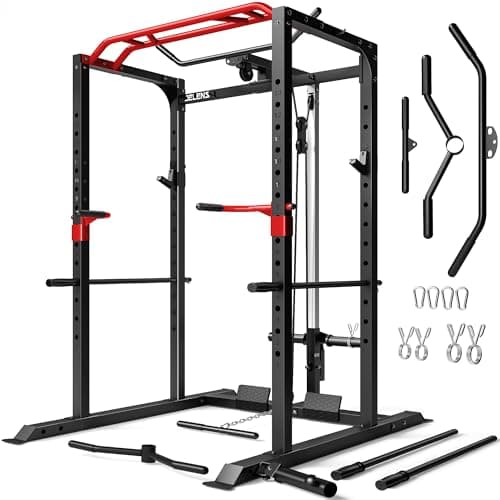
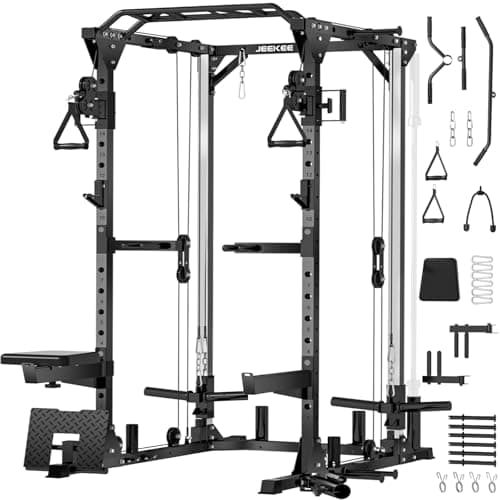
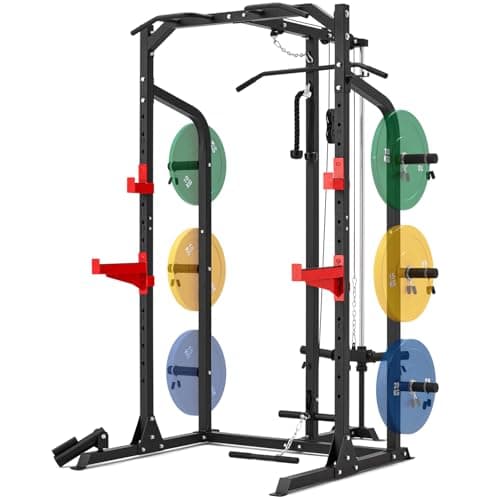
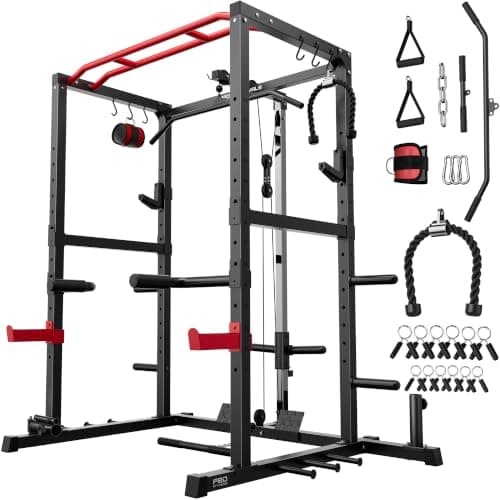
Buy the SPORTSROYALS 1,200 lb cage if you want a straightforward rack with a lat tower that works, or the JEEKEE if you specifically want independent dual pulleys for crossover work. Both save you buying a rack and a cable machine separately, which is the entire argument for this category.
Why build the cables in?
A barbell and a rack cover squats, presses, pulls and rows brilliantly. What they cover badly is vertical pulling under controlled load — lat pulldowns — and the light, high-rep isolation work that keeps shoulders and elbows healthy. You can solve that with a pull-up bar and bands, and plenty of people do. A cable tower solves it with adjustable resistance in small increments, which is a genuinely different tool.
Buying it built in is usually cheaper than buying it later. A bare cage plus a bolt-on lat attachmenttypically costs more than a cage that shipped with one, and you spend an evening fitting it. The counter-argument is real too: an integrated tower ties you to that rack's ecosystem for spares.
One number to read carefully on any of these: the pulley ratio. A tower reeved 2:1 puts about half the loaded weight in your hands, which is why cable work on a rack can feel light against the plates hanging off it. The arithmetic is in what a cable machine weight stack number means.
What we rank on
- The rack first, the cables second. A cable system bolted to a frame that flexes is a bad purchase. We rank the published capacity and frame construction before we look at the pulleys.
- Single tower or independent pulleys. One lat tower does pulldowns and low rows. Independent dual pulleys do those plus crossovers and unilateral work, because each side moves separately. That is the single biggest functional difference on this page.
- Plate-loaded, not stack-loaded. Every rack here loads with the Olympic plates you already own. That is cheaper, it uses plates you own anyway, and there is dramatically less to go wrong than in a selectorized stack.
- Cable serviceability. The steel cable is the shortest-lived part of the whole rack. We favor brands more likely to still be selling a replacement in five years.
- Attachments included. A lat bar, a row handle and a set of clips are $80 of accessories. Racks that include them are cheaper than their sticker suggests.
Which of these actually includes a lat pulldown?
"Rack with cables" covers three different things, and the difference decides whether you can do the movement you came here for. Every figure below is taken from the manufacturer listing for that rack; where a listing does not publish something, the table says so rather than guessing.
| Rack | Lat pulldown | Low row | Independent pulleys | Published frame rating |
|---|
| SPORTSROYALS | Yes, in the box | Yes | No — single tower | 1,200 lb |
| JELENS S11 | Yes, in the box | Via the adjustable pulley | No — single adjustable pulley | 2,000 lb |
| JEEKEE | Yes, in the box | Yes | Yes — the only one here | 2,000 lb |
| RUNFREELY | Yes — integrated pulley system | Not published | Not published | Not published |
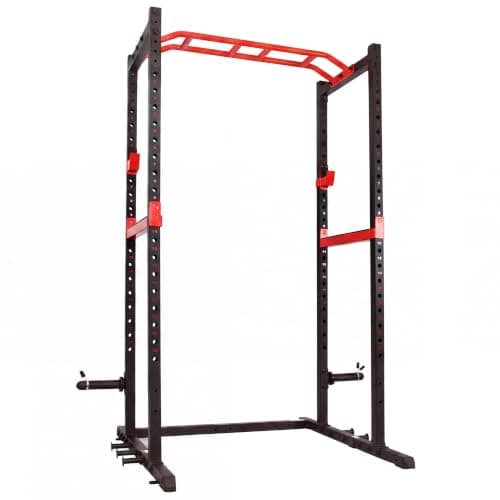
| Sunny Power Zone | No — added later from the Power Zone line | No | No | Not published |
Read that table as a shopping list rather than a ranking. If the whole reason you are here is a rack with a lat pulldown already attached, the first four qualify and the Sunny does not — it is on this page because its add-on line is how you get there later, which is a different and perfectly good plan.
If crossovers matter to you, only the JEEKEE does them, because crossovers need two pulleys that move independently. A single tower with one cable cannot produce that movement no matter how many handles come in the box.
Built into the rack, or a machine of its own?
The third way to get cables is not on this page at all: a standalone functional trainer, standing beside a bare rack rather than bolted into one. It buys far more pulley height positions and costs a second footprint, a second anchoring job and, usually, more money overall.
Which way round that lands depends almost entirely on whether you have bought your rack yet. We work through all three routes — built-in tower, bolt-on attachment, standalone machine — in power rack with cables vs functional trainer. And if you are still deciding how much rack to buy before you worry about the cables, the tier breakdown is in the best power racks by budget.
The honest durability trade-off
We rank home gym gear on how long it lasts, so we will say this plainly: a rack with cables is less buy-it-for-life than the same rack without them. The steel frame is as permanent as any other cage. The pulleys, the cable and the cable ends are not — they are wear items with a service life measured in years of use rather than decades.
That does not make it a bad purchase. It makes it a purchase with a maintenance item, like a bench pad or a barbell's sleeve bushings. Inspect the cable annually for broken strands, keep the pulleys free of grit, and budget on one cable replacement over a long ownership. Do that and the rack outlives everything else in the room anyway.
How much rack do you actually need?
Published capacities on this page run from around 1,200 lb to 2,000 lb. Those figures are useful mainly as a proxy for how the frame is built — nobody training at home is loading 2,000 lb onto anything. If you squat 315 and bench 225, every rack here clears your loads with an enormous margin, and you should spend the difference on plates, a better bar, or a bench that does not flex.
A cage with the pulleys built in is also the smallest way to own cables, because one frame does both jobs on one footprint. What that footprint has to include — and the clearance in front that decides whether you enjoy using it — is covered on how much space a functional trainer needs.
How to choose a cable rack
Measure the depth, not just the width
Cable towers hang off the back of a rack, and crossover arms swing out from the sides. The footprint on the listing is often the frame only. Add the tower depth and the arm swing before you decide it fits, and leave room to actually stand behind it for pulldowns.
Independent pulleys are worth it only if you will use them
If your cable work is pulldowns, rows and triceps pushdowns, a single lat tower does all of it and has half the mechanism. Independent dual pulleys earn their keep for crossovers, unilateral rows and anything where the two sides need different paths. Buy the extra complexity for a reason, not for the spec sheet.
Check what loads the cable
Plate-loaded cables use a carriage that takes your Olympic plates. Confirm the carriage takes 2 inch plates (all of these do) and look at how many it holds — a short post limits your pulldown weight more than the cable ever will.
Assume you will re-torque it
Cable racks have more fasteners than a plain cage and the pulleys apply load in directions the frame does not otherwise see. Torque check at a month, then annually — the same habit we recommend for every bolt-together rack.