Skip to content
Plate&Rack

The frame · Power Racks & Cages

How Much Space Does a Functional Trainer Need?

Nobody returns a cable machine because the frame did not fit. They return it because the attachment hits a wall at full extension — which is a different measurement, and not one any listing gives you.

By Stephen V.Updated How we choose
#ad

We earn a commission when you buy through our Amazon links, at no extra cost to you. It never affects our rankings, and we say so when the cheaper product is the better buy. How this works.

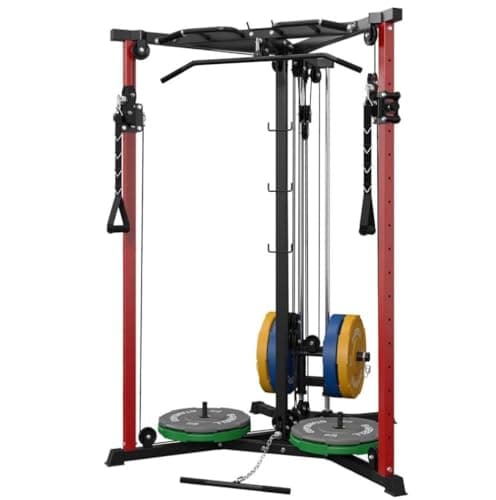
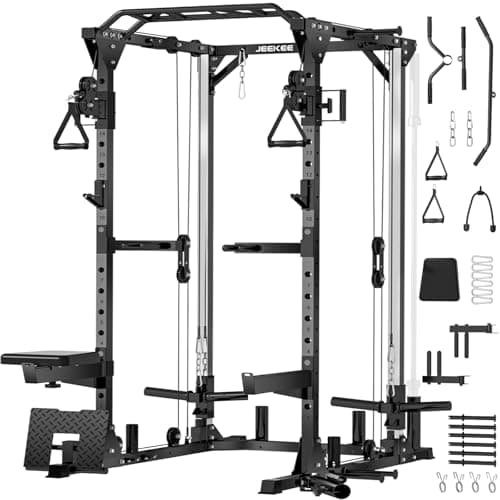
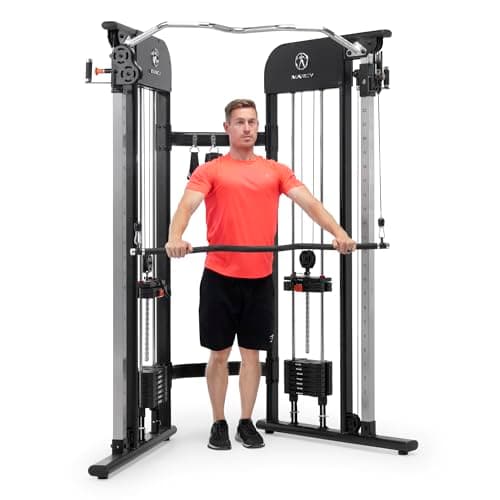
Plan on the frame plus about six feet of clear floor in front of it, plus enough ceiling for the high pulley to be above your reach, plus access to one side or the back to load plates or reach the stack. The number that catches people out is the second one: a cable exercise is defined by how far the handle travels, so the working space is the arc the attachment sweeps, not the rectangle the machine stands in. Of the machines we rank, the Mikolo cable crossover is the plate-loaded one with 17 pulley positions and the least inside it — the pick if space and simplicity both matter. The JEEKEE cage is the pick if the cables should share a footprint with your rack rather than take their own — a published 2,000 lb cage with independent dual pulleys, a lat pulldown and a seat. The Marcy MFT-942 is the pick if you want a true gym machine, with two 200 lb stacks at a 2:1 ratio — and it is also the largest and least forgiving of a small room.

If the room is the whole problem rather than one constraint among several, start at functional trainers for small spaces. This page is the measuring method behind that one, and it applies to any cable machine including the ones we do not rank.

The four measurements, in the order they bind

1. Cable travel in front of the machine

This is the measurement that decides whether you will enjoy owning a cable machine, and it is the one no listing gives. A cable press, a cable row, a crossover and a pallof press all end with the handle a long way from the pulley. If the wall behind you is closer than that, you shorten the exercise to fit the room.

A usable rule: stand where you would train, extend your arms fully in the direction the cable pulls, and add a pace. For most people that is five to seven feet of clear floor measured out from the pulley column. Two people doing crossovers need it on both sides. It is nearly always more than the frame itself occupies.

2. Ceiling height for the high pulley

A functional trainer earns its money at the top of the column — lat pulldowns, face pulls, triceps pushdowns and the high half of a crossover. For those the pulley must sit above your standing reach, and on a machine with an adjustable carriage that means the top setting has to clear your ceiling.

Measure to the lowest obstruction rather than the ceiling: a garage door track, a light fixture or a joist will bind before the plaster does. The low-ceiling problem has its own treatment for racks on power racks for low ceilings, and the arithmetic is the same here.

3. The frame footprint, which is the easy one

The footprint is the number people measure first and worry about most, and it is the least likely to be the binding constraint. It is also, unhelpfully, the number this category publishes least: not one of the three machines we rank states an assembled footprint on its listing, which is why the table below says so rather than guessing.

What you can take from the listings is the machine's shape. A crossover frame is wide and shallow; a cable cage is a cube; a dual-stack trainer is wide, deep and heavy. Those three shapes fit three different rooms, and the shape tells you more than a footprint would.

4. Access to load it

A plate-loaded machine needs you to be able to reach the loading pins with a plate in your hand, which usually means clear space at one side or behind. A weight-stack machine needs you to reach the selector pin — much less room, but it is still not zero, and a stack pushed flat against a wall is a machine you cannot change the weight on.

This is the constraint that most often turns a plan to put the machine in a corner into a plan to put it along a wall. Which of the two loading systems you want is settled on plate-loaded vs weight-stack cable machines.

The three, side by side

As publishedMikolo crossoverJEEKEE cable cageMarcy MFT-942
ShapeWide, shallow crossover frameFull cage with pulleysFreestanding dual-stack trainer
Assembled footprintNot publishedNot publishedNot published
LoadingPlate-loadedPlate-loadedTwo 200 lb stacks
Cable ratioNot publishedNot published2:1
Pulley positions17 adjustableIndependent dual pulleysDual adjustable pulleys
Doubles as a rackNoYes, 2,000 lb rated cageNo
Seat includedLat pulldown and seated rowYesNot published
Attachments includedNot published20+Not published
Needs loading accessYes, plate pinsYes, plate pinsSelector pin only

Every cell is quoted from the manufacturer listing linked in Sources, and where a listing does not state a figure the cell says so. The second row is the point of this page: none of the three publishes an assembled footprint, so the measuring is yours to do and the tape is the only reliable instrument in this purchase.

The cheapest way to need less space

Two of them, and both are worth considering before you buy a dedicated machine.

  • Put the cables on the rack you already own. A lat tower or pulley attachment bolts to an existing frame and adds no footprint at all, because the frame is already standing in the room. It is the single biggest space saving available and the options are on the lat pulldown attachments page.
  • Buy a cage that has the pulleys built in. One frame, one footprint, both jobs. That is the JEEKEE's whole argument, and the broader category is on the best power racks with cables. Whether that or a standalone machine suits you is the subject of power rack with cables vs functional trainer.

Both routes trade something. An attachment usually has fewer pulley positions than a dedicated machine; a cable cage puts the pulleys where the cage wants them rather than where a crossover would. Neither is a compromise on durability, which is the thing this site cares about most — and on the durability question a plate-loaded pulley with no stack and no selector is the simplest mechanism in the whole category.

Before you order: the five-minute floor test

Do this with masking tape and a tape measure. It takes less time than reading the reviews and it catches every mistake this page is about.

  • Tape the frame shape on the floor where you intend it to live — a rectangle a little wider than your arm span for a crossover, a square for a cage.
  • Stand inside it, extend your arms in the direction the cable will pull and take one pace. Tape that line too. That is your working envelope, and it is the number that matters.
  • Reach straight up. If your fingertips are within a foot of the ceiling or of any fixture, the high pulley is going to be a problem.
  • Check you can stand at the loading point with a plate held at waist height without touching a wall.
  • Walk the route from your front door to the tape with a tape measure. These machines arrive in long heavy cartons and doorways, stair turns and landings are where they get stuck.

If the tape says it does not fit, the honest options are the rack attachment, the cable cage, or waiting. A cable machine squeezed into a room that cannot hold its working envelope gets used for two exercises and resented for the rest — which is the case made at length on are functional trainers worth it.
The short answer

Quick picks

#ProductBest forScorePrice
01
Mikolo Mikolo Cable Crossover Functional Trainer (17 positions)
Mikolo Cable Crossover Functional Trainer (17 positions)

Plate-loaded dual pulleys at a fraction of stack-machine money — and with far less inside it to break.

Best value functional trainer
8.0
$379.99Amazon
02
JEEKEE JEEKEE Power Cage with Cable Crossover (2,000 lb)
JEEKEE Power Cage with Cable Crossover (2,000 lb)

Independent dual pulleys and a seat make this the closest thing here to a commercial functional trainer.

Best cable crossover rack
7.4
$479.99Amazon
03
Marcy Marcy Multi-Functional Trainer MFT-942 (dual 200 lb stacks)
Marcy Multi-Functional Trainer MFT-942 (dual 200 lb stacks)

A real dual-stack trainer from a brand that has been selling parts for decades — the one here that behaves like a gym machine.

Best dual weight-stack trainer
7.4
$1,677.67Amazon

#ad · Live prices from the Amazon Product API, as of October 23, 2026. Where we have no verified live price, we show none — we would rather leave a gap than print a number that has rotted.

In detail

The picks, in full

01
Mikolo Mikolo Cable Crossover Functional Trainer (17 positions)

Best value functional trainer

Mikolo Cable Crossover Functional Trainer (17 positions)

17 adjustable pulley positionsHigh + low pulleyPlate-loadedLat pulldown + seated row
8.0/10

Plate-loaded dual pulleys at a fraction of stack-machine money — and with far less inside it to break.

Build & hardware
7
Cable + pulley quality
7
Range of positions
9
Serviceability
8
Value
9

Pros

  • Plate-loaded rather than stack-loaded, which removes the selector pin, the guide rods and the proprietary stack — the three parts that end a cable machine's life
  • Seventeen pulley heights cover the whole crossover and pulldown range rather than the two or three a budget tower offers
  • You load it with the Olympic plates already in the room, so nothing new is proprietary

Cons

  • Loading plates between exercises is slower than moving a selector pin, and that friction is real
  • The listing does not publish a cable rating or a steel gauge, so it is a home-duty frame rather than a commercial one

Don't buy this if…

…you want to change resistance between sets in two seconds. That convenience is exactly what a weight stack buys, and it is the reason to pay for one.

$379.99View on Amazon

$429.9912% off

Price as of October 23, 2026. Prices change — Amazon's is the one that counts.

#ad · we may earn a commission from this link to Mikolo Cable Crossover Functional Trainer (17 positions)

02
JEEKEE JEEKEE Power Cage with Cable Crossover (2,000 lb)

Best cable crossover rack

JEEKEE Power Cage with Cable Crossover (2,000 lb)

2,000 lb ratedIndependent dual pulleysLat pulldown + seat20+ attachments
7.4/10

Independent dual pulleys and a seat make this the closest thing here to a commercial functional trainer.

Build & steel
7
Capacity
8
Expandability
9
Footprint
5
Value
8

Pros

  • Independent dual pulleys mean each side moves on its own — the feature that separates a crossover from a lat tower
  • Includes a seat cushion and a large attachment set, so you are not buying handles for a year
  • One frame replaces a cage, a lat machine and a crossover station in a garage that has room for one thing

Cons

  • The most complicated rack on this list, and complexity is the enemy of a buy-it-for-life purchase
  • Big footprint and a long assembly — this is a build-it-once, never-move-it machine

Don't buy this if…

…your training is squat, bench, deadlift and press. You would be buying and eventually maintaining a cable system to do accessory work a $40 set of bands covers.

$479.99View on Amazon

Price as of October 23, 2026. Prices change — Amazon's is the one that counts.

#ad · we may earn a commission from this link to JEEKEE Power Cage with Cable Crossover (2,000 lb)

03
Marcy Marcy Multi-Functional Trainer MFT-942 (dual 200 lb stacks)

Best dual weight-stack trainer

Marcy Multi-Functional Trainer MFT-942 (dual 200 lb stacks)

Two 200 lb stacks2:1 cable ratioDual adjustable pulleysModel MFT-942
7.4/10

A real dual-stack trainer from a brand that has been selling parts for decades — the one here that behaves like a gym machine.

Build & hardware
8
Cable + pulley quality
8
Range of positions
9
Serviceability
7
Value
5

Pros

  • Two independent 200 lb stacks mean instant weight changes and genuine unilateral work, which is the whole point of a functional trainer
  • The 2:1 ratio is published rather than left vague, so you can actually compute what the handle weighs
  • Marcy is an established brand with a long model history, which matters most on the one product class where cables and pulleys eventually need replacing

Cons

  • By far the most expensive item we rank, and the cost per year only works if you genuinely use cables
  • A stack machine has guide rods, bushings, cables and a selector — more wear items than everything else on this site combined

Don't buy this if…

…you mostly squat, press and pull with a barbell. A rack, a bar and plates will outlive this by decades and cost a fraction of it — cables are an addition to that, not a replacement for it.

$1,677.67View on Amazon

Price as of October 23, 2026. Prices change — Amazon's is the one that counts.

#ad · we may earn a commission from this link to Marcy Multi-Functional Trainer MFT-942 (dual 200 lb stacks)

How we picked

We do not run a testing lab

We compiled manufacturer specifications, read the published warranties, checked the relevant standards and aggregated owner reviews, then scored each product against a published rubric. The scores are judgments from documented research — they are not measurements we took, because we do not run a lab and we are not going to pretend we do. Where a number came from a manufacturer or a standard, we name it and link it in Sources.

Questions

Frequently asked

How much space do you need for a functional trainer?

The frame plus roughly five to seven feet of clear floor in front of it, enough ceiling for the high pulley to sit above your standing reach, and access to one side or the back for loading. The floor in front is the measurement that catches people out, because a cable exercise is defined by how far the handle travels rather than by where the machine stands.

How much space do you need in front of a functional trainer?

Enough to extend your arms fully in the direction the cable pulls, plus a pace — about five to seven feet for most people, and on both sides if you want to do crossovers. If the wall is closer than that, you will shorten the movement to fit the room, which is the main reason people stop using a cable machine they bought.

What ceiling height do you need for a cable machine?

Enough for the high pulley to sit above your standing reach, measured to the lowest obstruction rather than to the ceiling — a garage door track, a light or a joist will bind first. If the ceiling is the constraint, a rack-mounted lat attachment set at your own chosen height is the more flexible answer.

Do functional trainers publish their dimensions?

Mostly not. None of the three machines we rank states an assembled footprint on its listing, which is why we publish the measuring method instead of a table of numbers we would have had to invent. Treat a listing with no footprint as a listing that has told you nothing about whether it fits.

Is a functional trainer or a power rack with cables better for a small room?

A cage with the pulleys built in, almost always — one frame does both jobs on one footprint, where a rack plus a standalone trainer needs two. The trade is that the pulleys sit where the cage puts them. The full comparison is on power rack with cables vs functional trainer.

Keep reading

Receipts

Sources

We do not run a testing lab, and we do not pretend to. Every spec, warranty term and standard above is the manufacturer's or a published source, cited and linked. Where we could not verify something, we say so on the page rather than quietly leaving it out. Read our full method.