Skip to content
Plate&Rack

The frame · Power Racks & Cages

The Best Functional Trainers & Cable Machines

A cable machine is the least buy-it-for-life thing you can put in a home gym. That is not a reason to avoid one — it is a reason to buy the one with the shortest parts list.

By Stephen V.Updated How we choose
#ad

We earn a commission when you buy through our Amazon links, at no extra cost to you. It never affects our rankings, and we say so when the cheaper product is the better buy. How this works.

Buy the plate-loaded crossover if you want cables cheaply and permanently, the dual-stack trainer if you will genuinely train on it several times a week, and a rack with built-in pulleys if you have not bought your rack yet. All three get you cables. They differ enormously in how many parts they contain.

Why this is the hardest category on this site

Everything else we rank is essentially inert. A plate is iron. A bar is a shaft and two sleeves. A rack is welded or bolted tube. None of them has anything inside that is trying to move against something else — which is why the durability hierarchy puts them at the top.

A cable machine is the opposite. Steel cable runs over pulleys under load, thousands of times a year, bending sharply at each sheave. A weight stack rides on guide rods through plastic bushings. A selector pin goes in and out of a hole cut in soft steel. Every one of those is a wear interface, and they are the reason commercial gyms have a maintenance contract for the cable machines and nothing at all for the plates.

So the durability question here is not "will it last forever" — it will not. It is "when a part wears, can I get that part." That reframes the whole buying decision.

What we rank on

  • Number of wear interfaces. Plate-loaded beats stack-loaded on this measure by a wide margin: no guide rods, no plate bushings, no selector pin, no proprietary stack.
  • Cable and pulley specification. Steel cable over a bearing-mounted sheave is serviceable with ordinary industrial parts. A molded plastic wheel on a plain bolt is a consumable that will squeal within a couple of years.
  • Published ratio. A trainer that states its cable ratio — 2:1 is common — lets you compute what the handle actually weighs. One that stays quiet about it is asking you to guess, and the number is usually not in your favor.
  • Adjustment range. The whole point of a functional trainer is pulley height. Two or three positions is a lat tower with ambitions; seventeen is a trainer.
  • Brand persistence. On the one category where parts eventually matter, a brand with a long model history is worth a premium. See the durable home gym brands.

What the cable ratio actually means

On most home functional trainers the cable is reeved so that the handle moves further than the weight does. A 2:1 ratio means the handle travels twice as far and carries roughly half the load on the stack — so a 200 lb stack gives about 100 lb at the handle, before friction. This is not a trick; long cable travel is what makes crossovers and rotational work possible. But it does mean that a 200 lb stack and a 200 lb barbell are not the same 200 lb, and a listing that quotes stack weight without stating the ratio is quoting a number you cannot use.

Plate-loaded machines have the same issue in reverse: if the carriage runs on a 2:1 reeving, the plates you hang on it deliver about half their weight at the handle. Check the ratio, then stop comparing cable weights with barbell weights entirely.

The short answer

Quick picks

#ProductBest forScorePrice
01
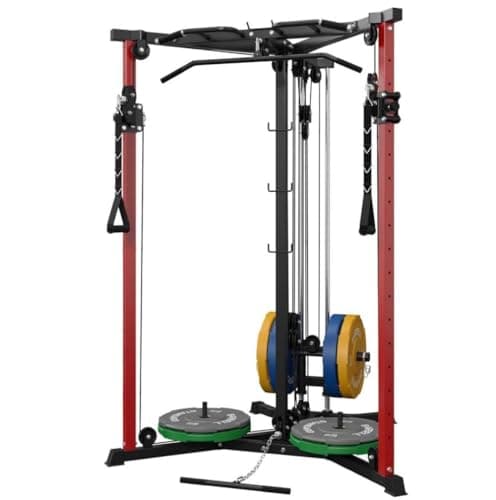
Mikolo Mikolo Cable Crossover Functional Trainer (17 positions)
Mikolo Cable Crossover Functional Trainer (17 positions)

Plate-loaded dual pulleys at a fraction of stack-machine money — and with far less inside it to break.

Best value functional trainer
8.0
$429.99Amazon
02
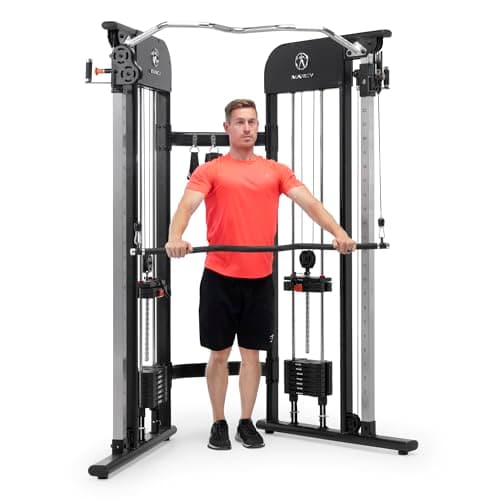
Marcy Marcy Multi-Functional Trainer MFT-942 (dual 200 lb stacks)
Marcy Multi-Functional Trainer MFT-942 (dual 200 lb stacks)

A real dual-stack trainer from a brand that has been selling parts for decades — the one here that behaves like a gym machine.

Best dual weight-stack trainer
7.4
Check price →
03
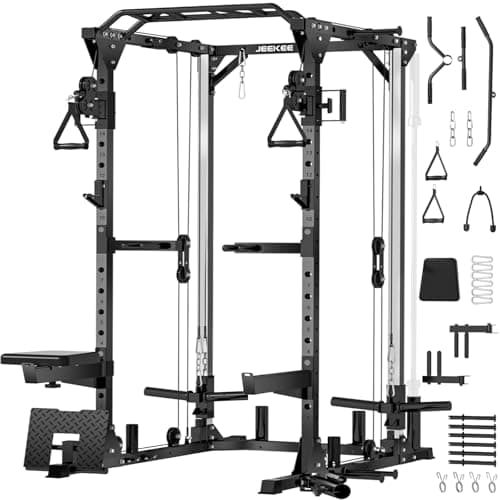
JEEKEE JEEKEE Power Cage with Cable Crossover (2,000 lb)
JEEKEE Power Cage with Cable Crossover (2,000 lb)

Independent dual pulleys and a seat make this the closest thing here to a commercial functional trainer.

Best cable crossover rack
7.4
$469.99Amazon

#ad · Live prices from the Amazon Product API, as of Sep 8, 2026. Where we have no verified live price, we show none — we would rather leave a gap than print a number that has rotted.

In detail

The picks, in full

01
Mikolo Mikolo Cable Crossover Functional Trainer (17 positions)

Best value functional trainer

Mikolo Cable Crossover Functional Trainer (17 positions)

17 adjustable pulley positionsHigh + low pulleyPlate-loadedLat pulldown + seated row
8.0/10

Plate-loaded dual pulleys at a fraction of stack-machine money — and with far less inside it to break.

Build & hardware
7
Cable + pulley quality
7
Range of positions
9
Serviceability
8
Value
9

Pros

  • Plate-loaded rather than stack-loaded, which removes the selector pin, the guide rods and the proprietary stack — the three parts that end a cable machine's life
  • Seventeen pulley heights cover the whole crossover and pulldown range rather than the two or three a budget tower offers
  • You load it with the Olympic plates already in the room, so nothing new is proprietary

Cons

  • Loading plates between exercises is slower than moving a selector pin, and that friction is real
  • The listing does not publish a cable rating or a steel gauge, so it is a home-duty frame rather than a commercial one

Don't buy this if…

you want to change resistance between sets in two seconds. That convenience is exactly what a weight stack buys, and it is the reason to pay for one.

$429.99View on Amazon

Price as of Sep 8, 2026. Prices change — Amazon's is the one that counts.

#ad · we may earn a commission from this link to Mikolo Cable Crossover Functional Trainer (17 positions)

02
Marcy Marcy Multi-Functional Trainer MFT-942 (dual 200 lb stacks)

Best dual weight-stack trainer

Marcy Multi-Functional Trainer MFT-942 (dual 200 lb stacks)

Two 200 lb stacks2:1 cable ratioDual adjustable pulleysModel MFT-942
7.4/10

A real dual-stack trainer from a brand that has been selling parts for decades — the one here that behaves like a gym machine.

Build & hardware
8
Cable + pulley quality
8
Range of positions
9
Serviceability
7
Value
5

Pros

  • Two independent 200 lb stacks mean instant weight changes and genuine unilateral work, which is the whole point of a functional trainer
  • The 2:1 ratio is published rather than left vague, so you can actually compute what the handle weighs
  • Marcy is an established brand with a long model history, which matters most on the one product class where cables and pulleys eventually need replacing

Cons

  • By far the most expensive item we rank, and the cost per year only works if you genuinely use cables
  • A stack machine has guide rods, bushings, cables and a selector — more wear items than everything else on this site combined

Don't buy this if…

you mostly squat, press and pull with a barbell. A rack, a bar and plates will outlive this by decades and cost a fraction of it — cables are an addition to that, not a replacement for it.

Check price on Amazon →

No buyable offer at the last price check (Sep 8, 2026). We show nothing rather than a stale number.

#ad · we may earn a commission from this link to Marcy Multi-Functional Trainer MFT-942 (dual 200 lb stacks)

03
JEEKEE JEEKEE Power Cage with Cable Crossover (2,000 lb)

Best cable crossover rack

JEEKEE Power Cage with Cable Crossover (2,000 lb)

2,000 lb ratedIndependent dual pulleysLat pulldown + seat20+ attachments
7.4/10

Independent dual pulleys and a seat make this the closest thing here to a commercial functional trainer.

Build & steel
7
Capacity
8
Expandability
9
Footprint
5
Value
8

Pros

  • Independent dual pulleys mean each side moves on its own — the feature that separates a crossover from a lat tower
  • Includes a seat cushion and a large attachment set, so you are not buying handles for a year
  • One frame replaces a cage, a lat machine and a crossover station in a garage that has room for one thing

Cons

  • The most complicated rack on this list, and complexity is the enemy of a buy-it-for-life purchase
  • Big footprint and a long assembly — this is a build-it-once, never-move-it machine

Don't buy this if…

your training is squat, bench, deadlift and press. You would be buying and eventually maintaining a cable system to do accessory work a $40 set of bands covers.

$469.99View on Amazon

Price as of Sep 8, 2026. Prices change — Amazon's is the one that counts.

#ad · we may earn a commission from this link to JEEKEE Power Cage with Cable Crossover (2,000 lb)

Do you actually need a cable machine?

Asked honestly, for a lot of home gyms the answer is no, and we would rather say that than sell a machine. A rack, a bar and plates cover every compound lift there is. What cables add is constant tension, easy unilateral work, and pulling angles a barbell cannot make — genuinely useful, but additive rather than foundational.

The order of purchase we recommend in what to buy, in what order puts cables near the end for exactly this reason. If you do not yet own a bench, buy the bench.

The three shapes this comes in

Plate-loaded crossover

Two adjustable pulleys, a carriage on each side, and you hang your own Olympic plates. The cheapest route to real dual-pulley work, and by a distance the one with the fewest parts. The cost is convenience: changing weight means moving plates.

Dual weight stacks

The gym-floor experience — pin the weight, train, move on. Two independent stacks let you load each side differently, which is the honest reason to want a trainer rather than a lat tower. It is also the most mechanically complex thing this site ranks, and the most expensive.

A rack with the pulleys built in

Structurally the smartest option if you have not bought a rack yet: one frame, one footprint, one anchoring job. You give up the pulley height range of a dedicated trainer and you are tied to that rack's cable geometry. Compare the options on racks with cables, and if you only want vertical pulling, a lat attachment is cheaper than all of it.

How to make one last

Inspect the cable at the pulleys. Wire rope frays where it bends. Run a rag along it every few months — the rag snags on a broken strand before your eye finds it. One broken strand means order a replacement cable; do not wait for two.

Keep grit out of the guide rods. On a stack machine, dust plus lubricant makes a grinding paste. Wipe the rods, then re-apply a light silicone or dry lubricant rather than a heavy grease that collects dirt.

Do not let the stack slam. Lowering under control is a training instruction everywhere else on this site; on a cable machine it is also a maintenance instruction. A dropped stack shock-loads the cable and the top plate every single rep.

Write the model number down. Cable machines are the one category where you will eventually order a part, and every parts request starts with a model number. Photograph the sticker on the frame when it arrives — see home gym replacement parts.
How we picked

We do not run a testing lab

We compiled manufacturer specifications, read the published warranties, checked the relevant standards and aggregated owner reviews, then scored each product against a published rubric. The scores are judgments from documented research — they are not measurements we took, because we do not run a lab and we are not going to pretend we do. Where a number came from a manufacturer or a standard, we name it and link it in Sources.

Questions

Frequently asked

Are functional trainers worth it for a home gym?

They are worth it if you will use cables several times a week and you already own a rack, a bar and plates. They are not a substitute for those. A functional trainer adds pulling angles and constant tension a barbell cannot produce — but it is also the piece with the most wear parts in the room, so buy it last and buy it for a reason.

What is the difference between a functional trainer and a cable crossover?

In practice the terms overlap. A cable crossover is the two-tower layout aimed at chest flyes and wide pulling. A functional trainer is usually a narrower single frame with two independently adjustable pulleys covering the same movements plus rows and pulldowns. What matters more than the label is whether the pulleys adjust through a useful range and whether the two sides are independent.

What does a 2:1 cable ratio mean?

It means the handle moves twice as far as the weight and carries roughly half of it. A 200 lb stack on a 2:1 machine gives about 100 lb at the handle before friction. The ratio exists to give you enough cable travel for full-range movements; it also means stack weight and barbell weight are not comparable numbers.

What breaks first on a cable machine?

The cable, then the pulleys. Wire rope frays where it bends hardest, which is at the sheave, so inspect there. After that it is pulley bearings — plastic wheels on plain bolts go first, sealed bearings on nylon or aluminum sheaves last far longer. Guide rods and selector pins on a stack machine come next.

Can I add cables to the power rack I already own?

Often, yes — a lat tower or pulley attachment bolts to a compatible rack for a fraction of the price of a trainer. Fitment depends on your upright dimension, hole diameter and whether the rack is bolted down. Our lat attachment roundup covers the measurements to take first.

Keep reading

Receipts

Sources

We do not run a testing lab, and we do not pretend to. Every spec, warranty term and standard above is the manufacturer's or a published source, cited and linked. Where we could not verify something, we say so on the page rather than quietly leaving it out. Read our full method.