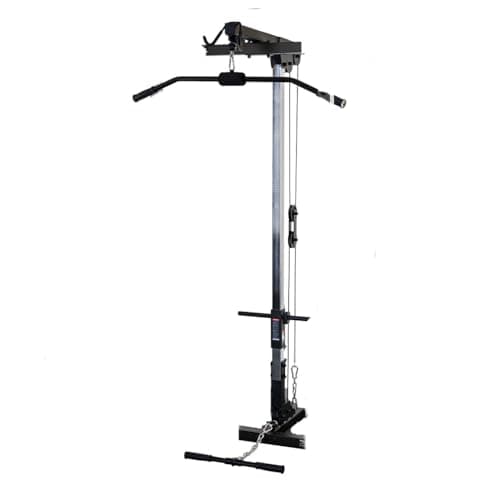
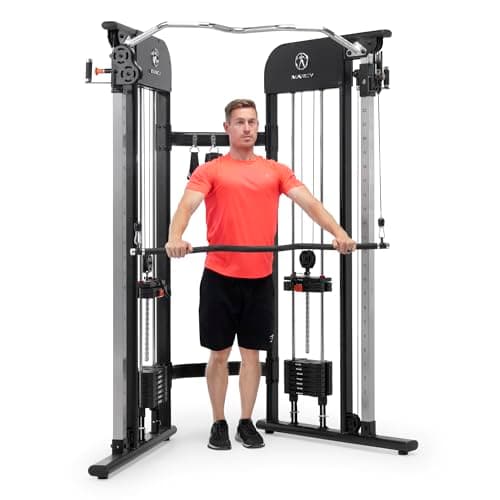
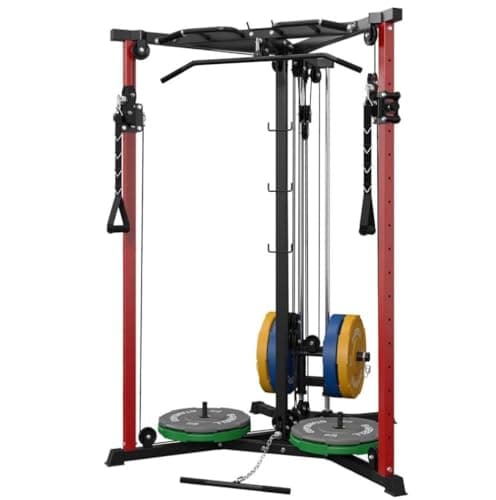
The frame of a home cable machine is powder-coated steel and will outlast its owner. The cable is the part that decides the machine's real service life, and on home-duty use it is the thing you should expect to replace rather than the thing you hope never fails. Buy the machine with the fewest proprietary parts — which means plate-loaded, like the Mikolo crossover — and the replacement is a generic cable rather than an obsolete assembly. A rack-mounted lat attachment such as the Body-Solid BFLA100 is simpler still: one cable, one pulley path, bolted to steel you already own. A dual-stack machine like the Marcy MFT-942 is the most capable and has the longest parts list.
The failure order
Every category on this site has one, and knowing it is how you buy well. For a cable machine it runs:
- The cable. Steel aircraft cable under a nylon or vinyl jacket. It fatigues where it bends around the pulleys, and it fails visibly first — the jacket splits, then individual strands break and stand proud as "fish hooks". This is your warning and you should act on it immediately.
- The pulleys. Plastic sheaves on plain axles wear oval, start squealing and then begin chewing the cable. Sealed-bearing or aluminum pulleys — the Major Fitness all-in-one is one of the few consumer frames that states aluminum — last far longer.
- The cable ends and attachment clips. Swages and carabiner gates round off with use. Cheap, easily replaced, and routinely ignored until a handle comes off mid-set.
- The selector pin and guide rods (stack machines only). Pins bend, rods and plate bushings wear, and the stack starts to rattle and bind. This is the stage where a machine with no parts supply becomes scrap.
- The upholstery. Pads compress and vinyl cracks. Cosmetic, and any upholsterer can re-cover a pad for a fraction of a new machine.
- The frame. Does not fail. Keep it dry and it is permanent — see keeping gym equipment from rusting in a garage if yours lives in an unheated space.
What drives the number
| Factor | Shortens life | Extends life |
|---|
| Pulley material | Molded plastic on a plain axle | Aluminum or sealed-bearing sheaves |
| Cable diameter and jacket | Thin cable, thin jacket | Thicker cable, intact jacket |
| Bend radius | Small pulleys, tight wraps | Larger sheaves, gentler wraps |
| Resistance type | Stack — rods, bushings, pin | Plate-loaded — cable only |
| Environment | Damp, unheated garage | Dry, temperature-stable room |
| Parts supply | Proprietary, no spares sold | Generic cable a rigging shop can make |
We do not publish a single "X years" figure for this category, because nobody has a defensible one: home use varies by an order of magnitude and no manufacturer publishes a cable cycle rating. What we can say with confidence is the order things fail in and which design choices move the date, and that is what the table above is.
The service routine, which almost nobody runs
Every month: run the cable through a rag along its whole length. You are feeling for a nick, a flat spot or a broken strand, not cleaning it. Thirty seconds.
Every six months: spin each pulley by hand with the cable slack. It should turn freely and silently. A gritty or noisy pulley is eating your cable.
Every six months: re-torque the frame fasteners. Bolted frames loosen; this is the same routine we recommend for a rack in how long power racks last.
At the first fish hook: stop using the machine and replace the cable. A cable does not fail gradually once strands start breaking, and the handle end is near your face on half the exercises.
How to buy one that stays serviceable
Fewer proprietary parts wins. A plate-loaded machine's only consumable is the cable, and a cable is a length of coated steel with a swaged end — any rigging shop can make one from the old one. A stack machine's rods, bushings and pin are specific to that model.
Ask about the cable before you buy. Not after. If the brand sells one, the machine is serviceable. If the answer is silence, assume you are having it made and price that into cost per year.
Prefer the simplest thing that does the job. If pulldowns and rows are the whole list, a rack attachment has one cable and nothing else — fewer parts than any freestanding machine, and it is bolted to a rack that is already permanent. The fitment rules are on the attachments page.
Keep it out of the damp. A cable jacket keeps water off the strands until it splits; after that a damp garage rusts the cable from the inside where you cannot see it. This is the one failure mode on this list that is entirely within your control.