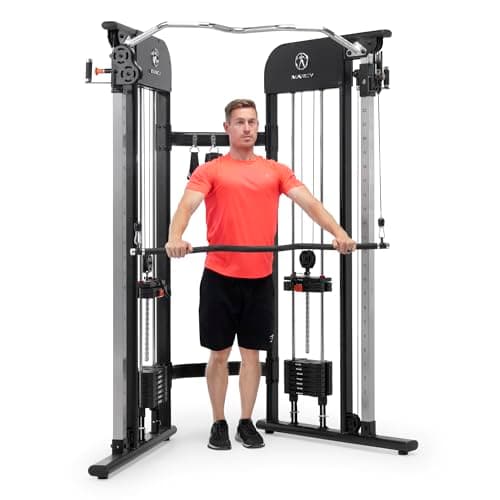
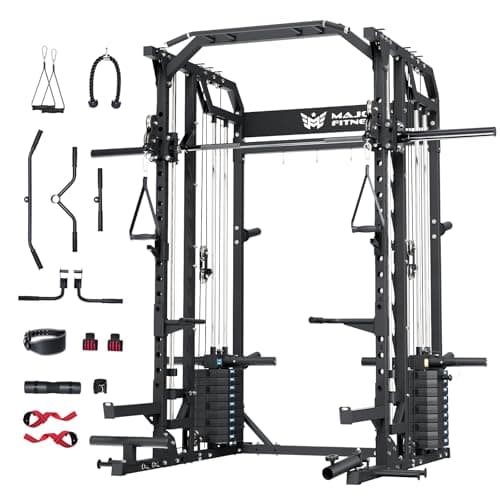
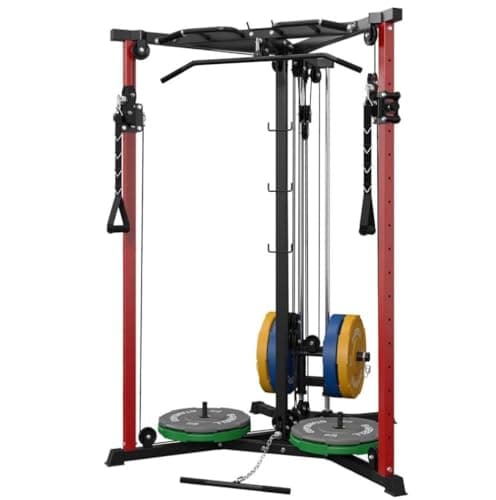
If you already own a power rack and a barbell, buy the functional trainer — the Mikolo cable crossover for most home gyms, the Marcy MFT-942 if you want real weight stacks. A trainer adds the horizontal and vertical pulling, the flies and the unilateral work a barbell physically cannot do. A Smith machine adds none of that: it does the lifts you already do, on a fixed bar path. The only buyer a Smith machine is genuinely right for is someone training alone who wants a guided bar and has no rack — and in that case the honest pick is an all-in-one like the Major Fitness Drone2, which is a Smith frame with the cables built into it.
What each machine actually is
A functional trainer is two cable columns with adjustable pulleys. Resistance comes from stacks or from plates, the handles move on whatever path your body chooses, and the exercise list is everything a cable can do: pulldowns, rows, flies, face pulls, triceps work, cable squats, wood chops, unilateral presses. It does not hold a barbell and it does not replace one.
A Smith machine is a barbell locked to two vertical or near-vertical rails, with hooks every few inches so you can rack it anywhere in the travel. It does squats, presses, rows and shrugs — the barbell list — with the bar path fixed and with a built-in bail-out. It does not do a single exercise a barbell cannot, and it cannot do the cable work a trainer does.
The two get compared because they occupy the same slot in a buying decision — "the big expensive machine in the corner" — not because they overlap functionally. The comparison that actually overlaps is power rack vs Smith machine, because a rack and a Smith machine really do compete for the same job. And if the Smith machine is the one you have settled on, the frames themselves are ranked in the best Smith machines roundup.
The three machines, side by side
| As published | Mikolo crossover trainer | Marcy MFT-942 | Major Fitness Drone2 |
|---|
| Machine type | Functional trainer | Functional trainer | Smith machine all-in-one |
| Resistance | Plate-loaded | Two 200 lb stacks | Plate-loaded bar + cables |
| Holds a free barbell | No | No | Yes — usable as a squat rack |
| Cable stations | Dual pulleys, 17 positions | Dual adjustable pulleys | Dual lat pulldown + crossover |
| Cable ratio published | Not published | Yes — 2:1 | Not published |
| Pulley material stated | Not published | Not published | Aluminum |
| Wear items | Cable, pulleys | Cable, pulleys, rods, pin, stack | Cable, pulleys, guide rods, bearings |
Every cell is quoted from the manufacturer listing linked in Sources, and where a figure is not printed on the listing the cell says so rather than estimating.
The durability argument, which is the one this site cares about
Both machines are mechanisms, and mechanisms are the opposite of what a buy-it-for-life home gym is built on. A rack, a bar and plates have essentially nothing in them that wears. These do.
A functional trainer's wear items are the cable and the pulleys, plus — if it is stack-loaded — the guide rods, bushings and selector pin. A Smith machine adds the two things a trainer does not have: long steel rails that have to stay straight and parallel, and the linear bearings or bushings the bar carriage rides on. Those bearings are the part that decides whether a Smith machine still feels smooth in year fifteen, and almost no consumer listing publishes what they are. The Drone2 at least publishes aluminum pulleys, which is a real spec on the part that spins under load.
The practical rule, the same one we apply in are all-in-one home gyms worth it: the more stations in one frame, the more ways the whole gym becomes unusable at once. Separate pieces fail separately and cheaply.
Which one adds something you do not already have
Run this test before spending anything. Write down the exercises you cannot currently do with your rack, bar and plates. For almost everyone the list is: lat pulldown, seated row, cable fly, face pull, triceps pushdown, cable lateral raise. Every single one of those is a cable exercise. Not one of them is a Smith machine exercise.
That is the whole argument. A functional trainer extends the gym; a Smith machine duplicates it with a different bar path. If the list of missing exercises is what is driving the purchase, the trainer is the answer, and if the budget is tight, a lat attachment on the rack you own covers the top two items for a fraction of the money.
The case for the Smith machine, stated fairly
There is one, and it is about training alone. A Smith bar can be racked at any point in the travel by rotating your wrists, which means a failed rep ends with the bar on the hooks rather than on you. If you train alone, have nobody to spot you, and are nervous about barbell benching or squatting, that is a real safety argument — the same one a cage with catch bars makes, which is why we normally send people to a cage instead.
The second case is space: an all-in-one Smith frame genuinely consolidates a rack, a Smith bar, a lat station and a crossover into one footprint. If you have exactly one spot and want every station in it, that is the shape the argument takes. You are paying for it in wear items and in a single point of failure for the whole gym.
What a Smith machine is not is a better way to lift. The fixed bar path removes the stabilizing work that is part of why free-weight training works, and it forces a joint path your body did not choose. We go further into machines versus free weights in strength machines vs free weights.
If you can only buy one
You own a rack and a bar: functional trainer. It adds exercises; the Smith machine does not.
You own nothing yet: buy neither first. A power rack, a barbell and plates cost less than either machine, do the compound lifts, and will outlive both by decades. Add cables afterwards.
You want one frame, one footprint, every station: an all-in-one Smith machine is the honest shape of that wish. Go in knowing you are buying mechanism, not steel.
Before you buy either machine
Write the missing-exercise list first
If every exercise on your list is a cable exercise, the decision is already made. If your list is empty, you do not need either machine yet and the money is better spent on plates.
Check the ceiling for a Smith machine, and the span for a trainer
A Smith frame needs the rail height plus your pressing lockout. A functional trainer needs lateral span for a standing fly, which is the dimension people forget — the machine fits, and then the exercise does not. Our power rack dimensions page has the measuring routine; apply the same method here.
Ask what the carriage rides on
On a Smith machine, linear bearings are smoother and more expensive than nylon bushings, and the difference shows up years later as either a smooth bar or a sticky one. Most consumer listings do not publish it. Treat silence as bushings.
Count the single points of failure
One frame carrying four stations means one broken cable can take your squat rack offline. If the machine is your entire gym, ask whether the brand sells replacement cables before you buy — replacement parts is the deciding question on anything with a mechanism in it.
Do not pay twice for a squat rack
If you already own a cage, a Smith all-in-one duplicates it. Buy the station you are missing, not a second frame to hold it.