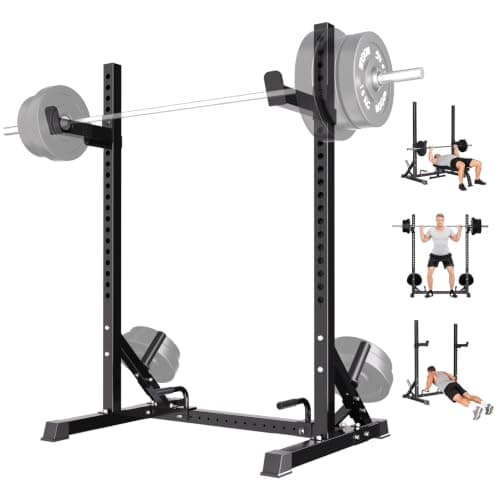
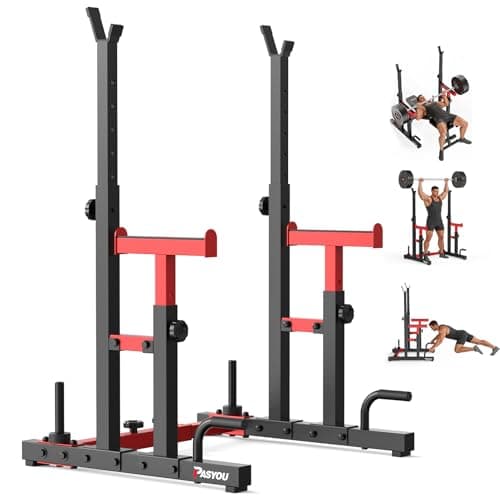
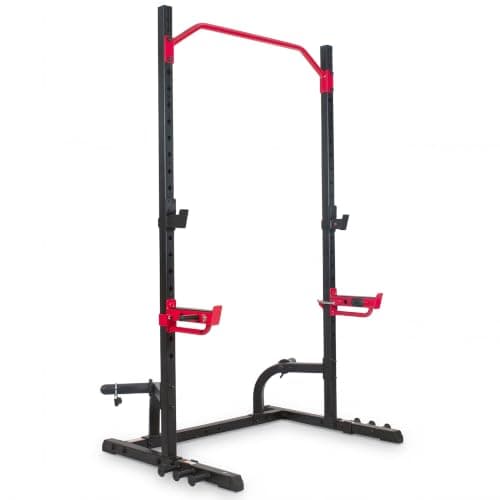
If the room allows a full cage, buy the full cage — the enclosed catch is the safest geometry available to a solo lifter. A half rack wins on footprint and on getting in and out quickly, and those are real advantages if you know what you are giving up for them.
The difference in one table
| Full rack (cage) | Half rack |
|---|
| Where you lift | Inside the frame | In front of or under the uprights |
| Failed-rep catch | Safeties on all four uprights around you | Spotter arms projecting forward |
| Footprint | Larger, roughly square | Shallower front to back |
| Tipping tendency | Low — load sits inside the base | Higher — load sits forward of the uprights |
| Anchoring | Often optional | More often necessary |
| Getting in and out | Step through the frame | Open front, nothing to step over |
| Attachment options | Broadest — four uprights to bolt to | Narrower |
The safety argument, honestly stated
In a cage, the safeties run alongside you for the whole length of the lift. If a squat fails at any point, the bar has somewhere to land, and you can duck out from under it inside the frame. On a half rack, the spotter arms project forward from the uprights, which means the catch depends on you failing in roughly the place the arms are — and on those arms being long enough to be under the bar when it drops.
That is not an argument that half racks are unsafe. It is an argument that they are less forgiving of a badly set up session. If you are meticulous about arm height and about where you stand, the gap narrows a lot. If you are the kind of lifter who sets the safeties once and never checks them again, buy the cage.
The tipping problem nobody mentions
This is the half rack's real structural weakness. When a loaded bar sits on spotter arms that project forward of the uprights, the load is outside the base — it wants to rotate the frame forward. Cages do not have this problem because the bar sits inside the footprint.
Manufacturers address it with longer base rails, heavier steel or bolt-down holes. The practical consequence for you is simple: half racks are more likely to genuinely need anchoring, and skipping it is a worse idea than it is on a cage. Our anchoring guide covers the options including what to do in a rental.
Where the half rack genuinely wins
Depth, not width
A cage is roughly as deep as it is wide. A half rack cuts the depth substantially, which is exactly the dimension that tends to be scarce in a single-car garage where you also want to park, or in a room with a walkway you cannot block.
Access
There is no frame to step through and no upright behind your head on a bench press. For anyone with mobility limitations, and for anyone doing a lot of exercises that involve walking the bar out, that openness is a genuine daily quality-of-life gain rather than a marketing point.
Price at the same steel quality
Fewer uprights and less material means that, compared like for like, a half rack costs less than a cage built to the same standard. If the budget is fixed, a half rack lets you buy better steel for the same money — which on a buy-it-for-life site is an argument worth taking seriously.
How to decide
Answer three questions. Does the room take a cage with loading clearance on both sides and headroom above the pull-up bar? Will you reliably reset spotter arms for each lift and each bench position? Can you anchor the frame if it needs it?
Three yeses and either works — pick on footprint and price. If the first answer is no, you are buying a half rack or a stand regardless. If the second answer is no, buy the cage; passive protection suits you better than protection that depends on setup discipline. If the third is no and you are looking at a half rack, weight the base instead or move to a cage.
Still weighing frame types? Our power rack vs squat rack comparison covers the third option, and the best half racks ranks the frames themselves.