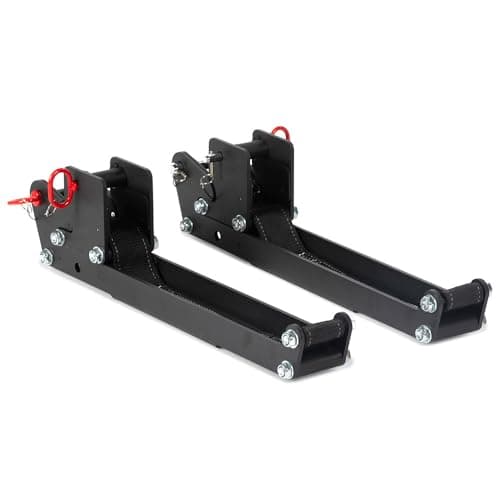
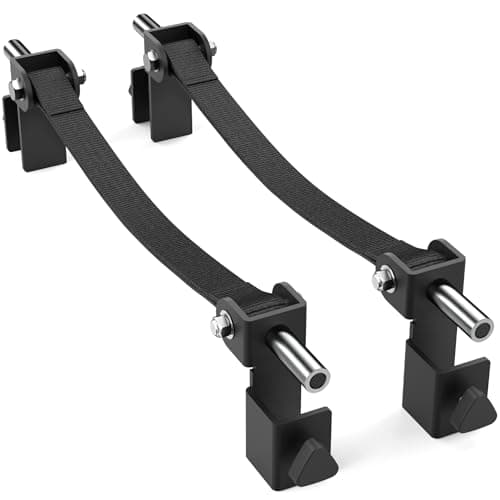
If your rack came with steel safeties, use them — they are stiffer, they cost nothing extra and they will outlive you. Straps are the better buy when your rack has none, when you bench heavy and want the softest possible catch, or when the noise of steel on steel is going to be a problem with the people you live with.
This is a safety page rather than a shopping page, so the ranked picks below are only the two strap sets — steel safeties are not usually bought separately, they come with the rack. If yours did not, that is worth knowing before you read further: a rack sold without adjustable safeties of some kind is not a rack we would recommend buying at all.
One naming note before the comparison, because it catches people out: the "safety bars" on this page are the catch bars inside a rack. A safety squat bar is something else entirely — a cambered barbell with a padded yoke. You want both, and squatting with the second makes the first non-negotiable.
The difference in one table
| Steel safety bars / pins | Nylon safety straps |
|---|
| How it catches | Rigid stop — the bar lands and stays | Elastic stop — the strap stretches, then holds |
| Effect on the barbell | Steel on steel; will mark knurl and sleeves over time | Nylon on steel; effectively no marking |
| Noise | Loud, and it carries through a house | Muted thud |
| Deflection under a dropped bar | Essentially none | Several inches — has to be set higher to compensate |
| Retro-fit to any rack | Only the maker's own, sized to the upright | Yes, if the strap length matches the rack depth |
| Doubles as a rack-pull surface | Yes | No — pulling from straps is not what they are for |
| Lifespan | Effectively permanent | Years, but nylon is a consumable — inspect and replace |
The one difference that actually decides it: deflection
A steel safety stops the bar where the steel is. A nylon strap stretches under the shock of a dropped bar and then holds — which is exactly what makes it kind to your barbell and your floor, and exactly what you have to allow for when you set the height.
The practical consequence is simple and it is the single most important thing on this page: set straps a hole or two higher than you would set steel pins. Then test it without a training partner and without ego. Load a light bar, take it to the bottom of the movement, and let it settle onto the safeties. Look at where it actually stops. Do that once, on each strap set, at each height you use — the setup routine is covered in full in how to set up a power rack.
Straps also do not all stretch the same amount. Webbing width, weave and length all change it, and a longer strap spanning a deeper rack has more material to stretch. This is why "set it two inches higher" is not a rule anyone can give you — you have to look at your own rack.
What each one does to your barbell
Steel safeties are hard on bars, and nobody selling racks mentions it. Dropping a loaded bar onto steel pins flattens knurl on the contact points and can mark the shaft. Over years of routine bailing, that is real wear on the most expensive piece of steel in the room — the piece our barbell lifespan guide otherwise describes as nearly indestructible.
Most makers of steel safeties address this with a plastic or UHMW sleeve over the pin, which is worth having and worth replacing when it wears through. Straps sidestep the problem entirely: nylon is softer than the bar, so the strap takes the damage rather than the knurl. If you own a bar you care about, that is a genuine argument.
Rated capacity, and why the number matters more here
Elsewhere on this site we treat published capacities as a proxy for how something is built. On safeties it is not a proxy — it is the specification. This is the one component in a home gym whose entire job is to absorb the worst thing that will ever happen in the room.
So buy the rated pair. Straps that publish a figure — the Synergee set states 750 lb, sized to a 23-inch depth on 2×2 racks — tell you the webbing and the hardware were specified. Straps that publish nothing are asking you to trust a stitch pattern you cannot see. The same logic applies when you replace a worn set: match the rating, not just the shape, as we argue in replacement parts.
Fitment: the numbers to check before ordering straps
- Rack depth. Straps are sold to span a specific depth. A strap set for a 23-inch rack fitted to a 30-inch rack does not reach; fitted to a 16-inch rack it hangs slack, which increases deflection.
- Upright dimension. The end hardware wraps the upright. 2×2 and 3×3 hardware are not interchangeable.
- Hole diameter and spacing. Pin-style strap ends still have to go through the hole, exactly like any other rack attachment.
When to inspect and replace straps
Nylon is the only part of a home gym that degrades on its own, without you doing anything. It is weakened by ultraviolet light, by abrasion and by repeated shock loading. A strap that lives in a sunlit garage window is aging in a way steel is not.
Look, twice a year, for: fuzzing or fraying at the edges, any cut in the webbing, glazing or stiffness where a bar lands repeatedly, and stitching that has pulled. Any of those means replace the set. Straps are cheap; the thing they are holding up is not.
So which should you buy?
Use the steel that came with your rack if it has adjustable safeties and you are happy with the noise. It is stiffer, it is free, and it lets you do rack pulls off the safeties.
Buy straps if your rack came without safeties, if you bench heavy alone and want the gentlest catch, if noise matters, or if you want to stop marking a bar you paid real money for. Plenty of people run both: steel low for squats and rack pulls, straps set at bench height.
Do not run neither. Solo lifting without a catch of some kind is the one thing on this site we would call genuinely dangerous, and it is the reason the enclosed cage exists at all — the argument is laid out in half rack vs full rack.
If you do not own a rack to put either of these in yet, the prior question is which bench-press setups are survivable without one. We rank the three that are — a cage with safeties, a combo frame with a published bar-catch rating, or dumbbells — on can you bench press without a rack.