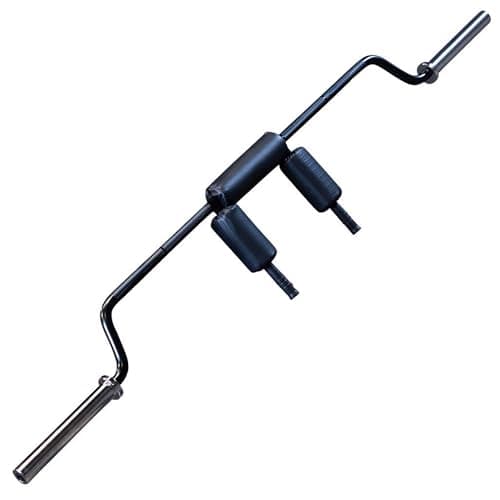
Buy the Body-Solid: a published 1,000 lb capacity, padding built into the yoke rather than slid over it, and the brand whose warranty terms came out strongest when we compared them. If you want the most specification per dollar rather than the most brand, the Bells of Steel bar is the only listing here that publishes what the bar itself weighs — and on a cambered bar, that number matters more than it does anywhere else.
What a safety squat bar actually does
A safety squat bar is a straight bar with a cambered center section and a padded yoke that sits across your shoulders and traps. Two handles project forward, so you hold the bar in front of you rather than reaching back for it. That single change does three things: it takes the shoulders, elbows and wrists out of the movement entirely, it lets you squat when a straight bar is not an option, and it shifts the load forward so the upper back has to work much harder to stay upright.
The first of those is why the bar survives in home gyms. Any lifter with a cranky shoulder, a stiff thoracic spine or an elbow that objects to a low-bar rack position can keep squatting with one. It is the same reasoning that keeps a trap bar in a gym long after the other specialty bars get sold: it removes a joint problem rather than adding a novelty. The case for that bar against an ordinary straight one is laid out in trap bar vs straight bar.
It is a second or third bar, never a first one. If you do not yet own a full-length Olympic bar, buy that first from the barbell roundup — and if you are squatting heavy enough to want a yoke on your shoulders, you are probably also at the point where a lifting belt earns its money. A safety squat bar cannot bench, cannot deadlift comfortably and is a poor tool for anything except squats, good mornings and lunges.
Two different products are sold under this name
This is the trap in the category and it is worth understanding before you look at a single price.
A complete safety squat bar is a whole barbell: cambered shaft, welded or bolted yoke, 2 inch Olympic sleeves. You load plates onto it and it replaces your straight bar for the set. Every bar ranked on this page is one of these.
A safety squat yoke attachment is a padded harness that clamps onto the straight bar you already own, converting it for the set and coming off afterward. It is cheaper, it stores in a drawer, and it is a genuinely reasonable purchase — but it is not the same object, and it behaves differently because the camber comes from the attachment rather than from the steel.
Marketplace listings use the word "attachment" loosely, and several use it in a title that also says "weight barbell". We have deliberately not ranked any listing whose title leaves the question open, because a reader who wanted one and received the other has been badly served. Read the title and the photographs before ordering, and if the listing will not commit, treat that as the answer.
What we rank on
Four specs describe a safety squat bar. Listings publish the first reliably, the second sometimes, and the third and fourth almost never — which is itself the most useful ranking signal in the category.
- Published capacity. Every bar here states one, and the range is enormous: 700 lb at the budget end, 1,500 lb at the top. In practice a home lifter will never load a cambered bar past a few hundred pounds, so capacity matters less as a ceiling than as evidence that somebody specified the steel.
- Camber depth. How far the shoulder section drops below the sleeves. This is the spec that decides how hard the bar tries to fold you forward, and it is the difference between two bars that look identical in a photograph. Exactly one listing in this roundup publishes it.
- Bar weight. A cambered bar is not 45 lb by default — these run heavier than a standard barbell because of the yoke and the pads. If the listing does not say, your training log is an estimate. Again, exactly one listing here publishes it.
- Length and sleeve type. Whether it seats in your J-hooks like a normal bar, and whether your plates fit. All five here take 2 inch Olympic plates; only one states an overall length.
After those, we weight brand persistence and parts availability, for the reason the whole site exists: the pads are the consumable on this product, and in ten years you want to be able to buy one. That is the same argument as our replacement parts guide.
The picks in context
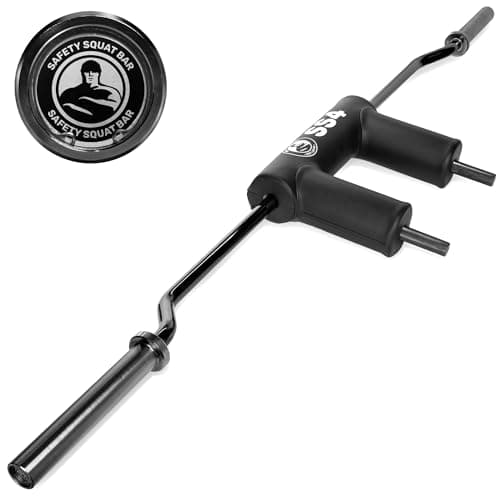
Body-Solid (1,000 lb) — the default
A four-figure published capacity, padding built into the yoke rather than sleeved over the shaft, and fixed handgrips. What earns it the top slot on this site specifically is the brand: Body-Solid came out of our warranty comparison with the strongest published in-home terms of the makers we checked. That is a brand-level observation, not a promise about this SKU — the listing itself states no warranty term, and we say so in its cons.
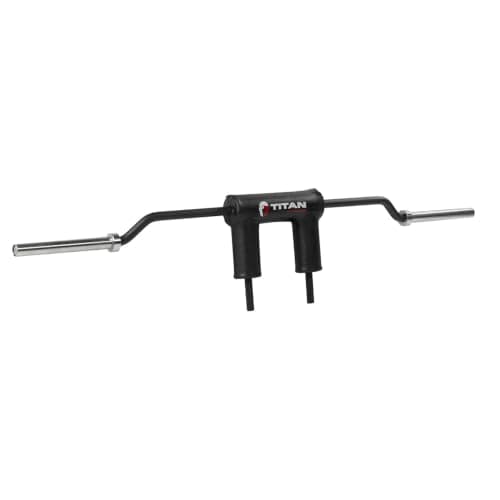
Titan TITAN Series (1,500 lb, 5 in camber) — the heavy-duty one
The highest rating here and, more usefully, the only listing that publishes a camber depth. Five inches is a lot of camber: it makes the bar demanding on the upper back, which is exactly what an experienced lifter wants from one and exactly what makes it the wrong first cambered bar. It is also the most expensive bar in the roundup by a wide margin, and most of that premium buys rating you will never use.
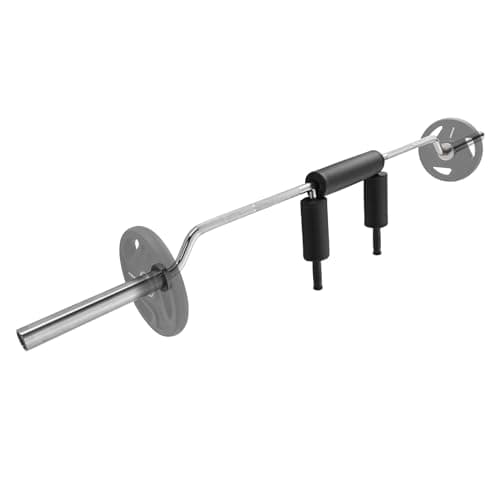
Bells of Steel 4.0 (45.6 lb bar, 1,500 lb) — the honest spec sheet
The only bar here that tells you what it weighs. That sounds like a small thing until you realize that every other listing on this page is asking you to log an unknown number as if it were 45 lb. At 45.6 lb it is heavier than a standard bar, so the empty bar alone is a meaningful load — which is information you can act on rather than a surprise. A "4.0" revision also implies a product that has been through versions.
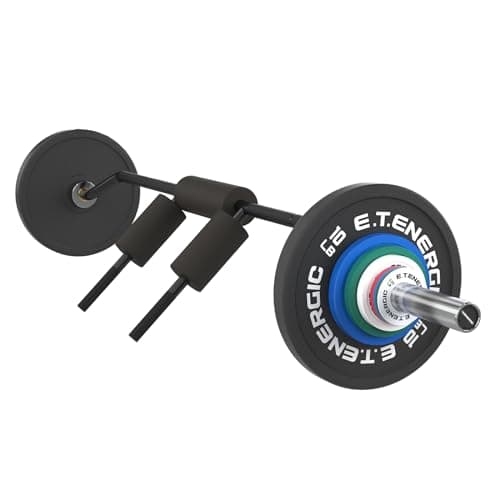
E.T.ENERGIC 7 ft (700 lb) — the full-length mid-price option
The only listing here that states an overall length, and 7 ft is the number that matters: it seats in a standard rack the same way your straight bar does, with the same hand spacing margin either side. The 700 lb rating is several times any load this bar will see at home. The gap is information — no bar weight, no camber depth, and no model history on this site.
VEVOR (700 lb, 28 mm) — the cheapest with a real number
The lowest price in the roundup attached to a published capacity rather than an unstated one, which is the line we will not cross. It also publishes a 28 mm shaft diameter, which none of the pricier bars do. That thinner shaft is the honest catch: it will flex more under load than a thicker bar, and on a cambered bar you feel flex through the yoke on your shoulders. Buy it to find out whether you like the movement, not to keep for a decade.
What the missing bar weight actually costs you
On a straight bar this problem does not exist — an Olympic bar is 20 kg and everybody knows it, as set out in Olympic barbell specs. A safety squat bar has no standard. The yoke, the pads and the camber all add steel, so these bars run heavier than 45 lb, and by an amount that varies between models.
The practical consequence is small but real: if you log a working set as "225" and the bar is actually 50 lb rather than 45, every number in your log is out by five pounds, and the comparison you are drawing against your straight-bar squat is out by more. It does not change what the training does to you. It does change whether your records mean anything.
If your bar does not publish a weight, put it on a bathroom scale once and write the number on the yoke with a paint pen. It takes two minutes and it is permanent.
Will it fit your rack?
Three checks, in order, and none of them takes longer than a tape measure.
- Sleeve type. All five bars here take 2 inch Olympic plates. If you own 1 inch standard plates, none of them fit — see Olympic vs standard plates before ordering anything.
- Overall length against your J-hook span. A 7 ft bar racks like your straight bar. A shorter cambered bar can still rack, but the margin either side of the J-hooks shrinks, and on a narrow squat stand that margin is what stops a misracked rep going badly. Only one listing here publishes a length, so measure your span first and be prepared to ask the seller.
- Yoke clearance inside a cage. The yoke is wide. Inside a full power rack you unrack, step back and the yoke passes between the uprights — check that your rack width allows it with the pads on, not just the bare shaft.
Camber depth, and why it decides how the bar feels
Camber is the vertical drop between the sleeves and the shoulder section. A deeper camber moves the load further forward of your center of mass, which makes the bar pull you into a forward lean and forces the upper back to fight it. That is the training effect people buy a safety squat bar for, and it is also why two bars with identical capacities can feel completely different.
A shallower camber behaves closer to a straight-bar high-bar squat and is easier to learn on. A deep camber — the Titan publishes 5 inches — is a genuinely harder bar to hold position under. Neither is better. But since almost no listing publishes the figure, assume a bar you cannot verify sits somewhere in the middle, and expect the first session to feel harder than the same weight on a straight bar regardless.
Do not run one without safeties
A cambered bar fails differently. When a straight-bar squat fails you dump the bar backward off your shoulders. With a safety squat bar your hands are out in front and the yoke is strapped across your traps, so shedding it takes a deliberate movement you will not be good at under load.
That makes adjustable safeties non-negotiable rather than advisable. Set them at the depth you actually squat to, test the height with an empty bar, and read safety bars vs safety straps if you are choosing between the two — straps are kinder to the knurl, steel is set-and-forget. And note the naming collision while you are there: "safety bars" in a rack are the catch bars, and a "safety squat bar" is a barbell. They are unrelated products with confusingly similar names.
If your rack is a squat stand rather than a cage, the same rule applies with spotter arms — and the anchoring advice in how to anchor a squat rack matters more here, because a forward-loaded bail puts force on the front of the stand.
What actually wears out on one
The steel does not. A cambered bar is welded tube and a shaft; there is no bearing, no bushing worth speaking of, and nothing that moves against anything else. Rank the consumables and the list is short:
- The pads. Foam compresses and the covering splits, in that order, over years of sweat and chalk. This is the one part you may want to replace, and it is the reason brand persistence carries weight in our scoring.
- The finish. Powder coat wears at the sleeves where plates slide on and off, and at the yoke where it contacts the rack. Exposed steel in a damp garage will surface-rust exactly as a barbell does — the fix is the same one in how to stop barbell rust.
- The welds, in theory. A yoke is welded to a shaft and that joint carries the whole load in bending. It is also massively overbuilt relative to home loads on every bar here. Inspect it annually; do not worry about it.
Who should skip it
Anybody who does not own a rack with safeties, anybody who does not yet own a full-length straight bar, and anybody whose squat is limited by their legs rather than by their shoulders or their upper back. A safety squat bar solves a specific set of problems — a shoulder that will not rack a bar, a back that wants more upright loading, a lifter who needs squat volume without more spinal fatigue. If none of those describe you, the money is better spent on plates or a bench, both of which get used every session.