Buy the straight bar first, every time. It squats, benches, presses, rows and deadlifts, it racks in any rack, and it is the bar every program on earth is written around. A trap bar is the better deadlift tool for a lot of people, but it is a one-lift-family specialist — and a specialist is the second bar you buy, not the first. If you already own a straight bar and are deciding whether a hex bar earns its floor space, the answer is usually yes and the reason is in the geometry rather than in the marketing.
This page compares the two as purchases. If you have already decided on a hex bar and want the ranked list, that is the trap bar roundup; for straight bars it is the barbell roundup.
They are not substitutes, and the lift list proves it
Most comparisons of these two bars argue about which produces a better deadlift. That is the less useful question in a home gym, where the binding constraint is how many bars you can own and store. Start with what each one can physically do:
| Lift | Straight bar | Trap / hex bar |
|---|
| Deadlift | Yes, bar in front of the shins | Yes, load in line with the body |
| Back squat | Yes | No |
| Bench press | Yes | No |
| Overhead press | Yes | No (some open frames allow a push press from the floor) |
| Barbell row | Yes | Yes, neutral grip |
| Shrugs | Yes, bar in front | Yes, and more comfortably |
| Loaded carries | Awkward | Yes — this is the hex bar's other job |
| Cleans and snatches | Yes | No |
| Works inside a rack on J-hooks | Yes | No |
That table is the whole argument. A straight bar covers every lift in a normal strength program; a trap bar covers the pull, the shrug, the carry and a neutral-grip row. Nobody builds a home gym around the second list.
The geometry, in one paragraph
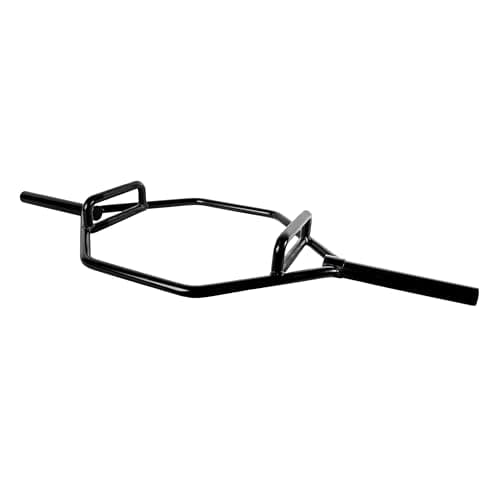
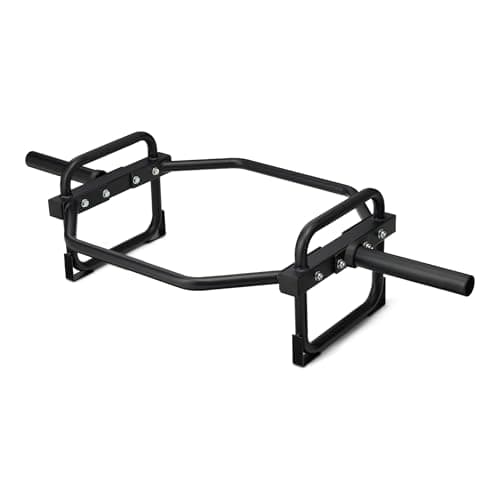
On a straight bar the load sits in front of your shins, so your hips have to travel further back and your torso leans further forward to reach it. Step inside a hex frame and the load sits in line with your body, the handles are at your sides, and you can stand more upright with the hips a little lower. Nothing mystical happens — the weight is simply closer to the joints lifting it, which is why most people pull more weight with a hex bar than with a straight bar and why the lift feels more like a squat than a hinge. Many lifters find the upright position easier on the lower back; that is a preference reported by a very large number of people rather than a claim we can measure, and we are not going to dress it up as one.
Most hex bars also give you two handle heights — raised handles shorten the range of motion, flush handles lengthen it. That is a genuine feature on a bar bought for pulling heavy and a genuine annoyance if your frame only offers the high setting.
What the listings actually publish
| As published | CAP The Beast (straight) | CAP Trap Bar, combo grip | Amazon Basics hex bar |
|---|
| Published capacity | 1,200 lb | 1,000 lb | 500 lb |
| Bar weight | 45 lb | Not published | Not published |
| Loadable sleeve length | Not published | 9 in | Not published |
| Grip | Dual knurl marks | 32 mm combo grips | Dual grip handles |
| Frame | Straight shaft | Closed hex, 26 in interior opening | Closed hex |
| Racks on J-hooks | Yes | No | No |
Two things in that table are worth more attention than the capacity numbers. The first is the published loadable sleeve length — 9 in on the CAP trap bar. That is enough for a serious load in cast iron and tight once you are stacking bumper plates, which are much thicker per pound. A full-length straight bar has more sleeve to work with, although neither of these two listings publishes the figure. The second is the interior opening: 26 in is the space you stand in, and a big lifter in wide shoes should check it rather than assume.
Bar weight is the specification this whole category hides. A straight bar is 45 lb or 44 lb and says so; hex bars vary from around 35 lb to over 60 lb and most listings will not tell you, which matters the first time you try to work out what you actually pulled. If a listing does not publish the bar weight, weigh it at home before you log a number. The dimensional conventions for straight bars are on our Olympic barbell specs page.
The rack is the deciding factor nobody mentions
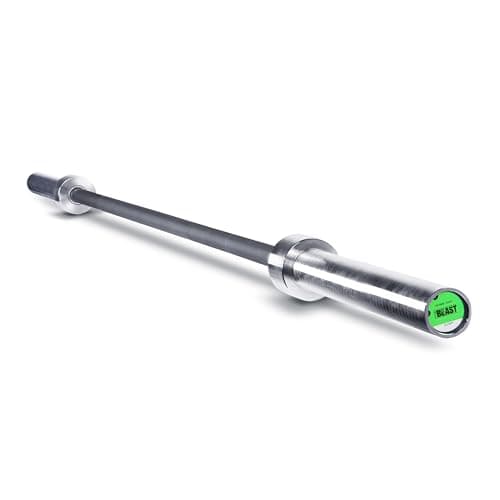
A straight bar lives in a rack. It sits on J-hooks at the right height, it comes off for a squat and it goes back on when you fail, and the safeties catch it if the rep does not finish. That single fact is why the straight bar is the first bar: a power rack is useless without one, and most of the lifts the rack exists to make safe can only be done with one.
A trap bar never touches the rack. It is loaded on the floor, lifted from the floor and set back down on the floor, which has one real advantage — there is no bailing out of a bad rep because the bar is already at the bottom of its range when things go wrong. It also means a trap bar can be the whole gym in a room with no rack at all, which is the argument made on are squat racks worth it.
Storage: the practical reason people regret the hex bar
A straight bar hangs on a wall holder, stands in a vertical tube or lies in a horizontal rack — every storage product in our barbell storage roundup is designed around a 2 in sleeve on a straight shaft. A hex frame fits none of them. It leans against a wall, it lies flat and takes up roughly four square feet of floor, or it hangs from a pair of dedicated hooks you will probably have to buy separately.
In a two-car garage that is nothing. In a spare bedroom or an apartment it is the difference between owning the bar and tripping over it, which is why the apartment home gym guide treats floor-stored equipment as a cost rather than a free addition.
Which lasts longer
Both outlive almost everything else in the room, and for the same reason: there is very little to go wrong. A straight bar can rust, can bend if a loaded bar is dropped on rack pins, and can develop slow or seized sleeves — all covered in how long do barbells last. A hex bar has the same sleeves plus a welded frame, and the welds are the thing to inspect: a frame that has been dropped loaded onto concrete from hip height for years is where a crack eventually shows.
Two hex-bar features add a mechanism and therefore a failure mode. Swivel handles, like the 360 degree handles published on the Sunny Health & Fitness Olympic Hex Trap Bar (Swivel Handles), are genuinely kinder on the wrists and are one more moving part. Integrated loading jacks on an open frame are superb for loading plates without a second person and add a lever that can bend. Neither is a reason to avoid the feature; both are reasons to buy the version with the better welds.
What each one costs, honestly
Hex bars and straight bars sit in different price markets. A straight bar is a commodity made by the thousand and priced accordingly; a trap bar is formed, jigged and welded, so the cheapest hex bars tend to have the lowest published capacities — 500 lb on two of the bars we rank — while the cheapest straight bars still clear that. What drives the number on either is laid out in how much a barbell costs. Live prices for all three bars here are in the table above, read from the Amazon Product API with the date they were read stamped underneath.
If you are buying both, buy them in the order this page recommends and let the plates be the thing you spend on in between. One set of plates loads either bar, and plates are the larger part of the bill — see how much weight plates cost.
How to choose between them
If this is your first bar, it is the straight bar
There is no situation in which a home gym is better served by owning a trap bar and no straight bar, unless you have decided you will never squat or bench. Buy the straight bar, buy the plates, add the hex bar later out of the same budget line.
If you own a straight bar and your deadlift is the lift you dread
This is the clearest case for a hex bar. The upright position suits a lot of people who find the conventional pull uncomfortable, and the carries it unlocks are worth having on their own. Buy the published capacity you need and ignore the rest of the marketing.
If you train without a rack
A trap bar is the most useful single bar for a rack-free room, because every lift it does starts and ends on the floor. Pair it with a bench and a pair of adjustable dumbbells and you have a complete gym with nothing overhead — benching without a rack covers the rest of that setup.
If you are tall
Tall lifters tend to get more out of a hex bar than short ones, because the longer the femur and torso, the further a straight bar sits from the hips at the start of a pull. Check the interior opening on the listing — 26 in on the CAP combo-grip bar is roomy, and some frames are noticeably tighter.
If the room is small, think about where it goes before you buy
A hex bar does not fit any standard bar storage. Decide where it will live — flat against a wall, hanging on hooks, or taking its share of the floor — before you order, not after.