Skip to content
Plate&Rack

The bar · Barbells

The Best Barbell Storage

A bar on the floor is a bar collecting grit in its sleeves and moisture on its knurl. Storage is not tidiness on this site — it is the cheapest thing you can buy to make a bar last.

By Stephen V.Updated How we choose
#ad

We earn a commission when you buy through our Amazon links, at no extra cost to you. It never affects our rankings, and we say so when the cheaper product is the better buy. How this works.

If you can drill, buy the wall mount — it uses no floor, cannot be knocked over and costs less than the freestanding holders. If you cannot, buy a vertical five-bar holder and put it in a corner. Either way, get the bar off the concrete. That is the entire point of this category.

Why storage is a durability purchase

Our barbell lifespan guide lists the four things that actually age a bar: grit in the sleeves, rust under a thin coating, a clogged knurl and a permanent bend. Leaving a bar on the floor contributes to three of them.

Concrete is the problem. It holds moisture, it releases it upward, and it is where every bit of chalk dust, grit and metal filing in the room ends up. A bar lying on a garage slab has its knurl pressed into that mixture and its sleeve openings facing it. A bar stood on end or hung on a wall has neither. This costs about the same as a pair of collars and does more for the bar than any amount of wiping down.

The fourth failure — the permanent bend — is a storage problem too, in the opposite direction. Bars left loaded on J-hooks for months, or leaned across two supports with plates on, are being asked to hold a static bending load they were not designed to hold indefinitely. Unload the bar, then store it.

What we rank on

  • Bar protection. Does it keep the knurl and the sleeve ends off the floor, and is the contact surface something softer than the bar? A lined slot beats bare steel.
  • Footprint. Wall-mounted uses none. Vertical uses about a square foot. Horizontal uses a wall run but no depth. This is usually the deciding spec in a real room.
  • Capacity, honestly counted. Five slots is only five slots if a trap bar or a curl bar will actually fit in one.
  • Nothing to wear out. Storage has no moving parts and should have no consumables beyond a plastic liner. Anything more complicated is a solved problem being re-solved.

Vertical, horizontal or wall-mounted?

Vertical holders

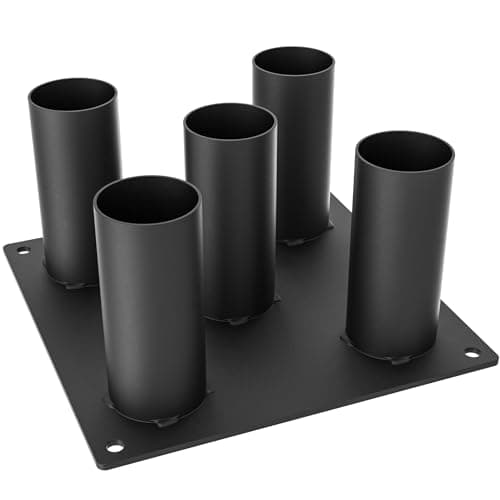
Bars stand on end in slots. The most storage per square foot of floor by a wide margin — five bars in roughly the space one bar occupies lying down. The trade-off is that the sleeve end rests on the base, so the base liner is the part to look at, and a freestanding unit in the middle of a room is easy to knock. Put it in a corner.

Wall-mounted holders

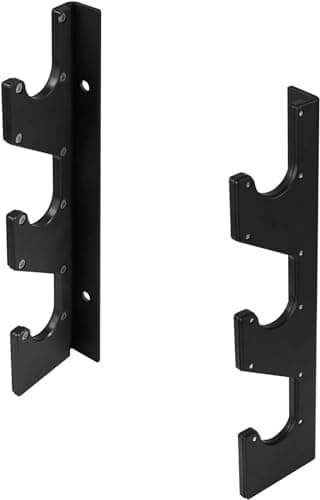
Bars hang vertically from a bracket screwed to the wall. Zero floor, no tipping, and the sleeve hangs clear of everything. This is the best answer if you can find studs and drill — and the answer to avoid entirely if the only wall is plasterboard with nothing behind it. A hundred pounds of steel coming off a wall is not a small failure.

Horizontal racks

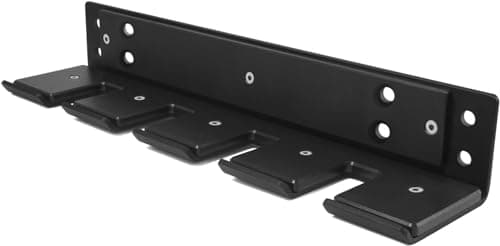
Bars lie in cradles at waist height, usually against a wall. Easiest to load and unload one-handed, and the kindest to the bar because the contact points are lined and spread. It uses wall length rather than floor area, which suits a garage bay. Fewer bars per unit than a vertical holder.

On the rack itself

Many racks have bar holders built into the uprights, and if yours does, use them first — it is free storage that also loads the base of the rack, which is a stability benefit. Our attachments roundup covers what bolts on where.

Sizing it to what you actually own

Count the bars, then add one. Most home gyms accumulate a straight Olympic bar, then an EZ curl bar, then a trap bar, and each of those has a different diameter and a different length. A five-slot holder that only physically accepts straight 2-inch sleeves is a two-slot holder in a gym with a trap bar in it.

The two dimensions to check before ordering are the slot diameter and the slot depth. A trap bar will not stand in a narrow slot, and a short curl bar in a deep slot can be awkward to lift back out.

What not to do

Do not lean bars in a corner. They slide, they fall, and a falling barbell finds whatever is on the floor — usually a plate, occasionally a foot.

Do not store a bar loaded. Plates left on a racked bar are a static bending load for however long you leave them. Strip it.

Do not store bars touching each other. Knurl against knurl in a vibrating garage is a slow way to wear both. Slotted holders exist precisely to keep them apart.

Do not put storage where the bar has to cross the room wet. Storage next to the rack means the thirty-second wipe-down actually happens; storage in another corner means it does not. The habit is in how to stop barbell rust.
The short answer

Quick picks

#ProductBest forScorePrice
01
Synergee Synergee 5-Bar Vertical Barbell Holder
Synergee 5-Bar Vertical Barbell Holder

Five bars stood on end in about a square foot of floor, with nothing on it that can wear out.

Best vertical bar holder
8.0
$49.95Amazon
02
Yes4All Yes4All Wall-Mounted Olympic Barbell Holder (4 bars)
Yes4All Wall-Mounted Olympic Barbell Holder (4 bars)

Four bars, zero floor space, and nothing to knock over — the storage answer if you can drill.

Best wall-mounted bar storage
8.4
$45.53Amazon
03
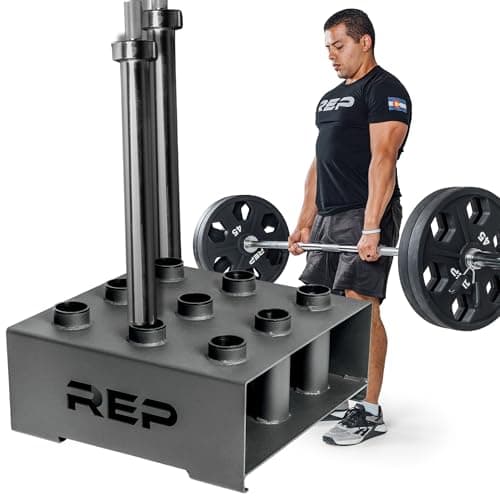
Yes4All Yes4All 9-Bar Vertical Barbell Storage Rack
Yes4All 9-Bar Vertical Barbell Storage Rack

The same vertical idea in a 20-inch square — nearly three times the steel of the small holders, and nine slots instead of five.

Most stable bar rack
7.6
$92.32Amazon
04
Yes4All Yes4All Horizontal Barbell Holder (Pair)
Yes4All Horizontal Barbell Holder (Pair)

Wall-mounted bar storage that costs less than a plate and saves the sleeves on every bar you own.

Best barbell storage
8.2
Check price →

#ad · Live prices from the Amazon Product API, as of Sep 8, 2026. Where we have no verified live price, we show none — we would rather leave a gap than print a number that has rotted.

In detail

The picks, in full

01
Synergee Synergee 5-Bar Vertical Barbell Holder

Best vertical bar holder

Synergee 5-Bar Vertical Barbell Holder

Holds 5 barsVertical storageFits Olympic + curl barsFreestanding
8.0/10

Five bars stood on end in about a square foot of floor, with nothing on it that can wear out.

Build & steel
8
Capacity
8
Bar protection
8
Footprint
8
Value
8

Pros

  • Vertical storage keeps knurl and sleeves off the floor, which is where rust and grit actually come from
  • Takes curl and trap bars as well as straight Olympic bars, so it stores the whole collection rather than half of it
  • A welded base and plastic-lined slots — no moving parts, so it either works forever or it never worked

Cons

  • Standing a bar on its end puts the sleeve on the floor, so the base liner is the part to inspect over time
  • Freestanding units want a corner; in the middle of a room they are easy to knock

Don't buy this if…

you own one bar. A wall bracket costs less, takes no floor and does the same job — a five-slot holder only earns its footprint once you have bars to fill it.

$49.95View on Amazon

Price as of Sep 8, 2026. Prices change — Amazon's is the one that counts.

#ad · we may earn a commission from this link to Synergee 5-Bar Vertical Barbell Holder

02
Yes4All Yes4All Wall-Mounted Olympic Barbell Holder (4 bars)

Best wall-mounted bar storage

Yes4All Wall-Mounted Olympic Barbell Holder (4 bars)

Holds 4 barsWall mountedVertical hangingFor 2 in Olympic bars
8.4/10

Four bars, zero floor space, and nothing to knock over — the storage answer if you can drill.

Build & steel
8
Capacity
7
Bar protection
9
Footprint
10
Value
8

Pros

  • Uses no floor at all, which in a garage bay or a spare bedroom is the scarcest resource there is
  • Cannot be tipped, unlike every freestanding holder
  • Wall mounting keeps sleeves off concrete, and concrete is where sleeve rust starts

Cons

  • You have to find studs and drill, which rules it out for many renters
  • Four bars rather than five, and the wall has to be able to take the load

Don't buy this if…

you cannot drill into the wall, or the only wall is drywall over nothing. A freestanding holder is the correct answer there — do not improvise a wall fixing for 100 lb of steel.

$45.53View on Amazon

Price as of Sep 8, 2026. Prices change — Amazon's is the one that counts.

#ad · we may earn a commission from this link to Yes4All Wall-Mounted Olympic Barbell Holder (4 bars)

03
Yes4All Yes4All 9-Bar Vertical Barbell Storage Rack

Most stable bar rack

Yes4All 9-Bar Vertical Barbell Storage Rack

Holds 9 bars20 × 20 in footprint28 lb of steelFits 2 in, curl + trap bars
7.6/10

The same vertical idea in a 20-inch square — nearly three times the steel of the small holders, and nine slots instead of five.

Build & steel
8
Capacity
9
Bar protection
7
Footprint
6
Value
8

Pros

  • A 20-inch square base carrying 28 lb of steel is far harder to tip than the 12-inch holders when you pull a 20 kg bar out one-handed
  • Nine slots take Olympic, curl, triceps and trap bars plus dumbbell handles, so the whole collection lives in one unit
  • Bolt holes and mounting hardware are included, so it can be fixed down rather than left freestanding

Cons

  • It takes about 2.8 sq ft of floor — nearly three times a five-bar holder, which is real space in a small room
  • The listing does not publish a load rating, so treat it as bar storage rather than a structural stand

Don't buy this if…

wall space is available. A wall-mounted holder is cheaper, cannot be knocked over, and gives the floor back entirely.

$92.32View on Amazon

Price as of Sep 8, 2026. Prices change — Amazon's is the one that counts.

#ad · we may earn a commission from this link to Yes4All 9-Bar Vertical Barbell Storage Rack

04
Yes4All Yes4All Horizontal Barbell Holder (Pair)

Best barbell storage

Yes4All Horizontal Barbell Holder (Pair)

Fits 2 in Olympic barsHorizontal wall mountAlso fits curl & triceps barsSold as a pair
8.2/10

Wall-mounted bar storage that costs less than a plate and saves the sleeves on every bar you own.

Durability
8
Capacity
6
Stability
8
Footprint
10
Value
9

Pros

  • Gets bars off the floor, which is the single thing that most extends a bar's life in a damp garage
  • Takes Olympic bars, curl bars, triceps bars and dumbbell handles from the same pair of hooks
  • Uses wall space instead of floor space — free real estate in a small gym

Cons

  • Wall-mounted, so it needs studs; it is not a renter-friendly solution on plasterboard
  • Horizontal storage needs a clear run of wall as long as the bar itself

Don't buy this if…

you can't drill the wall. A vertical floor-standing bar holder does the same job without fixings, at the cost of floor space.

Check price on Amazon →

No buyable offer at the last price check (Sep 8, 2026). We show nothing rather than a stale number.

#ad · we may earn a commission from this link to Yes4All Horizontal Barbell Holder (Pair)

How we picked

We do not run a testing lab

We compiled manufacturer specifications, read the published warranties, checked the relevant standards and aggregated owner reviews, then scored each product against a published rubric. The scores are judgments from documented research — they are not measurements we took, because we do not run a lab and we are not going to pretend we do. Where a number came from a manufacturer or a standard, we name it and link it in Sources.

Questions

Frequently asked

Should a barbell be stored vertically or horizontally?

Either is fine for the bar. Vertical stores far more bars per square foot of floor; horizontal is easier to load one-handed and spreads the contact along a lined cradle. What matters is that the bar is off the concrete and unloaded — the orientation is a space decision, not a durability one.

Is it bad to store a barbell on the floor?

Yes, and it is the most common way a good bar gets ruined slowly. Concrete holds moisture and collects grit; a bar lying on it has its knurl pressed into that and its sleeve openings facing it. Rust and gummed sleeve rotation are two of the four things that actually age a bar.

Can I leave weight plates on the bar between sessions?

Strip it. A loaded bar left on J-hooks for weeks is holding a static bending load it was not designed to hold indefinitely, and it takes the plates out of storage as well. Unload, wipe, store.

How many bars does a five-slot holder actually take?

Five straight Olympic bars — but check the slot diameter and depth before assuming a trap bar or a thick-handled specialty bar will fit. Home gyms accumulate curl bars, trap bars and safety squat bars, and those are the ones that will not go in a narrow slot.

Is a wall-mounted barbell holder safe?

Into studs or masonry, yes, and it is the best option there is — no floor used and nothing to knock over. Into plasterboard with no backing, no. Several bars is a serious static load; if you cannot find something solid to fix into, buy a freestanding holder instead.

Keep reading

Receipts

Sources

We do not run a testing lab, and we do not pretend to. Every spec, warranty term and standard above is the manufacturer's or a published source, cited and linked. Where we could not verify something, we say so on the page rather than quietly leaving it out. Read our full method.