Buy the TEEMOO if you want the highest published capacity and the better corrosion finish, or the CAP if you want the bar with the longest track record at the lowest risk. An EZ curl bar is a cheap, single-purpose tool that solves one specific problem: wrist pain on curls and triceps extensions.
What an EZ curl bar is actually for
The angled "W" shape lets your forearms rotate slightly inward on curls and skull crushers, which takes strain off the wrist and elbow. That is the entire pitch, and it is a good one — plenty of lifters who cannot curl a straight bar comfortably can curl an EZ bar for years without complaint.
What it is not is a replacement for a full 7 ft Olympic bar. At 47 inches it does not span a rack, the capacity is a fraction of a real bar's, and the knurl and sleeve construction are built for light accessory work. If you own one bar, it should be a full-length one. If you own two, this is the second.
What we rank on
- Published capacity.This category is unusually vague about it. Some bars publish 200 lb, some publish 500 lb, some publish nothing. We cite the maker's number and treat a missing figure as a reason to assume light duty only.
- Corrosion finish. A curl bar spends its life in the same garage as everything else, and it gets sweated on constantly. E-coat and chrome both resist rust better than paint. The barbell lifespan guide explains why the finish, not the steel, is usually what kills a home bar.
- Sleeve construction. Curl bar sleeves are usually fixed or lightly rotating. That is fine — nothing about curls needs spin — but a sleeve that binds against a collar is annoying forever.
- Knurl. Enough texture to hold with chalky hands, not so aggressive it shreds them on high-rep work. Curl bars generally get this right.
- Cost per year. A $40 bar kept fifteen years is under $3 a year. Almost nothing else in a gym is that cheap to own.
Straight bar, EZ bar, or neither?
If curls and extensions are comfortable with a straight bar, you do not need this purchase — spend the money on plates instead. If they are not comfortable, an EZ bar is a cheaper and more permanent fix than any amount of technique fiddling.
There is a third option worth knowing about: a landmine setup. A rack-mounted landmine plus your existing bar covers a lot of the same joint-friendly angles, and you may already own most of it.
The 47-inch problem
Every bar here is 47 inches. That is short enough to store almost anywhere and short enough that it will not rest on a standard rack's J-hooks. Plan storage before you buy: a wall-mounted holder or a bar rack keeps it off the floor, which is what stops the sleeves corroding where they sit in damp concrete dust.
The short answer
Quick picks
#ad · Live prices from the Amazon Product API, as of October 23, 2026. Where we have no verified live price, we show none — we would rather leave a gap than print a number that has rotted.
In detail
The picks, in full
Highest-rated curl bar
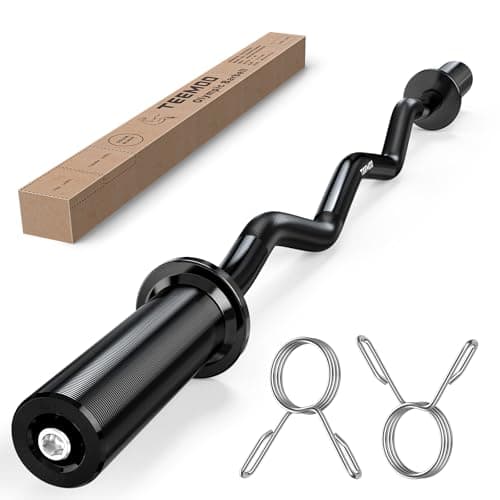
TEEMOO 47 in Olympic EZ Curl Bar (500 lb)
500 lb capacity47 in lengthE-coat finish2 spring collars included
A 500 lb rating and an E-coat finish put this well above the usual curl-bar spec sheet.
- Durability
- 8
- Finish
- 8
- Knurl & grip
- 7
- Capacity
- 9
- Value
- 8
Pros
- +A published 500 lb capacity — two and a half times the typical budget curl bar rating
- +E-coat is a genuinely good corrosion finish, better than paint at resisting sweat and damp air
- +Includes two spring collars, so it is usable straight out of the box
Cons
- −A newer brand without CAP's decade of listings behind it
- −The high rating is a manufacturer claim; nobody is loading a curl bar to 500 lb to test it
Don't buy this if…
…brand longevity is your deciding factor. CAP has been selling the same curl bar shape for years and is the safer bet on parts and consistency.
Best curl / accessory bar
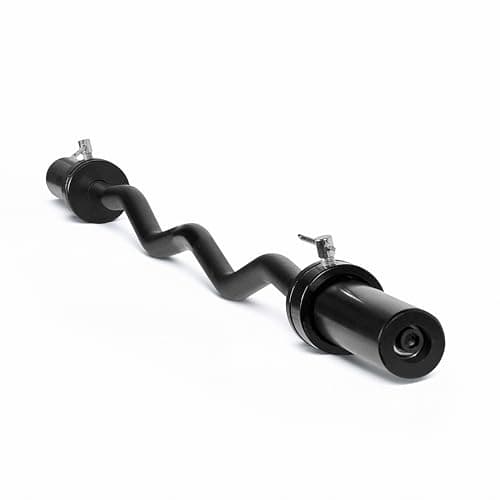
CAP 47" Olympic EZ Curl Bar
47 in OlympicAngled gripBlack finish2 in sleeves
The cheap accessory bar that saves your wrists on curls and skullcrushers.
- Tensile / build
- 6
- Coating
- 6
- Knurl & spin
- 6
- Capacity
- 6
- Value
- 8
Pros
- +The angled grip takes real strain off the wrists on curls and triceps extensions
- +Takes your existing Olympic plates, so no new weights needed
- +Cheap enough to be an easy add-on to a barbell setup
Cons
- −A single-purpose bar — it only earns its keep for arm work
- −Budget finish; keep it wiped down like any black bar
Don't buy this if…
…your training is squats, presses and pulls with a straight bar. A curl bar is an accessory, not a core purchase — skip it until arm isolation is actually on your program.
Best curl bar for damp spaces
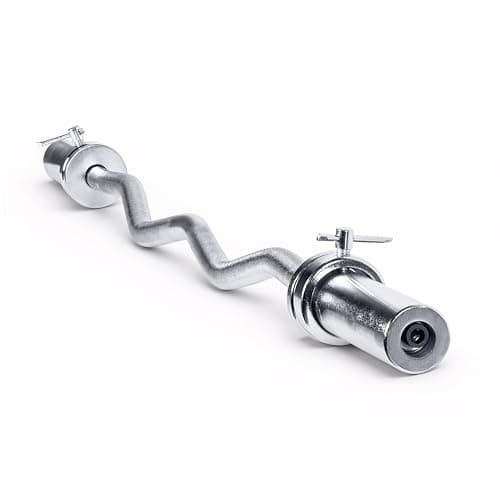
CAP 47 in Olympic EZ Curl Bar (Chrome, 200 lb)
47 in length200 lb capacityChrome finish2 in Olympic sleeves
The same proven CAP curl bar in chrome — the finish to pick if your gym is a damp garage.
- Durability
- 7
- Finish
- 8
- Knurl & grip
- 7
- Capacity
- 6
- Value
- 9
Pros
- +Chrome resists surface rust better than a painted black finish, which matters in an unheated garage
- +A 200 lb published capacity is far beyond what anyone curls or skull-crushes
- +CAP is one of the longest-standing budget names in the category, so listings and spares persist
Cons
- −Chrome chips at the collar contact points over years, and chips are where rust starts
- −200 lb capacity rules it out as a light squat or rack-pull bar
Don't buy this if…
…you want one bar for everything. A curl bar is a second bar by definition — buy a full 7 ft Olympic bar first.
Cheapest curl bar
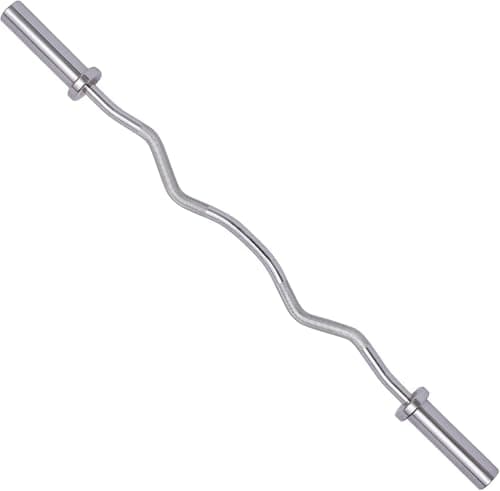
Fitvids 47 in Olympic EZ Curl Bar
47 in length2 in sleevesCurl bar geometryHome gym use
The cheapest honest way to add a curl bar to a rack you already own.
- Durability
- 6
- Finish
- 6
- Knurl & grip
- 6
- Capacity
- 5
- Value
- 9
Pros
- +The lowest price here for a full 2 in Olympic curl bar that fits the plates you already have
- +Angled grip does the one job a straight bar can't — take strain off the wrists on curls and extensions
- +Nothing complex to fail: it is a bent steel bar with two sleeves
Cons
- −No published capacity figure on the listing, so treat it as a light-accessory bar only
- −Budget sleeves spin less freely, which is irrelevant for curls and noticeable for nothing else
Don't buy this if…
…you want a bar with a documented rating. Pay a little more for one that publishes a capacity — an unrated bar is a bar you have to guess about.
How to buy a curl bar
Confirm it is Olympic, not standard
A 2 inch sleeve takes the plates you already own. A 1 inch standard curl bar takes different plates entirely and is a dead end unless you already own standard plates. Check before ordering — see Olympic vs standard.
Prefer a published capacity to a big claim
A bar that publishes 200 lb is more useful information than a bar that says "heavy duty". You will never load a curl bar near either number, but a maker willing to publish a figure is a maker who tested something.
Pick the finish for your room
Unheated garage, humid climate, or a bar that gets sweated on: chrome or E-coat. Conditioned indoor space: the finish barely matters and you should buy on price. Bare or painted steel in a damp garage will show surface rust within a year — fixable, but annoying.
Buy collars with it
A curl bar with plates sliding around is worse than no curl bar. A pair of spring clips costs almost nothing — see our collar roundup, and the lifting belts page for the other accessory every squat and deadlift guide on this site assumes you own. Some curl bars, like the TEEMOO, include a pair.
Wipe it down
Curl bars get more direct hand contact per session than any other bar you own, and hand sweat is what starts rust. Thirty seconds with a dry rag after use, plus the routine in our rust guide, is the whole maintenance program.
How we picked
We do not run a testing lab
We compiled manufacturer specifications, read the published warranties, checked the relevant standards and aggregated owner reviews, then scored each product against a published rubric. The scores are judgments from documented research — they are not measurements we took, because we do not run a lab and we are not going to pretend we do. Where a number came from a manufacturer or a standard, we name it and link it in Sources.
Questions
Frequently asked
Is an EZ curl bar worth buying?+
If straight-bar curls or skull crushers bother your wrists or elbows, yes — it is one of the cheapest permanent fixes in a home gym. If they do not bother you, it is a nice-to-have and the money is better spent on plates or a bench.
How much does an EZ curl bar weigh?+
Olympic EZ curl bars typically weigh in the region of 18 to 25 lb depending on length, wall thickness and sleeve design. Manufacturers do not always publish it, so if you need the exact figure for load tracking, check the specific listing rather than assuming a standard.
Can I use an EZ curl bar on a squat rack?+
Not usually — at 47 inches it is too short to span standard J-hooks safely. Curl bars are picked up from the floor or from a bench. If you want to rack a shorter bar, you need a rack with narrow-set uprights or a dedicated stand.
Do EZ curl bars fit normal Olympic plates?+
The Olympic versions do — the sleeves are 2 inches, the same as a full-size bar, so your existing plates fit. Standard 1 inch curl bars do not. Every bar on this page is the 2 inch Olympic type.
Receipts
Sources
We do not run a testing lab, and we do not pretend to. Every spec, warranty term and standard above is the manufacturer's or a published source, cited and linked. Where we could not verify something, we say so on the page rather than quietly leaving it out. Read our full method.