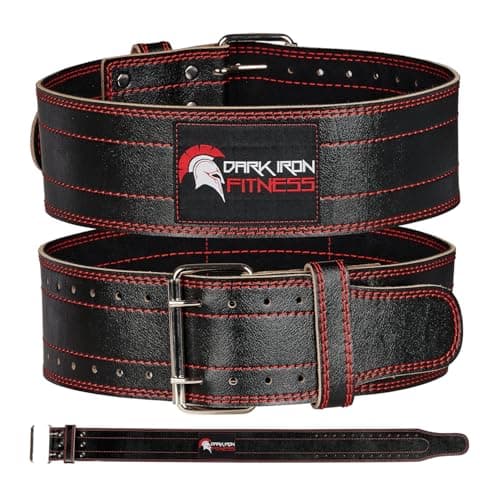
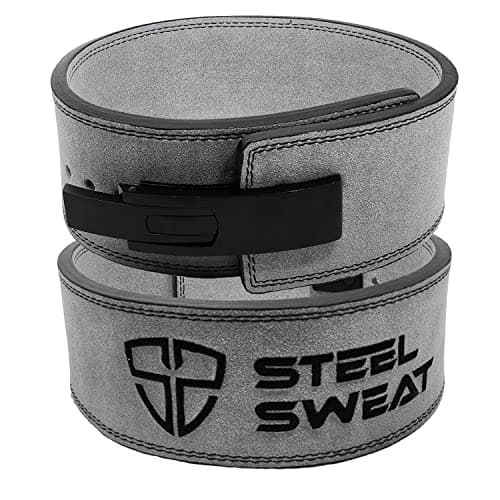
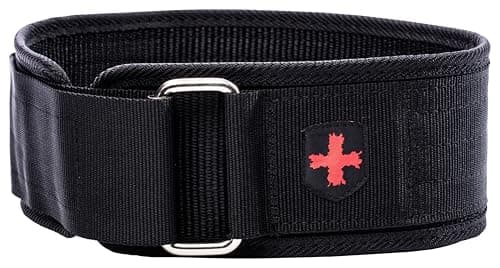
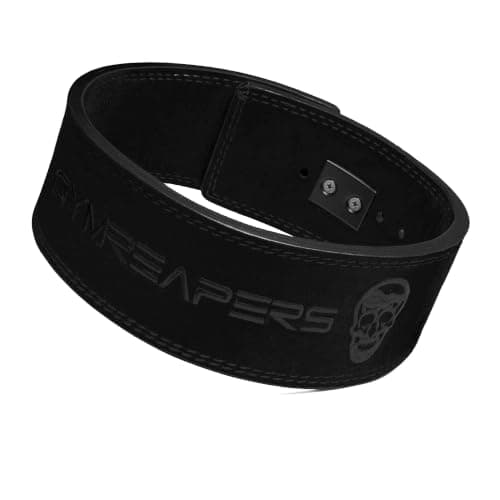
Buy the Gymreapers 10 mm lever belt if you squat or deadlift seriously: leather, 10 mm thick, a lever closure, and IPF approval — the only third-party certification available anywhere in home strength equipment, and the only one on this site. Buy the Dark Iron Fitness belt if you want genuine leather with reinforced stitching and a double prong for a third of the price. Buy the Element 26 if your training moves — cleans, front squats, circuits — because a self-locking nylon belt adjusts in a second and does not fight a rack position. Buy the Steel Sweat if you want the same published 10 mm leather lever spec as the top pick without paying for the federation stamp. And buy the Harbinger 4-inch nylon belt if you want the cheapest honest belt there is, which is plenty for general training.
What a belt actually does
A lifting belt is not back support in the way the phrase suggests. It is a surface to brace against. You take a breath, push your abdominal wall out into the belt, and the belt pushes back — which raises the pressure inside your torso and makes your whole midsection stiffer under load. A stiffer midsection transmits force better from your hips to the bar.
Two things follow from that, and they decide this entire ranking. First, the belt has to be stiff: a belt that folds, rolls or compresses gives you nothing to push into. Second, it has to go back to the same tightness every set, because an inconsistent brace is an inconsistent lift. Thickness and material deliver the first; the closure delivers the second.
Everything else on a belt listing — colors, logos, “lower back support”, hernia claims — is either cosmetic or a medical claim we are not going to repeat. This is an equipment page. And it is a different product from a dip belt, which hangs plates off your waist for weighted dips and pull-ups rather than giving you a surface to push into.
What we rank on, in this order
- Material and published thickness. Leather at 10 mm is the powerlifting standard because it will not fold at the waist under a maximal brace. Nylon flexes, which is a disadvantage at a one-rep max and an advantage in everything that moves. Two of these five publish a thickness in millimeters; the rest publish a width in inches or nothing.
- The closure. A lever returns to exactly one setting every time, which is the most repeatable brace available. A self-locking cam gets most of the way there with infinite adjustment. A prong buckle is the most adjustable and the least repeatable, and a double prong spreads the pull across two holes instead of tearing out one.
- Third-party approval, where it exists. IPF approval constrains thickness, width and construction and is checked by somebody other than the seller. Exactly one belt here has it. Across this whole site, certification is this rare — the only comparable case is the ASTM-certified benches on the heavy-duty benches page.
- Construction detail. Reinforced stitching is where a leather belt lives or dies, and it is the one construction spec some listings bother to state.
- Versatility. Last, deliberately. A 10 mm competition belt is the best belt for a heavy squat and an uncomfortable one for a conditioning circuit.
The five, side by side
| As published | Gymreapers lever | Dark Iron Fitness | Element 26 | Steel Sweat lever | Harbinger nylon |
|---|
| Material | Leather | Genuine leather | Nylon | Leather | Nylon |
| Thickness published | 10 mm | Not published | Not published | 10 mm | Not published |
| Width published | Not published | 4 in | Not published | Not published | 4 in |
| Closure | Lever | Double prong | Self-locking | Lever | Buckle |
| Federation approval | IPF approved | None stated | None stated | None stated | None stated |
| Stitching detail | Not published | Reinforced stitching | Not published | Not published | Not published |
| Best suited to | Heavy squats, deadlifts, competition | Heavy training, no competition | Olympic lifts, mixed training | Heavy training on a budget | General strength work |
Every cell is quoted from the manufacturer listing linked in Sources, read on 2026-10-11. This category publishes more than most of the home gym market — thickness, width, closure and in one case a federation approval — which is why the ranking can be built on specs rather than on inference. Where a listing states a width but not a thickness, or a thickness but not a width, the table says so.
Lever, prong or self-locking?
The closure is the part people get wrong, so it is worth being specific.
Lever
A metal lever that snaps shut at one fixed circumference. The best brace in the category, because it is identical on every set and it goes on and off in a second. The cost is that the lever is bolted to the belt at one position — changing it means a screwdriver, so the belt does not accommodate a bulky hoodie, a bodyweight change or another lifter. Two belts here use one.
Double prong
Two prongs through two rows of holes. Infinitely more adjustable than a lever across a range of sizes, noticeably slower to fasten, and never quite the same tightness twice. The double arrangement matters: one prong carries the whole pull through a single hole, which is where single-prong belts tear.
Self-locking cam
A cam mechanism that cinches to any tightness you pull and then locks. It is the useful compromise — the adjustability of a prong with most of the repeatability of a lever, and no holes to line up. Almost always paired with nylon, as it is here.
Leather or nylon?
Leather is stiffer, so it supports more at the top of a heavy brace, and it is effectively permanent — a leather belt darkens and softens over a decade rather than wearing out. It is also the wrong material for a damp room, which is the same caution we give about bars in how to stop barbell rust: leather left wet stiffens and cracks.
Nylon flexes. That costs you support under a maximal squat and buys you a belt you can actually wear through cleans, front squats, thrusters and anything where the bar sits on your torso. It is light, washable and indifferent to sweat.
If you train powerlifting-style — low-bar squat, bench, deadlift, heavy and slow — buy leather. If your week includes Olympic lifts or conditioning work, buy nylon and accept the trade. If you do both seriously, two belts is a normal answer and the cheapest nylon belt here costs less than a pair of change plates.
Who should not buy a belt yet
This matters more than which belt. A belt amplifies a brace; it does not create one. If you cannot yet take a breath and hold a rigid torso through a squat without a belt, the belt will mask that rather than fix it — and you will have bought a crutch instead of a tool.
The honest sequence is the one on what equipment do you need for strength training: a rack, a bar, plates and a bench come first, by a long way. A belt is an accessory for weights that are heavy relative to you, which for most people means somewhere past the first year of consistent barbell training. Before that, the money is better spent on small plates to keep progressing or on collars that actually hold or a belt, once the weights are heavy relative to you.
And when you do buy one: wear it for the heavy sets, not the warm-ups. A belt worn for everything is a belt you have stopped noticing, which defeats the purpose.
What fails on a lifting belt
Almost nothing, which is why this is a buy-once purchase. In order:
- Stitching, on a leather belt. Where the buckle or lever plate is sewn to the belt body. Reinforced stitching is the spec that delays this, and it is why one listing here naming it is worth something.
- Lever hardware. A cheap lever can loosen or distort. Check the screws occasionally, exactly as you would re-torque a rack.
- Prong holes. The hole you always use stretches over years. A double prong spreads the load and delays it.
- Nylon at the cam contact point. Webbing abrades where the mechanism grips it. The one genuine wear point on a nylon belt.
A leather belt kept dry will outlast most of the equipment in the room — the same category of purchase as cast iron plates. Keep it off a damp floor, wipe the sweat off it, and the only reason you will ever replace it is a change in what you train for.
How to buy a lifting belt
Pick the material from your training, not your budget
Heavy, slow barbell lifts: leather. Anything that moves — cleans, snatches, front squats, circuits: nylon. This decision determines more about whether you actually wear the belt than the price does.
Then pick the closure from how you train
A lever if your bodyweight and your layers are stable and you want the same brace every set. A self-locking cam if you want one belt that adapts. A double prong if you want adjustability and do not mind the extra seconds.
Measure your waist at the navel, not your trouser size
Belt sizing follows the circumference where the belt actually sits, which is higher and larger than your jeans measurement. Every one of these listings is sold by size variant — get this wrong on a lever belt and the lever has to be unbolted and moved.
Treat 13 mm as a specialist choice
10 mm is the thickness almost everyone wants, and it is what the two leather lever belts here publish. 13 mm exists for very heavy competitive lifters and is genuinely uncomfortable for everyone else. Thicker is not better; it is more specialized.
Only pay for a federation stamp if you will compete
IPF approval is real and is the only third-party check in this category — and it is worth nothing if you train at home and never enter a meet. One belt here publishes the same 10 mm leather lever specification for a fraction of the price without the approval, and for training that is the rational buy.
Buy it after the rack, the bar and the plates
A belt is the accessory that makes heavy lifts heavier, not the thing that makes a gym. If you are still assembling the room, start at home gym equipment, in what order and come back to this page in a year.