Skip to content
Plate&Rack

The load · Weight Plates

How Much Do Weight Plates Cost?

We will not print a price, because prices move and ours are live. What we will do is give you the arithmetic that makes every plate listing comparable in about ten seconds.

By Stephen V.Updated How we choose
#ad

We earn a commission when you buy through our Amazon links, at no extra cost to you. It never affects our rankings, and we say so when the cheaper product is the better buy. How this works.

Price plates per pound, never per plate. Take the live price on any listing, divide it by the total weight the listing publishes, and you have the only number that makes two plate listings comparable — and the CAP 150 lb Classic cast iron set is the lowest cost per pound of the four we rank here, which is why it leads the page. Do that sum on the prices in the table below, with today's date on them, and you will see the pattern immediately: plain cast iron is the cheapest weight you can buy, bumper plates cost more for the same pounds, competition plates cost more again, and buying by the pair always costs more per pound than buying a set.

Why this page gives you a method instead of a number

Plate prices move constantly — steel and rubber are commodities, shipping heavy freight is a meaningful part of the cost, and Amazon listings reprice daily. Any article that prints “expect to pay a dollar a pound” is out of date the week it is published, and we would rather not do that.

So every number on this page is live. The prices in the ranked table come from the Amazon Product API with the date they were read stamped underneath, and where we have no verified price we show none rather than printing a remembered one. Your job is one division; the arithmetic is below.

The cost-per-pound method

  1. Find the published total weight. Not the number of plates — the total. A listing that says “150 lb set” is giving you the number you need; a listing that says “6 plates” is not, and you have to add the weights up yourself.
  2. Divide the live price by that total. That is your cost per pound. Write it down for each listing you are comparing.
  3. Check whether a bar is included. Combo sets bundle a 7 ft bar into the total, which flatters the per-pound figure if you already own a bar and improves it if you do not. Our Olympic weight sets page ranks the bundles specifically.
  4. Check whether it is a pair or a single. A “35 lb plate” listing may be one plate or two, and that doubles or halves your answer. This is the single most common error in plate shopping.
  5. Then add shipping if it is not free. On a few hundred pounds of steel, shipping is not a rounding error.

The four, side by side

As publishedCAP 150 lb Classic ironCAP 110 lb Elite ironCAP 160 lb competition bumpersFitvids 35 lb iron pair
Published total weight150 lb110 lb160 lb70 lb (35 lb pair)
Plate typeCast iron, baked enamelCast iron, Elite finishCompetition-style bumperCast iron, deep dish
Weights included4 × 5, 4 × 10, 2 × 45 lbNot broken out on listingNot broken out on listing2 × 35 lb
Bar includedNoNoNoNo
DroppableNoNoYesNo
Buying formatSetSetSetPair
Cost per poundDivide the live price by 150Divide by 110Divide by 160Divide by 70

Every published figure is quoted from the manufacturer listing linked in Sources. Two of the four listings do not break out which plates make up the set, so confirm the breakdown on the listing before ordering — a 160 lb total made of small plates is a different purchase from one that includes a pair of 45s.

What makes a plate cost more

Rubber

A bumper plate is steel-hubbed rubber, and rubber costs more per pound than iron and takes more space on the sleeve. You are buying the ability to drop the bar without destroying the floor, the plate or the bar. If you never drop it, you are paying for nothing — the whole argument is on bumper vs iron plates.

Tolerance

Calibrated and competition plates are manufactured to a published weight tolerance and a thinner profile. That is real engineering and it costs real money, and it matters to competitive powerlifters and nobody else. We separate the two on calibrated vs competition plates.

Colour and coding

Colour coding is useful — a mis-loaded bar is obvious from across the room — and it is a premium. Plain black bumpers survive the same drops for less.

Handles and shape

Tri-grip and deep-dish iron plates are easier to carry and load, and they are bulkier in diameter for the same weight. Worth it if your plates move around constantly; not if they live on the bar. We rank them on the best weight plates with handles.

Buying format

This is the one most people get wrong. Buying by the pair almost always costs more per pound than buying a set, and the Fitvids pair above is in this ranking partly to demonstrate it. Pairs are for filling a specific gap in a collection you already own; sets are for starting one.

The cheapest honest way to buy weight

Plain cast iron plates, in a set, sized so the set includes the pair of 45s you will actually squat and deadlift with. That is the lowest cost per pound available new, and iron does not degrade — no rubber to perish, no hub to fail, nothing to service. We rank the iron on the cast iron plates page.

The cost that iron can impose later is the floor. Dropping iron chips tile, cracks sealed concrete and dents a bar, so if your training involves anything you bail out of, the money you saved on plates goes into bumpers or into flooring instead. Decide that before you order, not after — and read the flooring guide while you are deciding.

Cost per pound is not cost per year

One last thing, because it is the point of this site. Plates are among the very few purchases where the cost-per-year figure approaches zero: a cast iron plate bought today will be functionally identical in thirty years, so whatever you pay, you pay once. We run the arithmetic for a whole gym on home gym cost per year, and plates come out of it better than anything else in the room.

Which means the real risk in plate buying is not overpaying by a few cents a pound. It is buying the wrong format — bumpers you never drop, competition plates you never compete with, or pairs when a set was on the shelf. Get the format right and the per-pound number sorts itself out.

The other half of the bill works differently, because a bar is priced on specifications rather than on weight: how much does a barbell cost breaks down the four things that set the number on a bar listing.

The short answer

Quick picks

#ProductBest forScorePrice
01
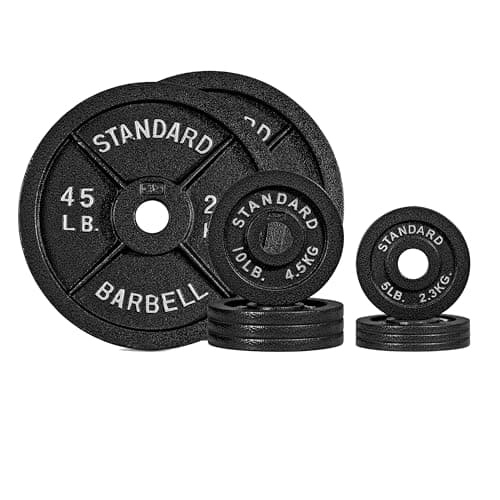
CAP Barbell CAP Barbell 150 lb Classic Olympic Cast Iron Plate Set
CAP Barbell 150 lb Classic Olympic Cast Iron Plate Set

More iron than the Elite set — including the pair of 45s a first barbell program actually needs — in the plain black finish that has been on garage floors for decades.

Best value iron set
7.0
$182.32Amazon
02
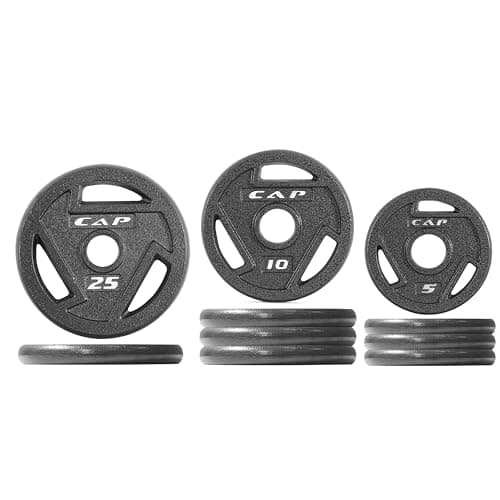
CAP Barbell CAP Barbell 110 lb Elite Olympic Cast Iron Plate Set
CAP Barbell 110 lb Elite Olympic Cast Iron Plate Set

Iron in a machined-face Elite finish — the set to buy once and never think about again.

Best cast iron plate set
7.2
$146.28Amazon
03
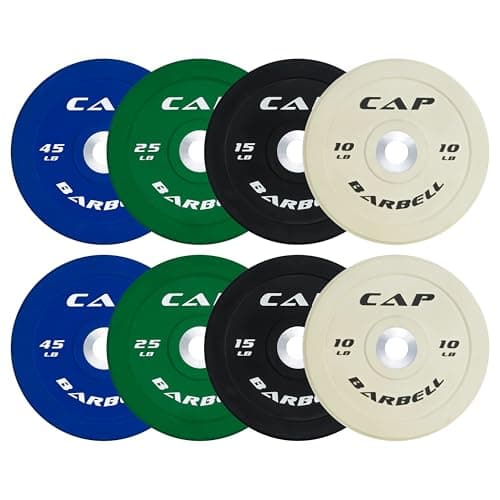
CAP Barbell CAP 160 lb Competition Olympic Bumper Plate Set
CAP 160 lb Competition Olympic Bumper Plate Set

A matched competition-style set in one purchase — the cheaper route to color-coded plates than buying pairs.

Best competition bumper set
7.8
$274.99Amazon
04
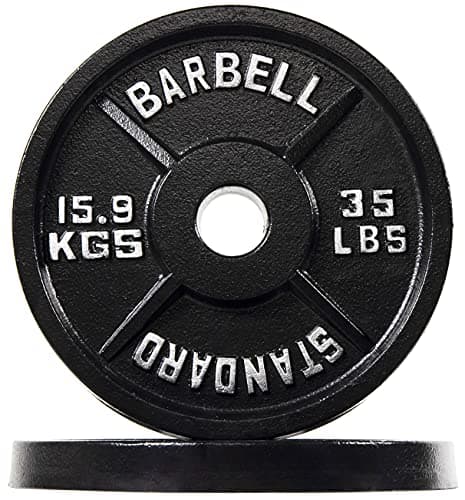
Fitvids Fitvids Olympic Cast Iron Plates (35 lb Pair)
Fitvids Olympic Cast Iron Plates (35 lb Pair)

Old-style deep-dish iron sold by the pair — the way to fill the gaps in a set you already own.

Best for adding pairs
6.6
$79.47Amazon

#ad · Live prices from the Amazon Product API, as of October 23, 2026. Where we have no verified live price, we show none — we would rather leave a gap than print a number that has rotted.

In detail

The picks, in full

01
CAP Barbell CAP Barbell 150 lb Classic Olympic Cast Iron Plate Set

Best value iron set

CAP Barbell 150 lb Classic Olympic Cast Iron Plate Set

150 lb set4×5, 4×10, 2×45 lb2 in OlympicBaked enamel cast iron
7.0/10

More iron than the Elite set — including the pair of 45s a first barbell program actually needs — in the plain black finish that has been on garage floors for decades.

Durability
9
Tolerance
6
Hub & fit
7
Floor safety
4
Value
9

Pros

  • 150 lb — four 5s, four 10s and a pair of 45s — is a full first barbell set rather than a starter kit you outgrow in a season
  • The pair of 45s is the part that matters: it is what turns a box of small plates into a loadable squat and deadlift
  • The lowest cost per pound of any set here, and iron does not degrade with age

Cons

  • Painted iron chips at the edges; expect cosmetic wear within a year of real use
  • Loud on a bare floor and unkind to the bar if you set down hard

Don't buy this if…

…your gym is over a finished floor or a room below. Iron transmits every set-down; bumpers or a rubber floor are the fix, and both cost money you should budget now.

$182.32View on Amazon

Price as of October 23, 2026. Prices change — Amazon's is the one that counts.

#ad · we may earn a commission from this link to CAP Barbell 150 lb Classic Olympic Cast Iron Plate Set

02
CAP Barbell CAP Barbell 110 lb Elite Olympic Cast Iron Plate Set

Best cast iron plate set

CAP Barbell 110 lb Elite Olympic Cast Iron Plate Set

110 lb set2 in OlympicElite seriesCast iron
7.2/10

Iron in a machined-face Elite finish — the set to buy once and never think about again.

Durability
9
Tolerance
7
Hub & fit
8
Floor safety
4
Value
8

Pros

  • Cast iron is the single most durable material in a home gym — these outlive the rack they hang on
  • A 110 lb starter set covers a beginner's working weights without buying singles piecemeal
  • CAP's Elite line is a step above the economy plates in finish consistency and hole tolerance

Cons

  • Iron chips paint where plates knock together, and bare chips will surface-rust in a damp garage
  • Not droppable — iron on concrete damages the plate, the floor and eventually the bar

Don't buy this if…

…you deadlift to failure and let the bar go. Bumper plates are the only sane choice for dropped lifts; iron is for controlled work.

$146.28View on Amazon

$159.999% off

Price as of October 23, 2026. Prices change — Amazon's is the one that counts.

#ad · we may earn a commission from this link to CAP Barbell 110 lb Elite Olympic Cast Iron Plate Set

03
CAP Barbell CAP 160 lb Competition Olympic Bumper Plate Set

Best competition bumper set

CAP 160 lb Competition Olympic Bumper Plate Set

160 lb total setCompetition styleColor codedOlympic 2 in bore
7.8/10

A matched competition-style set in one purchase — the cheaper route to color-coded plates than buying pairs.

Accuracy
8
Durability
8
Drop tolerance
9
Sleeve space
7
Value
7

Pros

  • A matched set arrives in matching thickness and color, which is the entire practical benefit of competition plates
  • Cheaper per pound than assembling the same weights pair by pair
  • 160 lb plus a 45 lb bar covers a beginner's whole working range before any second purchase

Cons

  • 160 lb is a starting set — a stronger lifter will be adding plates within the year
  • A set commits you to the maker's colors and thickness if you later want it to match

Don't buy this if…

…you already own black bumpers. Adding a competition set to them gets you two families of plates that do not match on thickness or color — buy more of what you own instead.

$274.99View on Amazon

Price as of October 23, 2026. Prices change — Amazon's is the one that counts.

#ad · we may earn a commission from this link to CAP 160 lb Competition Olympic Bumper Plate Set

04
Fitvids Fitvids Olympic Cast Iron Plates (35 lb Pair)

Best for adding pairs

Fitvids Olympic Cast Iron Plates (35 lb Pair)

35 lb pair2 in OlympicVintage deep-dish styleCast iron
6.6/10

Old-style deep-dish iron sold by the pair — the way to fill the gaps in a set you already own.

Durability
9
Tolerance
6
Hub & fit
7
Floor safety
4
Value
7

Pros

  • Sold as a pair rather than a fixed set, which is how you actually grow a plate collection
  • 35 lb is the awkward gap most starter sets skip, and it makes bar jumps sensible
  • Deep-dish iron is easier to grip and to lift off the floor than flat plates

Cons

  • Deep-dish plates take more space on the sleeve, so you fit fewer of them on a bar
  • Pair pricing means the cost per pound is higher than a bulk set

Don't buy this if…

…you are starting from nothing. A 110 or 150 lb set is far cheaper per pound than assembling the same weight one pair at a time.

$79.47View on Amazon

$89.9912% off

Price as of October 23, 2026. Prices change — Amazon's is the one that counts.

#ad · we may earn a commission from this link to Fitvids Olympic Cast Iron Plates (35 lb Pair)

How to buy plates without overpaying

Work in pounds per dollar, not plates per dollar

Divide every live price by the published total weight. It takes ten seconds per listing and it is the only comparison that survives a repricing.

Buy sets to start, pairs to fill gaps

A set is cheaper per pound and arrives as a usable spread. Pairs cost more per pound and exist so you can add the one weight you are missing — usually the 35s or a second pair of 45s.

Make sure the set contains a pair of 45s

A 110 lb set of small plates and a 150 lb set with two 45s are not the same purchase. The 45s are what turn a box of plates into a loadable squat and deadlift. Check the breakdown, and where the listing does not publish one, treat that as a thing to confirm before ordering.

Only pay for rubber if you drop the bar

Bumpers cost more per pound and take more sleeve space. They are the right purchase for dropped lifts and a waste for controlled ones. Be honest about which you do.

Price the floor into the plate decision

Cheap iron on an unprotected floor is a false economy, because the floor costs more than the plates did. A mat under the lifting area is part of the price of iron.

Buy once, then stop thinking about it

Plates are the most permanent thing in a home gym. Get the format and the breakdown right and this is a purchase you never revisit — which is the whole point of a buy-it-for-life home gym.
How we picked

We do not run a testing lab

We compiled manufacturer specifications, read the published warranties, checked the relevant standards and aggregated owner reviews, then scored each product against a published rubric. The scores are judgments from documented research — they are not measurements we took, because we do not run a lab and we are not going to pretend we do. Where a number came from a manufacturer or a standard, we name it and link it in Sources.

Questions

Frequently asked

How much do weight plates cost?

Prices move too often for a printed figure to be honest, so compare per pound instead: take the live price on a listing and divide it by the total weight it publishes. The prices in the table on this page are read from the Amazon Product API and carry the date they were read.

What is the cheapest type of weight plate?

Plain cast iron, bought as a set. It is the lowest cost per pound of any plate format, and iron does not degrade — there is no rubber to perish and no hub to fail. The trade is that it must not be dropped.

Are bumper plates worth the extra cost?

Only if you drop the bar. Bumpers cost more per pound and take more space on the sleeve, and what you buy is protection for the floor, the bar and the plate during dropped lifts. For controlled squats, presses and deadlifts, iron does the same job for less.

Is it cheaper to buy a weight set or individual plates?

A set, almost always — the per-pound price on a set beats buying the same weights pair by pair. Individual pairs are for adding a weight you are missing, not for assembling a collection from scratch.

How much weight do I need to start?

Enough to include a pair of 45s plus small plates for progression, which is what a 150 lb set gives you. Below that you have a starter kit rather than a loadable barbell. We cover the sequence on what weight plates to buy first.

Do weight plates hold their value?

Better than almost any other equipment, because they do not wear out and there is nothing to service. That is also why used iron is such a strong buy, and why the cost-per-year figure on plates is close to nothing however much you pay up front.

Keep reading

Receipts

Sources

We do not run a testing lab, and we do not pretend to. Every spec, warranty term and standard above is the manufacturer's or a published source, cited and linked. Where we could not verify something, we say so on the page rather than quietly leaving it out. Read our full method.