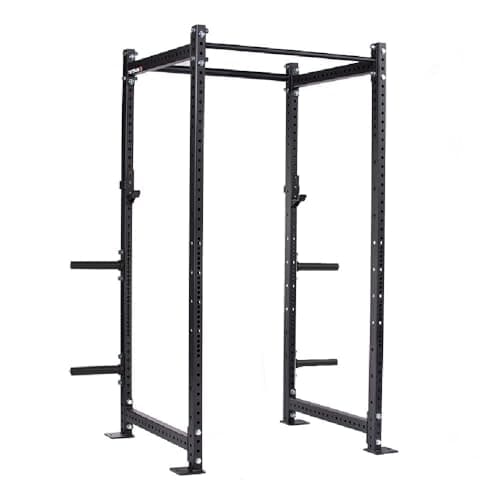
The Titan T-3 short rack is what you buy when the ceiling is the constraint and you still want a rack with an actual parts channel behind it. An 1,100 lb published capacity, 36 inches of depth, integrated plate holders and a maker that documents its replacement-part process. What you give up is headroom for pull-ups and room to move inside the cage.
We review this the way we review everything: from the published specification, the maker's own documentation and the way the thing is built. We do not run a testing lab and we have not loaded this rack ourselves — the method is set out on how we choose.
Why this rack keeps coming up
Titan occupies a specific rung on the ladder. Below it sit the marketplace cages — VEVOR, PASYOU, Signature — which are honest value and which we recommend often. Above it sit the direct-only premium brands, chiefly Rogue, which are not on the marketplace at all and which we cover in Rogue Fitness alternatives. Titan is the rung in between: enthusiast specification, published numbers, an attachment ecosystem, and a price that is roughly double the budget cages and roughly half the premium ones.
For a buy-it-for-life buyer that rung is interesting, because the two things that end a rack's life are a frame that flexes and a maker who will not sell you a J-cup. Titan addresses both.
The specification, and what each number means
1,100 lb capacity
Published rather than implied, which is the first thing we look for. In practical terms almost nobody will approach it — but as we argue on the steel gauge guide, the rating is most useful as a proxy for how the frame is built. An 1,100 lb figure on a home cage puts it clearly above the 700–800 lb marketplace band.
36-inch depth
This is the number to think hardest about. Thirty-six inches is enough to squat and bench inside the cage comfortably. It is tight for rack pulls, tight for a spotter to stand behind you, and tight if you want to leave a bench permanently inside the frame. Deeper racks — 43 inches and up — feel like a room; a 36-inch cage feels like a frame you step into.
The short frame
This is the whole reason the model exists, and the whole reason to be careful. A short rack fits under a basement ceiling or a garage door track where a full-height cage will not. It also lowers the pull-up bar, and on a short rack the bar can end up low enough that taller lifters have to tuck their knees. If your ceiling can take a full-height rack, buy the full-height rack — the short one solves a problem you do not have.
Weight plate holders
More useful than they look. Plates hung on the uprights are mass in the base of the rack, and mass in the base is the cheapest stability upgrade there is. They also keep plates off the floor, which is where plate rust starts.
The hole pattern
Titan builds the T-3 line on Westside spacing — closer hole spacing through the bench-press range, so you can set J-hooks and safeties to the inch where it matters. This is a genuine enthusiast feature rather than a marketing one, and it is worth more day to day than another two hundred pounds of rating.
What will wear out first
On a rack of this construction, nothing structural. The wear list is short and entirely made of small parts: the plastic or UHMW liners inside the J-cups, which take bar-on-steel contact; the safety pins or straps; and the bolts, which bed in over the first weeks and want re-torquing.
That is precisely why the parts channel matters more than the steel. Titan publishes a replacement-part request process through its support site and sells attachments across the T-3 and X-3 lines, so a chewed J-cup liner is a small order rather than the end of a rack. Our replacement parts guide explains why we treat that as a buying criterion rather than an afterthought.
What the listing does not tell you
The Amazon listing publishes capacity, depth and the plate holders. It does not publish a steel gauge in the title, and we are not going to assert one we have not seen stated — if the exact wall thickness matters to your decision, confirm it with the seller before ordering rather than inferring it from the price. That is the same discipline we apply to every rack on the main roundup.
Who should buy something else
- Anyone with normal ceiling height. Buy full height. The pull-up bar alone is worth it.
- Anyone who wants the cheapest workable cage. The budget rack roundup covers cages at a third of this price that will hold everything a home lifter loads.
- Anyone short on floor rather than height. A squat stand or a folding wall-mounted rack gives the floor back between sessions; a short cage still occupies its footprint permanently.
- Anyone who wants depth for rack pulls. Thirty-six inches is not the rack for that.
Living with it
Bolt it down if you can — this is a bolt-down design and it is also the prerequisite for adding a lat tower later. Load the plate holders evenly on both sides rather than stacking one upright. Re-check the bolt torque after the first few sessions and then once or twice a year, working around the frame in the same order each time. Set the safeties before you need them, using the routine in how to set up a power rack.