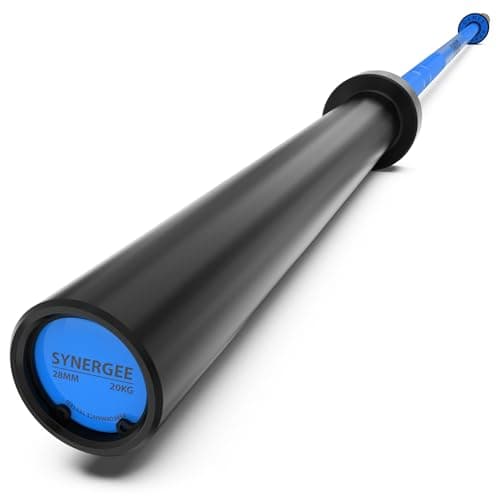
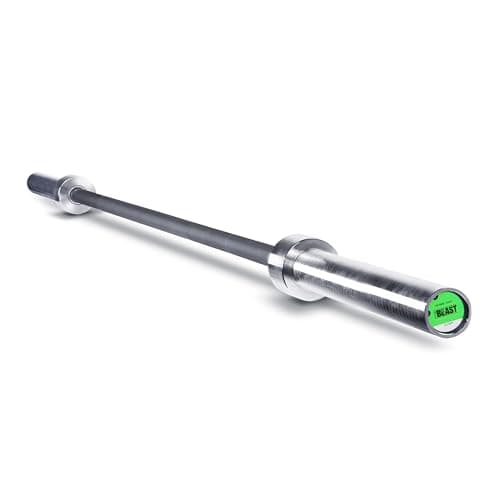
A power bar is stiff, aggressively knurled and built for squat, bench and deadlift. An Olympic weightlifting bar is whippy, smoothly knurled and built to spin for cleans and snatches. If you do a bit of both, buy a multipurpose bar and stop agonizing.
The four differences that matter
| Spec | Power bar | Olympic weightlifting bar | Why it matters |
|---|
| Whip (flex) | Stiff | Deliberately whippy | Whip helps a clean; it makes a heavy squat feel unstable |
| Knurl | Aggressive, often with a center knurl | Moderate, no center knurl | Center knurl grips a squat; it shreds your neck on cleans |
| Sleeve rotation | Bushings, modest spin | Bearings, fast spin | Fast spin protects wrists in a catch; irrelevant for pressing |
| Shaft diameter | Thicker (typically 29 mm) | Thinner (typically 28 mm) | Thicker resists bending; thinner is easier to grip and hook |
Whip: the difference you feel first
Whip is how much the bar flexes under load. A weightlifting bar is engineered to flex and rebound, because that oscillation helps a lifter change direction under a clean. A power bar is engineered to resist flex, because a bar bouncing on your back during a heavy squat is unsettling and moves the load around.
Whip comes primarily from tensile strength and shaft diameter, not from the bar being "better". A high tensile rating and a thinner shaft produce a bar that flexes a long way and springs back without taking a set. That is why cheap thin bars are dangerous and expensive thin bars are not — the steel is doing something different.
Knurl: the difference you feel forever
Power bars have sharp, deep knurl and usually a center knurl patch to stop the bar sliding on a squat. Weightlifting bars use a smoother knurl and skip the center patch entirely, because in a clean the bar drags up your torso and a center knurl takes skin with it.
This is the spec people underestimate. Knurl is permanent — you cannot make an aggressive bar gentle, and a bar too smooth for your grip stays too smooth. If you can, put your hands on a bar before buying. If you cannot, a multipurpose bar's medium knurl is the low-regret choice.
Spin: only matters if you catch the bar
In a clean or a snatch, the bar rotates in your hands as the wrists turn over. If the sleeves do not spin freely, that rotation is transmitted into your wrists. Needle bearings solve it; bronze or composite bushings give a modest spin that is entirely adequate for everything else.
For durability — our actual subject — bushings win. A bushing bar has fewer parts, tolerates neglect better, and is far easier to service. Bearings are precision components that dislike grit and moisture. In a garage, a good bushing bar is the more permanent object, and that is covered in detail in how long barbells last.
So which should you buy?
Buy a power bar if you squat, bench and deadlift, do not clean or snatch, and want the stiffest, grippiest bar you can get.
Buy a weightlifting bar if you actually train the Olympic lifts regularly — not occasionally, regularly. It is a specialist tool and it costs specialist money.
Buy a multipurpose bar — which is what almost every bar in our barbell roundup is — if you do a mix, or if you are not sure. A multipurpose bar has medium knurl, no or light center knurl, bushings, and a shaft diameter between the two. It does everything well and nothing perfectly, and it is the correct answer for the large majority of home gyms.
The specs to check before you buy either
Tensile strength first — this is the PSI figure that decides whether a bar takes a permanent bend. Then the coating, because in a home gym rust kills more bars than load does. Then the sleeve construction. Everything else is preference. The two bars ranked below sit at opposite ends of that spectrum and both publish their numbers, which is why they are here.