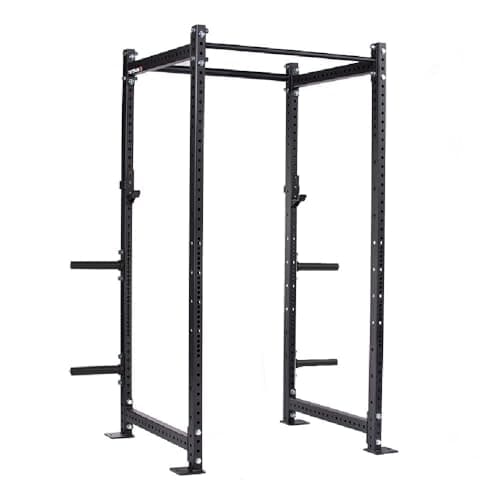
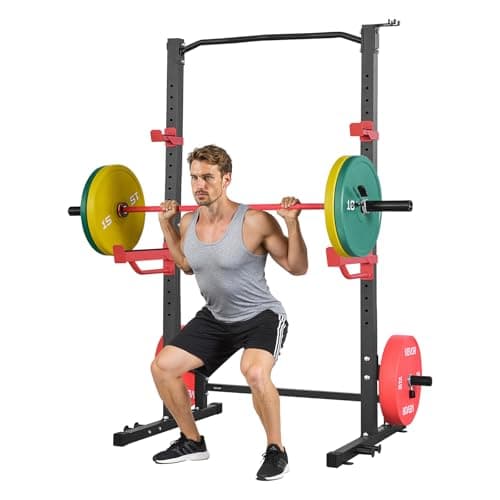
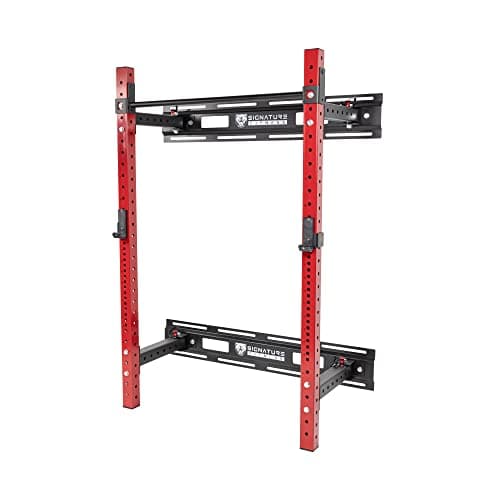
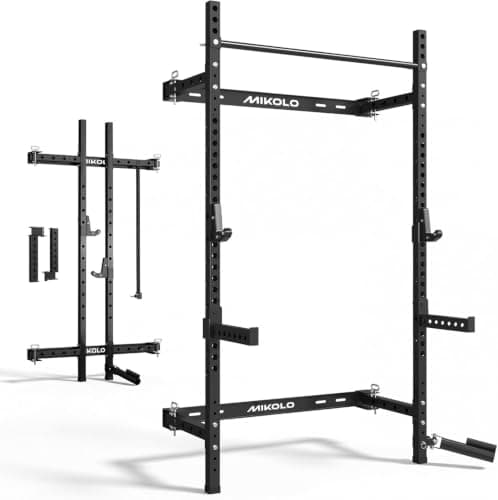
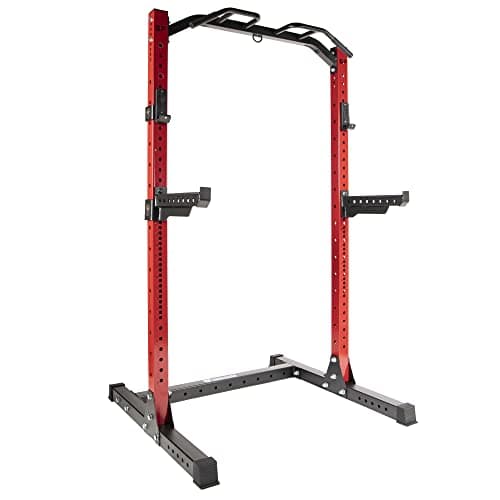
If you want the last rack you buy, buy 3x3 in 11-gauge steel. If you want a rack that is plenty for the loads most home lifters ever use, at a fraction of the price and a third of the mass, buy 2x2 with safeties and stop worrying about it. The rest of this page is what those two sentences leave out: why the numbers on the two listings look alike when the racks are not, what 2x3 buys you in the middle, and why the hole size matters more than the tube once the rack is ten years old.
What the numbers mean
"2x2" and "3x3" are the outside dimensions of the upright tube in inches. They say nothing about the wall thickness — that is the gauge, explained in power rack steel gauge — and the two specs have to be read together. A 3x3 tube in 11-gauge steel has walls about 0.120 inches thick; a 2x2 tube in 14-gauge has walls about 0.075 inches thick. Stiffness rises quickly with the size of the section, so the bigger tube is far stiffer than the wall-thickness ratio alone suggests.
On the listings we rank, the pattern is consistent: every 2x2 rack is a budget or folding rack, and every 3x3 rack is 11-gauge. The 2x3 size sits between them and, on the one 2x3 rack here, is also 11-gauge.
Why two 1,000 lb racks can be very different racks
The VEVOR cage and the Signature SF-SS1 both publish 1,000 lb. The VEVOR is 2x2 and weighs 59.75 lb by its listing. The Signature is 3x3 11-gauge and weighs 155 lb. The Signature fold-in cage, also 3x3 11-gauge and also 1,000 lb, weighs 158 lb. That is not a rounding difference; it is two and a half times the steel.
A capacity rating is a manufacturer's statement about static load — what the frame will hold. It does not describe how much the upright deflects when a heavy bar is walked out and set back down with force, and it does not describe how the rack behaves when a failed squat is dumped onto the safeties. Mass and section size do. That is why, on this site, the frame weight on the listing is read as a spec and the rating is read as a claim.
The racks, by upright size
| Rack | Uprights | Wall / gauge | Rated | Frame weight | Holes |
|---|
| Signature SF-SS1 | 3x3 in | 11-gauge | 1,000 lb | 155 lb | 47 per upright, Westside on the bench zone |
| Signature fold-in cage | 3x3 in | 11-gauge | 1,000 lb | 158 lb | 47 per upright, Westside on the bench zone |
| Titan T-3 short | 2x3 in | 11-gauge | 1,100 lb rackable; 4,400 lb total | 200 lb | Westside through the bench zone, 2 in above and below |
| VEVOR power cage | 2x2 in | Not published (reinforced frame) | 1,000 lb | 59.75 lb | 11 J-hook levels, 7 safety levels |
| Mikolo folding rack | 2x2 in | 13-gauge | 1,000 lb | 80 lb | Not itemized |
All figures from the manufacturer listings read on 2026-09-18, linked in Sources. Where a listing does not state a value the cell says so.
What 3x3 actually buys you
Stiffness under a walk-out. The bigger section resists the front-to-back bend a loaded bar puts on the upright. On a 2x2 you can sometimes see the top of the rack move on a heavy re-rack; on an 11-gauge 3x3 you generally cannot.
Mass without anchoring. A 155 lb frame is a frame that mostly stays put. A 60 lb frame relies on rubber feet, plate storage or anchors. Anchoring is covered in how to anchor a squat rack; a heavy rack needs it less.
A parts ecosystem. This is the durability argument, and it is the one people miss. 3x3 uprights with 5/8 inch holes are close to a de facto standard at the enthusiast tier — Rogue's Monster Lite line publishes exactly that, as our Rogue alternatives page documents — and a rack built to that pattern can take J-cups, safeties and attachments from several makers for as long as the pattern exists. A 2x2 rack with 1 inch holes takes the parts its own maker sells, and sometimes a generic pin-and-pipe attachment. When the maker stops selling the part, the rack is what it is. See home gym replacement parts.
Fine hole spacing where it matters. Both Signature racks and the Titan publish Westside spacing — 1 inch spacing through the bench zone — which lets you set safeties an inch under your chest instead of settling for two inches too low. Budget racks typically publish a count of positions instead.
What 2x2 actually buys you
The price. The 2x2 racks here list at a fraction of the 3x3 racks, and the live prices above show the current gap. For a lot of people that is the difference between owning a rack this year and not.
The footprint and the fold. The Mikolo folds to a published 2 inches deep against the wall. A 2x2 cage weighs little enough that one person can move it. In an apartment or a shared garage, that can be the deciding spec — see the best folding power racks.
Enough capacity, honestly. A published 1,000 lb rating on a 2x2 cage is a manufacturer claim, but the loads most home lifters rack — 200 to 400 lb — are so far under it that the tube size is not what limits the training. The safeties are. A 2x2 rack with safety bars is a safe rack; a 3x3 rack without them is not. Buy the safeties first, at any size.
The 2x3 middle
Titan's T-3 is the one 2x3 rack we rank, and it is 11-gauge with a 200 lb frame, which puts it in the 3x3 racks' company on mass and wall. The extra inch runs front to back, which is the direction a walked-out bar bends an upright, so 2x3 captures much of the stiffness gain of 3x3 in a slimmer rack. Its hole pattern is its own ecosystem — Titan sells the parts for it — rather than the 3x3 standard. Our Titan T-3 review goes through what that means in practice.
Which one, by buyer
Buy 3x3 11-gauge if you intend to keep the rack for decades, want attachments from more than one maker, lift or plan to lift heavy, or simply never want to think about the rack again. Cost per year — the arithmetic is in home gym cost per year — favors it comfortably over a long ownership.
Buy 2x2 if the budget is fixed, the room is small, the rack needs to fold or move, or you are honestly unsure you will still be lifting in five years. Get one with safeties in the box and re-torque it. It is a real rack. The budget field is ranked in the best budget power racks.
Buy 2x3 if you want most of the stiffness and mass of 3x3 in a rack built for a low ceiling or a shallow room, and you are content with one maker's parts.
How to read a rack listing for upright size
Find both numbers
Tube size and gauge, or tube size and wall thickness in millimeters. If the listing gives one without the other, assume the missing one is the budget value. A listing that gives neither is telling you something.
Read the frame weight as a spec
It is the one number a listing cannot inflate, and it tracks tube size and wall closely. Racks of the same nominal capacity that differ two-fold in weight differ two-fold in steel.
Check the hole size and pattern
5/8 inch holes on 3x3 uprights is the widest parts ecosystem. 1 inch holes on 2x2 is the budget pattern. Westside spacing on the bench zone is worth having at any size, and a listing that names it usually means it. The attachments roundup explains how to confirm fit before you buy an add-on.
Do not cross-shop on the rating
Every rack on this page publishes 1,000 lb or more. The rating separates none of them. Tube, wall, mass and hole pattern do.