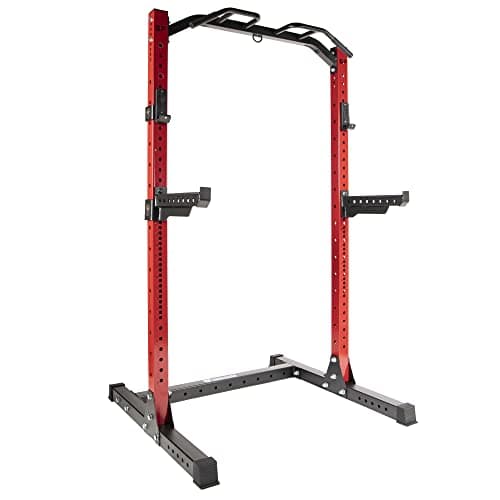
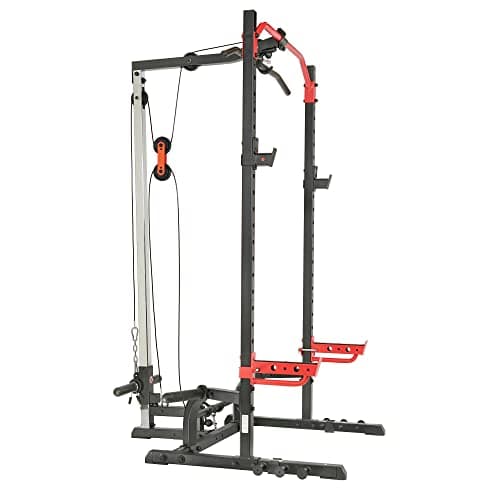
Buy this if you want pulling work and pressing work from one compact frame and you do not want to hunt for a compatible lat tower in two years. Skip it if your training is squats and presses — you would be paying for a cable stack that sits idle and eventually needs attention.
What it is
A squat stand with an integrated lat pulldown, sold as part of the Sunny Power Zone line. The published specification covers a squat stand and cage frame, the lat pulldown attachment included rather than optional, adjustable hooks, and compatibility with the rest of the Power Zone attachment range.
That last point is the strategic one. A stand from a brand with no attachment line is a terminal purchase — what you buy is what you have. A stand inside an ecosystem is a starting point, and it shares parts with the Sunny cages we rank elsewhere on the site.
The case for the integrated cable stack
Pulling work without a second frame
A barbell home gym is naturally press-heavy. You can squat, bench, overhead press and deadlift with a bar and a rack; the one thing you cannot easily do is a loaded vertical pull. A lat pulldown fixes that gap directly, and doing it from the frame you already own means no second footprint and no second purchase.
Buying it now is cheaper than adding it later
Bolt-on lat towers are not cheap, and they are frame-specific. Buying a stand with the tower already fitted removes both the price and the compatibility risk. If you know you want cable work, integrated is the lower-cost path — and it is the reason this stand rates well on expandability despite being the most expensive squat option in our roundup.
Compact for what it does
A stand footprint with a working cable station is a genuinely good use of a small room. The alternative — a squat rack plus a separate functional trainer — needs far more floor.
The honest drawbacks
You are paying for the hardware whether you use it or not
This is the most expensive squat option in our squat rack roundup, and the cable hardware is exactly what the premium buys. If your program is squats, presses and rows with a barbell, that money is better spent on heavier uprights — the Signature SF-SS1 gives you 3×3 inch steel and a published 1,000 lb rating for less.
Cables and pulleys are the wear items
On a site about equipment that outlives you, this deserves stating plainly: the steel frame will effectively last forever, and the cable will not. Cables stretch and fray, pulleys develop play, and those are the parts most likely to need attention over a decade. The mitigation is that it is a named brand with an attachment line, so parts are more likely to exist than they are for an anonymous listing.
A stand is still a stand
Adding a cable station does not change the safety geometry. You are lifting on a stand, not inside a cage, so spotter arm setup carries the same weight it does on any open frame — see half rack vs full rack for what that trade-off actually means.
How it compares
| Sunny Power Zone stand | Signature SF-SS1 |
|---|
| Cable station | Lat pulldown included | None |
| Upright profile | Not published as 3×3 | 3×3 in |
| Published capacity | Not stated on the listing | 1,000 lb |
| Expandability | Power Zone attachment line | Conversion-kit ready |
| Wear parts | Cable and pulleys | Effectively none |
Read that table as a fork rather than a ranking. The Sunny buys capability; the Signature buys steel and longevity. Both are defensible — they are answers to different questions.
Who should buy it
The lifter in a small room who wants a complete upper-body program from one frame, and who would otherwise end up buying a lat tower within a year anyway. For that person the integrated stack is the cheaper and tidier route, and the Power Zone ecosystem means the frame is not a dead end.
Everyone whose training is a barbell and nothing else should buy a plain stand with better steel and spend the difference on plates. Paying for a cable stack you never touch is the opposite of buying once.