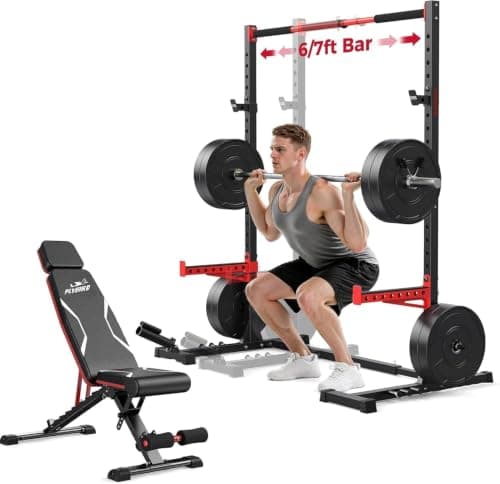
The FLYBIRD SR1 is the rack to buy when you want a proper pull-up bar and a wide range of safety positions without giving a full cage's worth of floor to the project. It is not the stiffest frame you can buy, and it is not the rack for a 500 lb squat. For the lifter it is aimed at, it does the job and keeps doing it.
Why we looked at this one
Most racks in this bracket are anonymous. The SR1 is not — it is one of the more widely sold multi-function squat racks on Amazon, it publishes real numbers, and it turns up in our squat rack roundup as a pick. That combination makes it worth a dedicated page: enough people are considering it that the honest version of the answer is useful.
We do not run a testing lab and we did not build one for this review. What we did is read the manufacturer's published specification, compare it against the racks around it at the same price, and apply the same durability rubric we apply to everything — the one published here.
The specification, and what each number means
22 safety positions
This is the headline number and it is more useful than it sounds. Safety-catch granularity decides whether you can set the catches just below your bottom position on every lift you do. Coarse spacing means the catches are either in your way or too low to help. Twenty-two positions across the upright is fine spacing for this class of rack, and it is the spec that most improves day-to-day usability.
The pull-up bar
Integrated rather than an add-on, which matters for two reasons. It is one less purchase, and — more importantly — an integrated bar is engineered into the frame's load path rather than clamped to it. On an open rack, a pull-up bar also acts as a top brace, tying the uprights together and stiffening the whole structure.
Multi-function frame
The SR1 sits between a plain stand and a half rack: uprights with catches and hooks, connected top and bottom, on a base that provides its own stability. That geometry is what lets it work as a squat, bench and press station in a footprint a cage cannot match.
What is not published
FLYBIRD does not publish a steel gauge for the SR1. We are not going to guess one. What we can say is what the absence means in practice: judge it on the published capacity and on the price bracket, and if you need a documented 11-gauge 3×3 frame, this is not that rack and nothing at this price is. Our gauge guide explains what you are trading.
What will wear out first
On a rack like this, in order: the J-hook liners (the plastic or rubber protecting your bar knurl), then the finish where the bar contacts the hooks, then the hardware if it is never re-torqued. The steel itself, kept dry, is essentially permanent.
None of those are failures — they are maintenance. Re-torque the bolts after the first month and once a year after that. Keep the rack out of standing damp. Replace the hook liners when they flatten. Do that and this is a rack you keep for a decade, which puts the cost per year in a bracket almost nothing else competes with.
Who should buy something else
Three groups. If you train heavy singles alone and want the enclosure, buy a power cage — no open rack replaces full-length safeties. If your space has another job, buy a folding wall-mounted rack. And if you want to add a lat tower and cables later, look at the racks with cables built in — the SR1 is a complete tool rather than the first stage of a system.
Living with the SR1
Assembly
Bolt-together, like almost every rack in this class. Assemble it loosely first, get every bolt started, then tighten in stages — tightening one joint fully before starting the next is how people end up with holes that will not line up.
Set the safeties before you need them
With 22 positions there is no excuse for lifting with the catches in the wrong place. Set them one notch below your bottom position on squats, and at chest height minus a couple of inches on bench. Do it before the working sets, not after the first missed rep.
Anchor it if you can
Any open rack is better bolted down. If your floor allows it, anchoring removes the tipping question completely — our anchoring guide covers concrete and wood.
What to buy alongside it
A rack is one third of a gym. You still need a bar, plates, and a bench that does not flex under a press. Budget for all three before deciding how much rack you can afford.