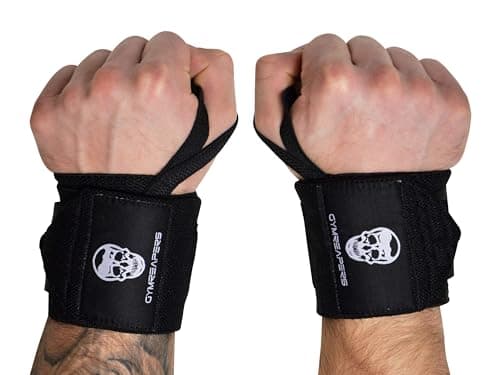
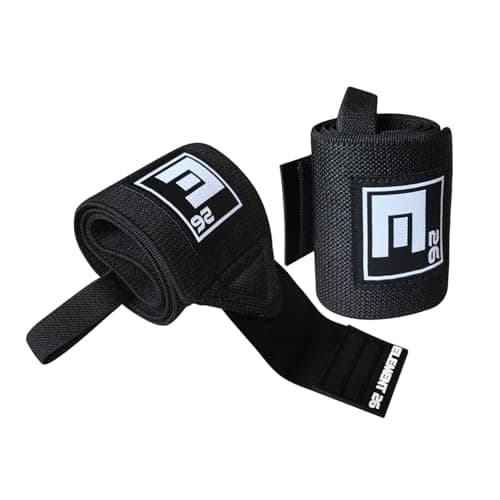
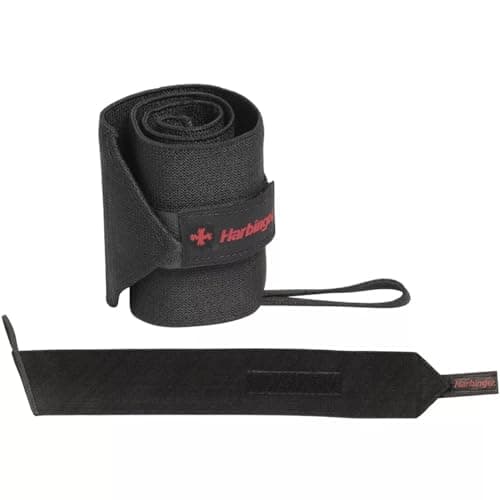
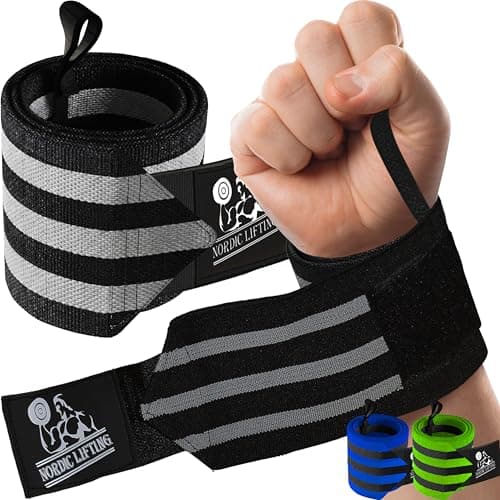
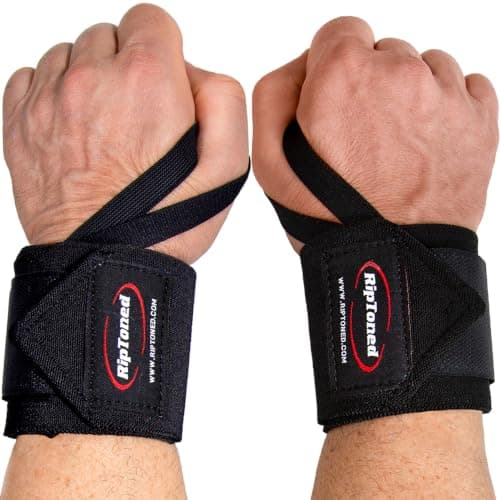
Buy the pair that publishes a length and a stiffness grade. In a category where every listing shouts Heavy Duty and almost none of them state a number, those two figures are the entire difference between choosing a wrap and being handed one. A wrist wrap is a strip of elastic webbing with a thumb loop at one end and a hook-and-loop closure at the other. It has no bearings, no coating and no hardware. What it does have is a working life measured in how long the elastic keeps its snap-back, and a failure point you can see coming: the stitching at the thumb loop.
This page exists because the site already ranks the other three items in this family — lifting belts, lifting straps and dip belts — and every bench, press and squat page on it assumed a reader who already owned wraps. Every price here is read live from the Amazon Product API and date-stamped underneath, because any page that types a number into prose is wrong a week later.
What a wrist wrap does, and what it does not
A wrap limits how far the wrist can bend backwards while it is carrying load. Under a bench press, an overhead press or a heavy back squat, the bar sits in the heel of the hand and the joint wants to fold back; a wrap takes some of that and keeps the hand stacked over the forearm. That is the whole mechanism. It is why wraps are worn for presses and squats and why they are close to useless on a deadlift or a row, where nothing is pushing the wrist backwards.
The confusion worth clearing up before you buy: a wrap supports the joint on a push, a strap takes your grip out of the equation on a pull. They are not the same purchase, they do not substitute for each other, and the brands deliberately name them similarly — several of the listings on this page sit a click away from a product called a wrist strap from the same company. If your hands are giving out on deadlifts, you want the lifting strap page, not this one.
One more thing we will say plainly, because the autocomplete around this query is full of it: a wrist wrap is training equipment, not a treatment. If a wrist hurts when it is not loaded, or hurts in a specific spot rather than feeling generally worked, that is a question for a clinician and not for a twenty-dollar accessory. Nothing on this page is medical advice and we are not going to pretend a wrap fixes anything.
How we ranked them
Four criteria, in this order, and three of the four are about what the listing is willing to commit to:
- Published length. Length decides how many turns you get around the wrist and how much tail is left to tension the closure. 18 in is the common competition length; 20 in gives a thicker wrist the same turns. A listing that publishes neither is asking you to find out after it arrives.
- Published stiffness, or an approval that implies one. Stiff wraps support more and are less comfortable; flexible wraps are the opposite. Exactly one listing in this group states a grade, and it is also the only one carrying a powerlifting-federation approval.
- Thumb loop and closure construction. These are the two parts that fail. The loop takes the entire tensioning load every time you put the wrap on, and the hook-and-loop closure collects lint until it stops holding. A listing that calls out reinforced stitching has at least noticed where the problem is.
- What the listing actually commits to. A brand that prints 18 in, Stiff and USPA approved has made three claims you can hold it to. A brand that prints Super Heavy Duty has told you what it would rather discuss.
We do not run a lab and we do not pretend to. These are judgments from the published listings, the construction involved and aggregated owner reports, scored against our published rubric.
The five, side by side
| As published | Rip Toned | Gymreapers | Element 26 | Harbinger Pro | Nordic Lifting |
|---|
| Published length | 18 in | 18 in | 20 in | 20 in | Not published |
| Stiffness grade | Stiff (stated) | Not published | Not published | Not published | Not published |
| Federation approval | USPA and USAPL | None published | None published | None published | None published |
| Thumb loop | Yes | Yes, stated heavy duty | Not published | Yes | Not published |
| Other stated feature | Flex version of same wrap | Competition Grade (claim) | Quick release | Sold as a pair | Reinforced stitching |
| Elastic content | Not published | Not published | Not published | Not published | Not published |
Every cell is quoted from the manufacturer listing linked in Sources, and where a listing states nothing the cell says so rather than guessing. Look at the shape of that table: four of five publish a length, one publishes a stiffness grade, one carries an approval, and not one publishes what the wrap is actually made of. For a product whose entire function is elastic recovery, nobody stating the elastic content is the single most revealing fact in the category.
18 in or 20 in
The practical difference is one turn. At 18 in most people get two to three turns around the wrist with enough tail left to pull the closure tight, which is what a competition wrap is designed to do. At 20 in a thick wrist gets those same turns and a slim wrist gets an extra one, which either feels like more support or feels like a cuff that bunches into the heel of the hand — it depends on your wrist, and nobody can tell you in advance which it will be.
If you are buying blind: 18 in is the safer default for a wrist under about seven inches around, 20 in above that. If you intend to compete, check your federation’s own rules rather than a product page, because the length limit is written into them and it is not the same everywhere.
Stiff or flexible — the spec almost nobody publishes
Wraps are built in grades. A stiff wrap uses a denser weave and more elastic tension: it holds a lot and it fights you on anything requiring a bent wrist. A flexible wrap is comfortable for general gym work and gives up some support near a maximum. This is the single most important thing about how a wrap feels, and of the five listings here exactly one publishes it.
That is why this page ranks a federation approval so highly. USPA and USAPL approval does not make a wrap stronger; what it does is force the manufacturer to build to a published dimensional and construction standard and submit the result, which means the words on the listing have been checked by somebody other than the marketing department. It is the same reasoning that put an IPF-approved lever belt at the top of our lifting belt roundup — on this site, a third-party check beats a confident adjective every time.
Wraps, straps and belts are three different purchases
Three items, three jobs, and the fastest way to waste money here is to buy the wrong one for the problem you have:
- A wrist wrap supports the wrist joint on a push — bench, overhead press, heavy squat. This page.
- A lifting strap moves the load of a pull off your fingers — deadlift, row, shrug, high-rep pull-up. That is the lifting strap page.
- A lifting belt gives your trunk something to brace against on a squat or a press. That is the lifting belt page, and the belt that hangs plates for dips and pull-ups is a fourth, different item on the dip belt page.
And one honest redirect: if your wrists hurt specifically under a back squat, the problem is usually the bar position rather than the absence of a wrap, and the fix is a bar whose handles let the wrist sit neutral. We compare the two bars that do that in safety squat bar vs trap bar. Buying a wrap to solve a geometry problem is the one mistake this page would like to prevent.
What actually wears out
Three things, in the order they happen:
- Elastic fatigue. The webbing stops snapping back to its original length, so the same number of turns gives less support. It is gradual, it takes years of regular use, and the tell is that you keep pulling the wrap tighter to get the same feel.
- Hook-and-loop clogging. The hook side fills with lint and chalk and stops gripping. This is the most common reason a pair gets thrown away and it is almost always recoverable: pick the hooks clean with a stiff brush and keep the wrap rolled rather than crumpled in a bag with the closure open.
- Thumb-loop stitching. The loop takes the whole tensioning force every single time, so this is where a wrap tears. Nordic Lifting is the only listing here that names reinforced stitching, which is why it is on the page at all despite publishing no length.
None of that is sudden and none of it is dangerous, which is a pleasant change from most of what this site covers. A wrap that is past it stops helping; it does not drop a bar on you. The maintenance is the same as every piece of textile gear in a gym: do not leave it damp, which is the same rule as keeping steel from rusting in a garage.
How to put a wrap on (the part nobody writes down)
Thumb loop over the thumb, with the wrap running along the back of the hand. Start the first turn just below the wrist bone — not over the joint — then wrap upward and slightly overlapping so the last turn sits above the joint. Pull each turn to tension as you go rather than cinching at the end, close the hook-and-loop, then take the loop off your thumb before you lift. Leaving the loop on pulls the wrap out of position under load and is the reason some people decide wraps are uncomfortable.
Two notes that matter. It should feel firm, not numb: if your hand tingles or goes pale, the wrap is on the joint or too tight and you have just made your press worse. And take them off between working sets. A wrap worn for a whole session is a wrap worn for the warm-up sets that do not need one, which is how the elastic dies early.
Where the money goes
We describe brackets rather than price them, because the live figures in the table above do that job and stay correct. The honest news in this category is that there is barely a spread: the cheapest pair here and the most expensive sit within a few dollars of each other, and the whole category costs less than a single bumper plate. So the value argument is not about saving money, it is about which claims you are buying. The entry bracket gets you a 20 in wrap with a thumb loop from a brand that has sold the same line for decades. The middle bracket — where almost everything here sits — gets you 18 in or 20 in and a brand adjective. The top of the range, which is the same money, gets you a published stiffness grade and a federation approval. When the price is flat, take the specs; that is the whole recommendation.
One more piece of arithmetic for a buy-it-for-life gym: a pair of wraps costs about what one month of a commercial gym membership costs, and it should last the better part of a decade. That is the same math we run across the whole room in home gym cost per year, and accessories are where it looks best.
Buying a pair you will still own in ten years
Buy a published length
It is the one spec that changes how the wrap works, and four of the five pairs here state it. If two pairs cost the same and one publishes 18 in while the other publishes a slogan, the choice has been made for you.
Pick the stiffness by the lift, not by the price
If your reason for buying is a heavy bench or a maximal squat, buy stiff and accept that it is unpleasant on light days. If your reason is general gym work and some pressing, buy flexible and keep wearing them, because the wrap you actually put on is worth more than the one in the drawer.
Treat the thumb loop as the wear part
It is the component under load every time you put the wrap on, and it is the part that tears. Reinforced stitching is worth real money here, and it is the cheapest thing a manufacturer can do well.
Do not buy a wrap to train through pain
A wrap limits wrist extension under load. It does not treat anything, and training through a joint that hurts unloaded is how a small problem becomes a long one. See a clinician; the wrap will still be there afterwards.
Keep the closure clean and the pair dry
Hook-and-loop that will not hold is the most common reason a usable wrap gets replaced, and it is a two-minute fix with a stiff brush. Roll them closed, hang them up, and do not leave them in a damp bag — the same rule as every textile item in a garage gym.
Buy one pair, not a multi-pack
Several brands in this category sell two-pair bundles at a discount, and they are almost always the variant with no published specs. One pair of a wrap that states its length will outlast two pairs of anything else, which is the whole premise of this site.