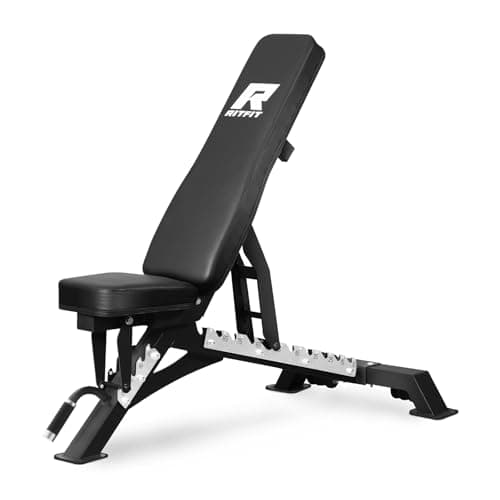
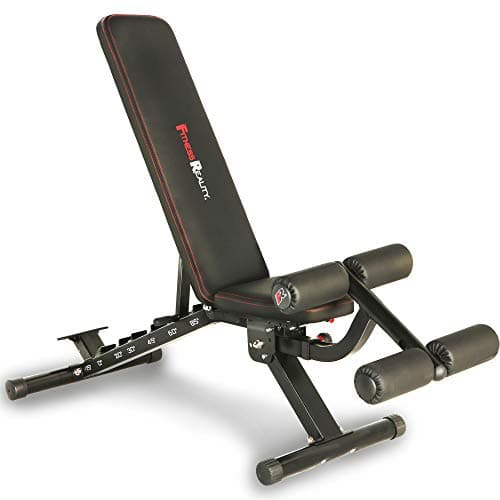
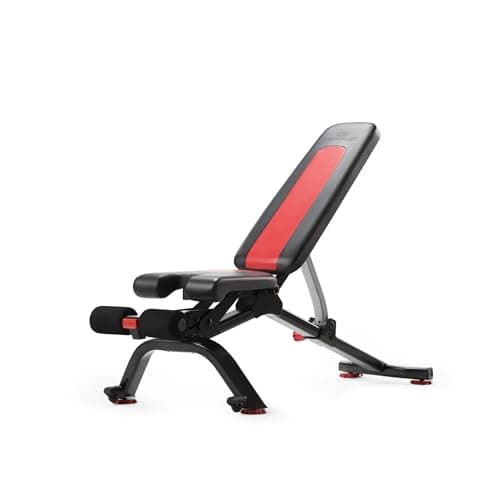
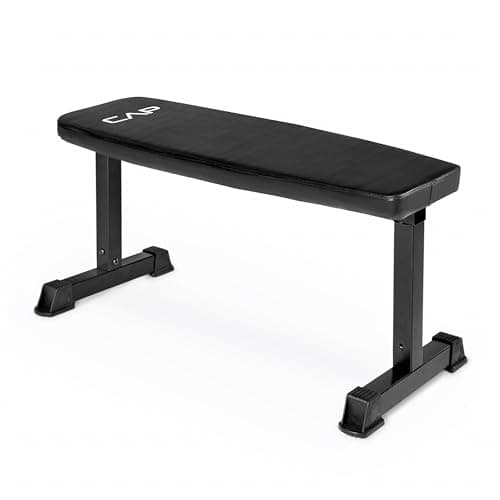
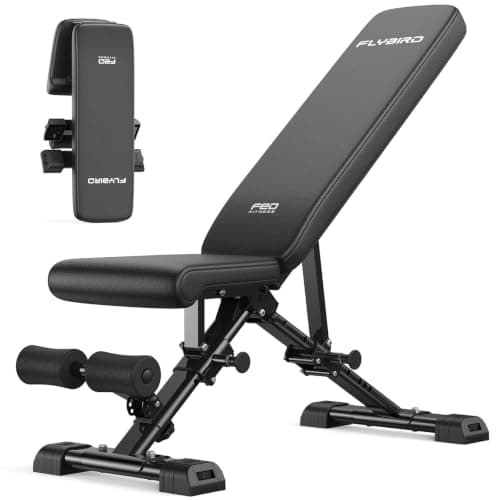
Buy the FLYBIRD WB5 if you want one bench to live in a rack: it is ASTM-certified to 800 lb, it adjusts flat to incline to decline, and it folds flat so it stores against a wall when the rack is being used for squats. Buy the RitFit if you press heavy and want the biggest published rating on the page. Buy the Fitness Reality 2000 Super Max XL if the seat-to-back gap on cheap benches annoys you. Buy the BowFlex 5.1S if you want the widest pad and wheels to roll it out of the cage. And buy the CAP flat bench if you only ever bench flat — it has nothing in it to develop play, which makes it the closest thing to a permanent bench on this page.
Why a bench for a rack is a different purchase
Almost every bench review ranks pads and adjustment angles. Those matter, and we rank them too — on adjustable benches and on flat benches. But a bench that lives inside a power cage is solving three problems that have nothing to do with comfort:
- It has to fit between the uprights. A cage's inside width is fixed. A bench with a wide A-frame base or splayed feet can be an inch too wide and simply will not go in, no matter how good it is.
- It has to sit at the right height under the bar. Your J-hooks adjust in fixed increments, usually one to three inches. The pad height sets where your chest is. If the pad is unusually tall or unusually low, you may find there is no hole position that gives a clean unrack.
- It has to come out again. The same cage squats on Monday. A bench you have to drag out sideways every session is a bench you will stop moving, and then you will stop squatting.
The one measurement that decides it
Measure the inside width of your rack between the uprights, then measure the widest point of the bench — usually the feet, not the pad. The bench has to be narrower. Then measure the inside depth of the cage front to back and compare it with the bench's overall length: a long FID bench in a short cage will stick out of the back, which is fine for pressing and awkward for everything else.
None of the five listings here publishes a pad height or an overall length. That is the normal state of this category and we are not going to invent the numbers. Measure the bench when it arrives, set your J-hooks once, and mark the hole you settled on with a paint pen — that one minute removes the guesswork forever. The same measuring discipline for the rack side is in power rack dimensions.
The five, side by side
| As published | FLYBIRD WB5 | RitFit | Fitness Reality 2000 | BowFlex 5.1S | CAP flat |
|---|
| Rated capacity | 800 lb (ASTM) | 1,300 lb | 850 lb | Not published | Not published |
| Adjustment | Full incline / flat / decline | Full incline / flat / decline | Incline / flat / decline | 6 back positions, no decline | Flat only |
| Stores away | Folds flat | Not published | Foldable | Stands upright, wheels | No — but it is light |
| Seat-to-back gap | Narrow gap at steep incline | Not published | No-gap design | Not published | Not applicable |
| Moving parts | Ladder adjustment | Ladder + leg lock | Multiple adjustment points | Backrest ladder | None |
| Pad height / length | Not published | Not published | Not published | Not published | Not published |
Every cell comes from the manufacturer listing linked in Sources. The bottom row is the one people most want filled in and the one no listing in this category publishes — so it stays empty rather than estimated.
Why the certified rating beats the biggest rating
The RitFit publishes 1,300 lb and the FLYBIRD publishes 800 lb, and we rank the FLYBIRD first. The reason is the word ASTM. A number on a listing is the manufacturer's own statement; a number tied to a published safety standard is a number somebody had to test against. For a bench that will spend its life under a loaded bar inside a cage, we would rather have the smaller certified figure than the larger uncertified one. The full argument, and the three kinds of capacity claim, is on weight bench capacity explained.
This is also why we rank a plain flat bench fifth rather than last-and-ignored. A flat bench has no ladder, no pivot and no hinge, so it cannot develop the play that eventually makes an adjustable bench feel loose. If your rack only ever sees flat bench and squats, it is the buy-it-for-life answer and the cheapest thing on the page.
Can you bench press in a power rack?
Yes, and it is the safest way to bench alone. Set the safety bars or straps just below your chest height while lying on the bench — close enough that a failed rep lands on them rather than on you, high enough that they do not block a full-depth rep. Then set the J-hooks so you can unrack without pressing the bar up first. Whether to use steel safety bars or straps for this is worked through in safety bars vs safety straps.
If you are buying the rack and the bench together as one purchase, there is a whole product class that bundles them — bench press rack combos — and the honest summary there is that the category ceiling is around a 300 lb bar. A real cage plus a separate bench costs about the same and outlasts it.
How to pick a bench that lives in your rack
Measure the inside width first, the pad second
Tape measure across the inside faces of the uprights. Then find the widest point of the bench on the listing — if it is not published, email the seller or buy one with a narrow tube base rather than a splayed A-frame. A bench that does not fit between the uprights is useless at any price.
Prefer wheels or a fold over a carry handle
You will move this bench several times a week. Transport wheels or a flat fold take ten seconds; lifting a 60 lb bench over a safety bar does not, and the bench that is annoying to move is the one that quietly ends your squat sessions.
Treat the ladder as the wear part
On an adjustable bench, the ladder adjustment is what develops play. Check that the pop-pin or ladder detent seats positively with no rattle when new, and re-check it yearly. The pad and the ladder are the two parts that end a bench's life — see how long weight benches last.
Buy the certification, not the biggest number
An ASTM-referenced rating is worth more than a larger unreferenced one. Where no standard is cited, read the capacity as a marketing figure and judge the bench on frame tube size and pad support instead.
If you only bench flat, buy flat
An adjustable bench you never adjust is a hinge you did not need. A welded flat bench has nothing to loosen, costs the least, and is the most durable thing in this category.